Rafael Villalobos takes helm of Miami-Dade schools amid enrollment decline
Key Points(5)
- Miami-Dade County Public Schools welcomed Rafael Villalobos as its new superintendent Tuesday, following a unanimous vote by the district’s eight-member school board.
- Villalobos, who began his education career 32 years ago as a teacher at South Dade Senior High School, spoke at the Fillmore Miami Beach about his vision for the district and the more than 330,000 students it serves.
- He was praised for his grit, determination and experience as he takes over leadership of one of the nation’s largest public school systems.
- Villalobos later became a principal at four different public schools and held various leadership positions throughout the district.
- “We want to make sure that our students receive all the resources and programs that they deserve,” he said.
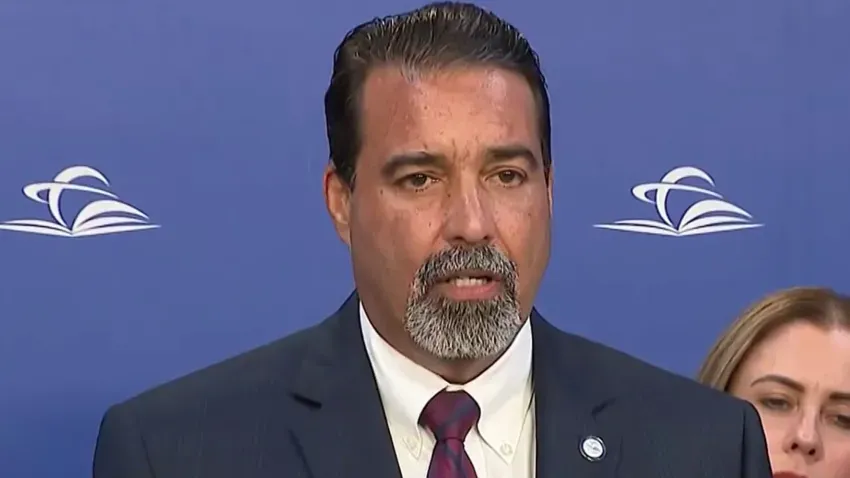
Rafael Villalobos was formally installed Tuesday as superintendent of Miami-Dade County Public Schools, taking the helm of one of the nation’s largest school districts as it grapples with declining enrollment, budget pressures and the possibility of major changes at under-enrolled schools.
Villalobos, a longtime Miami-Dade educator who began his career 32 years ago as a teacher at South Dade Senior High School, addressed students, families and community members during an installation ceremony at the Fillmore Miami Beach.
He succeeds José Dotres after being unanimously selected by the eight-member Miami-Dade County School Board.
During his remarks, Villalobos outlined an agenda focused on boosting enrollment, improving student literacy, ensuring students have access to needed resources and programs, and securing appropriate salaries for district employees.
“So as superintendent of M-DCPS, it is my obligation, it is my duty to make sure parents and students have all of the resources that they deserve,” Villalobos said. “Our students deserve the best, our families deserve the best.”
He also called for greater community involvement in the district’s decision-making process, encouraging parents and residents to participate in upcoming meetings.
“We want your input, we want you to come to our community meetings, we want to have those discussions with you, because at the end of the day, this is an effort that we all share,” he said.
Villalobos takes over the district at a challenging time for traditional public school enrollment. Schools began the academic year with 215,078 students, about 15,100 fewer than the previous year and roughly 5,300 below the district’s projected decline.
However, Villalobos said enrollment has continued to increase since the first day of school, narrowing the gap between actual and projected numbers.
“We were about three and a half, four thousand students under what we had estimated, but every day our enrollment continues to increase,” he said.
The district expects to have a clearer picture in October, when the first enrollment count used to determine state funding takes place.
The enrollment decline could have significant financial implications for the district. Villalobos did not rule out making mid-year budget adjustments, similar to steps taken last year, but said the district has already been working internally to reduce costs.
Another major issue facing the new superintendent is the future of under-enrolled campuses. Villalobos has paused a process that could have resulted in closures or other significant changes at about two dozen public schools while his administration conducts a broader assessment.
“We put a pause on it because I really want to assess all of the schools,” he said. “I want to assess how the schools were selected and I want to make sure that we have a greater understanding, not only among all of our community, but also among our staff.”
Villalobos has spent his entire career within Miami-Dade County Public Schools, moving from the classroom into administration and serving as principal at four public schools before taking on several district leadership roles.
As superintendent, he said he wants Miami-Dade schools to become a model for districts nationwide, with improving reading proficiency among his top academic priorities.
“Our future is our children and that is the most important thing we have to offer,” Villalobos said.