Mottley calls for Caribbean to remain a zone of peace
Key Points(5)
- Barbados Prime Minister Mia Mottley on Thursday called for the Caribbean region to remain a zone of peace and that there should be no acceptance of the region “becoming a theatre for confrontation or for the unilateral and unjustified use of force”.
- In an address to the 81st session of the United Nations General Assembly (UNGA), Mottley said that it is also necessary for political leaders in the Caribbean to play a pivotal role in ensuring that the region remains peaceful and progressive.
- “Still, preparations for a return to constitutional government are moving forward, even with great difficulty.
- But those efforts cannot succeed unless security improves, particularly in the areas containing more than half of Haiti’s electorate,” she argued.
- “Let me remind you that it was in 2022 that this recent, more heightened state of insecurity began with the fuel riots.
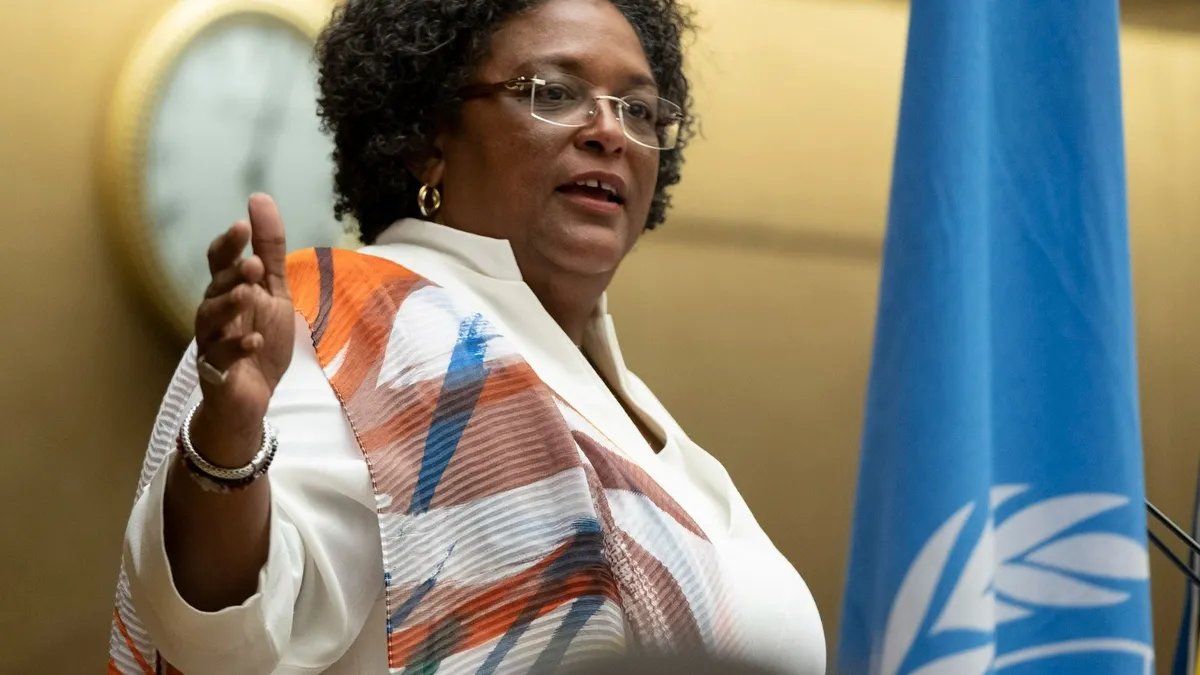
Barbados Prime Minister Mia Mottley has called for the Caribbean to remain a zone of peace, warning against the region becoming “a theatre for confrontation or for the unilateral and unjustified use of force.”
Addressing the 81st session of the United Nations General Assembly (UNGA) on Thursday, Mottley said Caribbean political leaders have a responsibility to help preserve the region’s peace and stability.
“The Caribbean must remain a Zone of Peace,” she said.
Mottley highlighted the security crisis in Haiti, where armed gangs continue to control large areas and undermine efforts to restore constitutional government following the 2021 assassination of President Jovenel Moise.
She said the deteriorating security situation continues to hamper political renewal and economic recovery, even as preparations for a return to constitutional government move forward.
“Those efforts cannot succeed unless security improves, particularly in the areas containing more than half of Haiti’s electorate,” Mottley said.
Barbados, she said, supports the full deployment and renewal of the mandate of the multinational security mission authorised by the UN Security Council to combat armed gangs in Haiti.
“Let me remind you that it was in 2022 that this recent, more heightened state of insecurity began with the fuel riots. Enough is enough,” she said.
Mottley also thanked countries that have contributed to efforts to help Haiti address its crisis, including members of the Caribbean Community’s (CARICOM) Eminent Persons Group.
The three-member group is chaired by former St Lucia Prime Minister Dr Kenny Anthony and includes former Jamaican Prime Minister Bruce Golding and former Bahamas Prime Minister Perry Christie.
Mottley said the group has been working to build consensus among Haitian stakeholders and maintain engagement with international partners.
Barbados backs Cuba
The Barbadian leader also raised concerns about what she described as worsening humanitarian pressures in Cuba amid continued US economic and trade restrictions against Havana.
“Too many people are suffering. Restrictions on trade, finance and access to fuel are intensifying hardship not only for Cuban citizens, but also for all others who study and live there,” Mottley said.
Barbados, she said, has consistently opposed the US embargo and other unilateral coercive measures against Cuba.
“As always, we call for constructive engagement. This must be grounded in dialogue, sovereign equality and respect for international law,” she said.
Mottley also expressed Barbados’ solidarity with Venezuela following the devastating earthquakes that struck the country in June, saying Bridgetown remained committed to supporting its longer-term recovery.
“A stable, sovereign, peaceful and democratic Venezuela is vital to the security and prosperity of the wider Caribbean,” she said.
She used the opportunity to reiterate Barbados’ support for Guyana as it pursues a peaceful resolution of its longstanding border controversy with Venezuela through the International Court of Justice.
“This is in the interest of the people of Guyana, Venezuela and the people of the wider Caribbean,” Mottley said.
Mottley renews call for reparatory justice
Mottley also used her UNGA address to renew the Caribbean’s call for reparatory justice for the legacy of slavery and colonialism.
She referred to a United Nations resolution adopted on March 25, saying it acknowledged that the trafficking of enslaved Africans and racialised chattel enslavement constituted the gravest crimes against humanity.
“Yes, we in Barbados painfully know this reality. Regrettably, we still carry the scars,” Mottley said.
She noted Barbados’ historical role in the development of systems of slavery, including the passage of the island’s first Slave Code in 1661.
“Others followed, including the infamous Code Noir of 1685. It was only repealed this year; hence the wounds are still raw,” she said.
Mottley said Barbados accepts a moral responsibility to address the consequences of slavery through reparatory justice.
“We must effect healing through reparatory justice. It is the right thing to do,” she said.
Caribbean leaders approved a revised CARICOM Ten Point Plan for Reparatory Justice in July, she noted, arguing that discussions about reparations should be accompanied by efforts at self-repair within Caribbean societies.
“For the Caribbean, for Africa and for all of those countries concerned, the honest engagement must begin,” Mottley said.
“We do not ask for reparations without accepting responsibility for our own self-repair, which we have undertaken for decades.”
Mottley also connected the legacy of slavery to what she described as persistent inequalities in global political and financial institutions.
“The mindset that established, justified and sustained slavery is the same mindset that sustains the iniquities and inequities within the power structures of this very institution and within the international financial architecture,” she said.
Her comments formed part of a broader appeal for greater fairness in the international system and for Caribbean states to have a stronger voice in shaping the global institutions that affect their security, development and economic prospects.