Haitians eager to return home and vote, says prime minister
Key Points(5)
- Haitian Prime Minister Alix Didier Fils-Aimé says Haitians are eager to regain security, return to their homes and participate in long-delayed elections as the country continues to grapple with widespread gang violence.
- A people who can wait no longer.
- A people waiting to regain security, to return home to work, to send their children to school, and to freely choose their leaders,” Fils-Aimé said at a special United Nations meeting on Haiti’s security situation on Thursday.
- Armed gangs continue to carry out widespread violence across the Caribbean country, including killings, kidnappings and sexual violence.
- About 6.4 million people require humanitarian assistance, while nearly 1.5 million have been displaced, according to the United Nations.
Haitian Prime Minister Alix Didier Fils-Aimé says Haitians are eager to regain security, return to their homes and participate in long-delayed elections as the country continues to grapple with widespread gang violence.
“There is a people. A people who can wait no longer. A people waiting to regain security, to return home to work, to send their children to school, and to freely choose their leaders,” Fils-Aimé said at a special United Nations meeting on Haiti’s security situation on Thursday.
Armed gangs continue to carry out widespread violence across the Caribbean country, including killings, kidnappings and sexual violence. About 6.4 million people require humanitarian assistance, while nearly 1.5 million have been displaced, according to the United Nations.
Gangs control large parts of the capital, Port-au-Prince, as well as key transport routes, restricting access to essential services and the delivery of humanitarian aid.
Calls for greater international support
Fils-Aimé called for greater international cooperation to address the illicit flow of weapons, ammunition and other resources that fuel gang violence in Haiti.
“Haiti's security depends on our collective ability to combat the illicit flows that fuel violence: weapons, ammunition, trafficking, and transnational criminal networks,” he said.
The Haitian government and UN officials also backed extending the mandate of the UN Security Council-authorised Gang Suppression Force (GSF), which is tasked with combating armed gangs, protecting critical infrastructure and facilitating the delivery of humanitarian assistance.
However, the mission remains significantly under-resourced.
UN Special Representative for Haiti Carlos Ruiz Massieu said only 1,083 personnel are currently deployed, compared with the 5,500 authorised by the Security Council.
He called for the force to reach full deployment as soon as possible.
At the same time, Haitian officials stressed that international security assistance must ultimately strengthen the capacity of Haitian institutions rather than replace them.
“Haiti must ultimately rest on the capabilities of the Haitian state,” Fils-Aimé said.
He said security operations were only the first step toward resolving the country’s crisis.
“The real test is whether we can hold those gains and translate them into lasting change for the Haitian population,” he said.
“When an area becomes accessible again, the State and basic services need to follow: police and local authorities, but also schools, justice institutions and economic activity.”
Fils-Aimé said Haiti is working to strengthen its security forces through the recruitment and training of additional police officers and soldiers.
He also highlighted two specialised judicial units focused on tackling impunity, financial crime, mass atrocity crimes and sexual violence.
Protecting children
The protection of children was another major focus of the UN meeting.
UN Economic and Social Council President Amar Bendjama called for greater protection for children exposed to gang violence, including those recruited or otherwise associated with armed groups.
“Protecting children from violence, from gang recruitment, while providing safe pathways for children associated with armed groups, must be a priority across our efforts,” Bendjama said.
“They need access to protection, to education, to essential services. They also need opportunities to build for themselves a safe and secure future.”
Ruiz Massieu similarly called for “differentiated pathways” for children associated with gangs, stressing that efforts to dismantle armed groups and prosecute those responsible for serious crimes must also account for the needs of children caught up in the violence.
Elections scheduled for December
The security crisis has repeatedly disrupted Haiti’s political process, with general elections delayed since 2019.
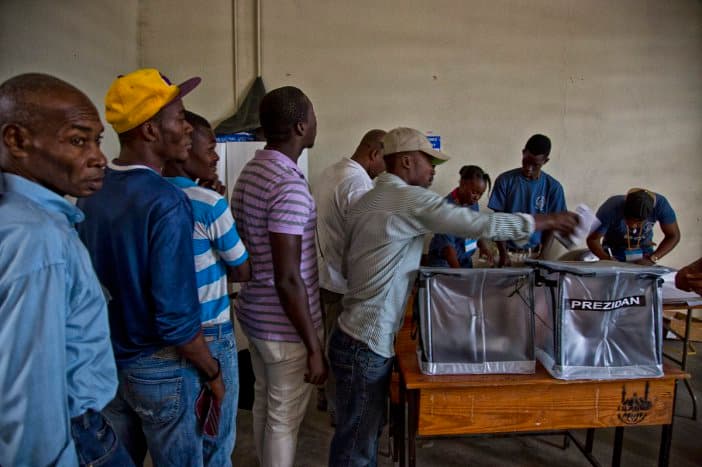
Elections are now scheduled for December 13, 2026, with the UN and other international partners calling for the process to be credible, free, fair and inclusive.
Fils-Aimé said preparations are already underway, with electoral operations launched, citizens registering and political organisations being certified.
“Haiti’s next government must come through the ballot box,” he said. “Voting restores legitimacy, and legitimacy paves the way for stability.”
The prime minister said Haitians have waited long enough to reclaim their ability to participate in the country’s political future.
For the government and its international partners, restoring security ahead of the elections remains a central challenge, particularly in areas where gang control has displaced large numbers of residents and restricted access to polling, schools, health services and other basic institutions.