Home Blog Page 36

Cutty Ranks files multi-million dollar lawsuit over ‘Dame Tu Cosita’ royalties

Cutty Ranks

Veteran Jamaican dancehall artist Cutty Ranks has taken legal action over what he claims are millions of dollars in unpaid royalties tied to the global hit “Dame Tu Cosita.”

The deejay, born Philip Thomas, has filed a lawsuit against Payday Publishing, the dance music company owned by Patrick Moxey, alleging that he has been underpaid by at least US$3 million for his role in the record’s success.

Cutty Ranks, who is both a co-writer and featured artist on the track alongside Panamanian producer El Chombo, says the dispute stems from agreements signed around 2018, when the song experienced a massive resurgence.

Originally released in 1997 on El Chombo’s Cuentos de la Cripta 2 album, “Dame Tu Cosita” found new life more than two decades later after a viral video featuring a dancing green alien captured global attention. The renewed buzz prompted a reworked version of the track, along with a remix featuring international stars Karol G and Pitbull.

The reboot proved to be a commercial juggernaut, topping Billboard’s Hot Latin Songs chart and peaking at No. 36 on the Billboard Hot 100, cementing its place as one of the most recognizable crossover hits to emerge from the dancehall-reggaetón space.

However, despite the song’s success, Cutty Ranks claims he has not received his fair share. According to court filings, the artist entered into licensing agreements with Payday Publishing, which reportedly promised to administer his composition rights and pay him at least 75 percent of royalties generated. Ranks now alleges that the company failed to honor those terms and did not provide proper accounting of earnings.

“Plaintiff and defendant had an agreement… Defendant has failed to remit such sums and has failed to provide an accounting,” his attorney, Catherine Gibson, stated in the lawsuit, adding that the breach has resulted in significant financial losses.

The dancehall veteran also revealed that he issued a notice of default to the company last year, but claims the matter remained unresolved, prompting the current legal action. In addition to seeking damages, Ranks is requesting that Payday cover his legal fees.

Representatives for Payday Publishing have not yet responded publicly to the allegations. Notably, El Chombo is not named in the lawsuit.

The case adds another layer of controversy to “Dame Tu Cosita,” which has already been entangled in legal disputes. In 2021, legendary Jamaican production duo Steely & Clevie filed a separate lawsuit against El Chombo, alleging that the song infringed on their 1989 track “Fish Market.” That case, which has since expanded to include claims against numerous global artists, remains ongoing.


Florida Association of Women Law Enforcement Professionals launches first annual scholarship

scholarship

The Florida Association of Women Law Enforcement Professionals (FAWLEP) has announced the launch of its First Annual FAWLEP Scholarship, aimed at supporting young women pursuing careers in law enforcement, criminal justice, and related fields.

The scholarship program reflects FAWLEP’s commitment to cultivating the next generation of female leaders dedicated to public service. Three $1,000 scholarships will be awarded to high school seniors across Florida who demonstrate strong academics, leadership potential, and a commitment to community service.

Eligible applicants must be female high school seniors enrolled in Florida, maintain a minimum GPA of 2.5, show an interest in a law enforcement or criminal justice career, and participate in community service or leadership activities. Applicants are required to submit a completed scholarship form, a one-page personal statement outlining their career goals, one letter of recommendation, an official transcript, and proof of acceptance to a college or university.

Application deadline is May 4, 2026. Apply at: https://form.jotform.com/260878151531054

FAWLEP encourages educators, agencies, and community leaders to share the opportunity with eligible students. By investing in young women passionate about public service, the organization seeks to strengthen the future of law enforcement through diversity, leadership, and dedication.

For more information about FAWLEP and its programs, visit fawlep.org.
.

BCPS opens late application window for 2026/27 school choice programs

More Than 125 Colleges, Universities, Technical Schools and Military Branches participating in Broward County College Fair

Broward County Public Schools (BCPS) announced that the School Choice Late Application Window for the 2026/27 school year will open on Wednesday, April 1, at 8 a.m. This period allows families to apply for school reassignments, Nova schools, and magnet programs with available seats.

Families who submitted a School Choice application during the earlier Open Enrollment Window do not need to reapply, as their application remains active throughout the process. However, those wishing to add additional school options for their child may submit a new application during this late window.

Applications must be submitted through the BCPS Focus Parent Portal. Families can find step-by-step instructions for creating an account, linking students, and obtaining a BCPS student number for children not currently enrolled at BCPS School Choice
.

BCPS encourages parents and guardians to take advantage of this opportunity to explore programs that best meet their child’s educational needs.

Jamaica gets major airlift boost as Virgin Atlantic expands Heathrow flights

Virgin Atlantic

Jamaica Tourist Board (JTB) has welcomed a significant expansion in air service from Virgin Atlantic between London Heathrow Airport and Montego Bay for the Summer 2026 travel season.

From June 1 to October 24, 2026, Virgin Atlantic will operate daily flights on the route, increasing from the previously scheduled four flights per week. The expanded schedule will add 15,480 seats across the summer period, providing greater connectivity and more travel options for visitors from the United Kingdom.

Edmund Bartlett, Jamaica’s Minister of Tourism, said the move underscores the importance of the UK market to the island’s tourism growth.

“The UK remains one of our most important source markets, and this increased airlift will be instrumental in driving our continued recovery and growth. We are particularly encouraged by this show of confidence at such a pivotal time, and we look forward to working closely with our airline partners to ensure Jamaica remains front of mind for British travellers,” Bartlett said.

Tourism officials noted that the expansion reflects continued demand from British travellers, supported by strong booking trends and growing interest in Jamaica as a destination.

Donovan White, Director of Tourism, said the development aligns with Jamaica’s broader growth strategy for the UK market.

“We are pleased with the confidence Virgin Atlantic continues to have in the destination. This expansion also speaks to the demand for Jamaica in the UK and is in alignment with our growth strategy for the region,” White said.

Officials also noted that bookings for the first quarter of 2026 have started strongly, with travel agents and tour operators reporting increased demand. The additional airlift is expected to further boost visitor arrivals during the peak summer travel period.

The Jamaica Tourist Board said it will collaborate with Virgin Atlantic on joint marketing campaigns and trade engagement initiatives aimed at increasing awareness and driving bookings throughout the summer season.

Jamaica Kingsmen announced as newest Caribbean Premier League franchise

Jamaica Kingsmen
FRONT ROW: Left to right: Minister of Tourism, Edmund Bartlett, Minister of Sport, Olivia Grange, Kingsmen Owner, Fawad Sarwar, Pete Russell, CEO, Caribbean Premier League BACK ROW: Left to right: Andrew Swaby, Mayor of Kingston, Donovan White, Director of Tourism, Dr Akshai Mansingh, Chris Dehring, CEO, Cricket West Indies, Dr Donovan Bennett, President, Jamaica Cricket Association. PHOTO: Althelstan Bellamy

The Caribbean Premier League (CPL) has officially confirmed that its newest franchise will be known as the Jamaica Kingsmen, ushering in a new chapter for cricket in the Caribbean.

The Jamaica Kingsmen will represent Jamaica in the tournament, bringing what league officials described as a fresh identity, renewed energy, and a commitment to excellence both on and off the field. The addition of the team is part of the CPL’s ongoing efforts to expand the game across the region while highlighting the culture and passion of each territory.

The franchise is owned by a United States-based group led by Fawad Sarwar, which also owns a team of the same name in the Pakistan Super League (PSL). Officials say the cross-league ownership represents a step toward strengthening global cricket connections and expanding the Kingsmen brand across major T20 competitions.

Pete Russell, CEO of the Republic Bank CPL, welcomed the new franchise.

“We are thrilled to introduce the Jamaica Kingsmen to the CPL family. Jamaica has always been a powerhouse in Caribbean cricket, and this new team represents a bold step forward in building on that legacy. The involvement of an experienced international ownership group further highlights the growing global appeal of the CPL,” Russell said.

Sarwar also highlighted the significance of bringing the Kingsmen brand to Jamaica.

“It is an honour to bring the Kingsmen brand to the Caribbean. Jamaica has a rich cricketing heritage and passionate fans, and we are committed to building a team that reflects that pride and competes at the highest level. We look forward to contributing to the continued growth of the CPL and to creating something truly special for the people of Jamaica in true Tallawah spirit,” he said.

League officials said the name “Kingsmen” reflects strength, pride, and leadership — qualities associated with Jamaica’s cricketing tradition and influence on the regional and international game.

The franchise will be based in Kingston and will play its home matches at Sabina Park, one of the Caribbean’s most iconic cricket venues.

The Republic Bank CPL continues to expand its global footprint as one of the world’s premier T20 leagues, with the addition of the Jamaica Kingsmen expected to further boost cricket’s popularity in Jamaica and across the Caribbean.

Broward school awarded $50,000 STEM classroom makeover grant from FPL

broward school

A Broward County school is set to receive a major classroom transformation after being selected as one of 10 winners in the Florida Power & Light Company’s 2025-26 STEM Classroom Makeover Grant program.

Sunrise Middle School was awarded a $50,000 grant to redesign its classroom into an innovative STEM learning environment aimed at expanding opportunities for students in science, technology, engineering, and mathematics.

“At Sunrise Middle School, where learning truly comes to life, The FALCON’s Nest represents a bold new chapter for our students,” said Denise Calder, magnet coordinator at the school. “Through our partnership with Florida Power & Light Company, this STEM Lab becomes a launchpad where curiosity takes shape, ideas are tested, and real-world challenges inspire meaningful solutions—preparing students to rise as tomorrow’s problem-solvers and leaders.”

The grant is part of the Florida Power & Light Company (FPL) Classroom Makeover Grant program, which selects schools across Florida to receive funding to modernize classrooms and enhance STEM education.

Each winning school will have one year to redesign and revitalize its classroom with updated technology, modern equipment, and hands-on learning tools. Planned upgrades may include virtual reality technology, 3D printers, robotics kits, and interactive displays designed to foster collaboration, critical thinking, and problem-solving skills.

“At FPL, we are committed to empowering students through education and we recognize the limitless opportunities that STEM learning can bring,” said Pam Rauch, vice president of External Affairs and Economic Development at FPL. “With STEM education forming the anchor of a thriving future, these grants are designed to spark creativity, exploration and a lifelong passion for learning within our communities. As we celebrate the fifth year of this program, we are proud to continue expanding its reach and positively impacting even more students.”

Now in its fifth year, the STEM Classroom Makeover Grant program is supported by the NextEra Energy Foundation, the corporate foundation of NextEra Energy and FPL. The initiative provides $50,000 grants to eligible Florida schools serving economically disadvantaged students, including Title I public, charter, or private schools, or schools with at least 40 percent economically disadvantaged enrollment.

“This investment in Sunrise Middle School represents exactly what’s possible when education and industry come together to create opportunity,” said James A. Knapp, president and CEO of the Broward Education Foundation. “By bringing cutting-edge STEM resources into the classroom, we’re not only enhancing how students learn, we’re opening doors to future careers and empowering the next generation of innovators right here in Broward County.”

Officials say the upgraded classroom is expected to provide hundreds of students with new opportunities to explore STEM fields and prepare for future careers.

Saint Lucia Labour Party condemns Chastanet remarks on 2025 election

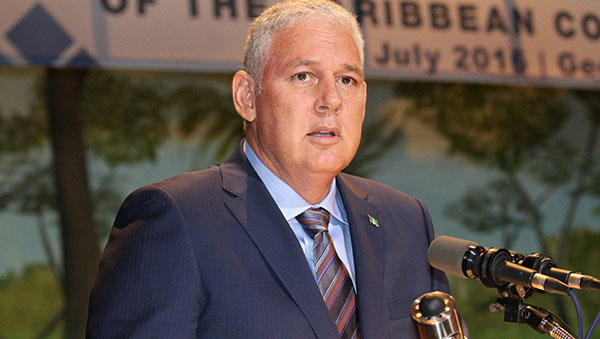
Prime Minister Allen Chastanet st lucia

The Saint Lucia Labour Party (SLP) has strongly criticized comments made by Opposition Leader Allen Chastanet, accusing him of undermining confidence in the country’s electoral process following the 2025 General Elections.

In a statement, the SLP described Chastanet’s remarks suggesting the election was influenced by “electoral list manipulation,” “significant financial influences,” and other unnamed forces as “irresponsible, reckless, and deeply damaging.”

“These should not be the words of a responsible national leader,” the party said. “These are the words of a politician trying to explain rejection at the ballot box by showing contempt for the institutions that safeguard our democracy.”

The party said Chastanet’s comments amounted to an “unjustified smear” against the Electoral Commission, Electoral Department, and election workers who, it noted, carried out their duties professionally to ensure a peaceful and credible vote.

The SLP also pointed to assessments by international observer missions, including the Caribbean Community Election Observation Mission, which said voters were able to exercise their franchise in a “peaceful, orderly and transparent manner,” and that results reflected the will of the people.

Similarly, the Organization of American States (OAS) observation mission reported that election day was conducted in an orderly, peaceful, and professional manner, according to the statement.

Official results published by the Saint Lucia Electoral Department showed the SLP winning 14 seats, while the United Workers Party secured one seat and two independents captured the remaining constituencies.

“That outcome was decided by the people of Saint Lucia. It was not manufactured. It was not stolen. It was delivered through the legitimate and democratic process,” the SLP stated.

The party challenged Chastanet to present evidence to the Electoral Commission, the courts, or relevant regional or international bodies if he has proof supporting his claims.

“If Mr. Chastanet has evidence, he should submit it to the competent authorities immediately… But if he has no evidence, then he should stop poisoning the public space with disinformation. Saint Lucia’s democracy is too important to be used as cover for one man’s political frustration,” the statement said.

The SLP added that as Leader of the Opposition, Chastanet holds a constitutional office that requires maturity and respect for democratic institutions.

“Instead of fueling distrust and encouraging conspiracy theories, he should exercise better judgment, speak with responsibility, and acknowledge what independent election observers and official results have said: Allen Chastanet lost convincingly.”

The party said it would continue to defend the integrity of Saint Lucia’s electoral system and reject what it described as attempts to undermine confidence in the country’s democratic institutions.

Cayman Island’s Melesia Adderley among honorees at CAWI 2026

Melesia Adderley
Melesia Adderley, founder of Women’s Haven, was recognized at the 2026 CAWI Honors in Maryland.

The 2nd Annual Caribbean and African Women of Impact (CAWI) Honors brought together leaders, creatives, and entrepreneurs from across the diaspora on March 22 in Silver Spring, with Caribbean women playing a strong and visible role among this year’s honorees.

The event, staged under the theme “Bloom & Flourish,” brought together leaders, creatives, and entrepreneurs from across the diaspora, celebrating women of Caribbean and African heritage whose work is shaping communities in business, culture, and the arts.

Among the honorees was Melesia Adderley of the Cayman Islands, founder of Women’s Haven, who was recognized for her contributions to wellness and community-centered entrepreneurship. Adderley’s recognition also marked a milestone, as she became the first Caymanian to receive a CAWI honor.

Cultural entrepreneur Naomi Green was also among those honored for her work spanning entertainment and sustainability, alongside other women contributing to creative and cultural industries across the diaspora.

The evening also recognized actress Gabourey Sidibe as a 2026 Icon Honoree. Although she was not in attendance, organizers highlighted her influence and the opportunities she has created for others through her work.

Singer and artist Wayna, who received the Social Songbird Icon Award, reflected on the emotional tone of the evening, noting that many of the stories shared on stage centered on resilience, personal loss, and perseverance on the path to success.

Wayna is a Grammy-nominated Ethio-American singer who won the Songbird Award.

The awards were presented by SEA The Difference, with support from partners including Narcisso Wine Cellar, BakanalTV, Fetelist, and the Cayman Islands Department of Tourism.

Organizers said the CAWI Honors continues to expand as a diaspora-centered platform designed to recognize achievement while strengthening connections across Caribbean and African communities.

As the event grows, it is also creating new opportunities for Caribbean voices to gain visibility and celebrate shared cultural achievements across borders.

25 new soccer mini-pitches coming to Miami-Dade County Public Schools

Miami-Dade County Public Schools

Twenty-five new soccer mini-pitches will be installed at Miami-Dade County Public Schools as part of a broader initiative aimed at expanding youth sports programming and increasing access to recreational spaces for children across the county.

The effort is part of the Miami-Dade Soccer Initiative, a collaborative and philanthropic campaign to build 50 mini-pitches countywide while expanding structured soccer programming at each location.

A new mini-pitch at Oak Grove Elementary in Northeast Miami-Dade is scheduled to officially open on Wednesday, April 1, marking one of the first installations under the initiative. The project is being led by the U.S. Soccer Foundation in partnership with Griffin Catalyst, The Children’s Trust, the Miami World Cup 2026 Host Committee, and Miami-Dade County Public Schools.

Organizers say the mini-pitches will host evidence-based soccer programs designed to increase opportunities for children living in under-resourced communities to participate in organized sports and benefit from physical activity and mentorship.

The initiative is supported by a $5 million donation from Kenneth C. Griffin, founder and CEO of Citadel and founder of Griffin Catalyst. The funding will support the development of 50 mini-pitches across Miami-Dade County.

Research from North Carolina State University indicates that more than 6.5 million young people nationwide live within a 10-minute walk of a U.S. Soccer Foundation mini-pitch. On average, each site hosts approximately nine hours of programming and 43 hours of open play weekly.

Local leaders and education officials are expected to attend the Oak Grove Elementary opening, including Miami-Dade Mayor Daniella Levine Cava, School Board Member Dr. Steve Gallon III, Miami-Dade County Public Schools Superintendent Dr. Jose L. Dotres, U.S. Soccer Foundation President and CEO Ed Foster-Simeon, The Children’s Trust President and CEO James Haj, FIFA World Cup 26 Miami Host Committee Co-Chair Rodney Barreto, President and CEO Alina Hudak, and Griffin Catalyst Director of Philanthropy Julia Quinn.

The broader initiative aims to expand youth programming across Miami-Dade while creating safe spaces for recreation, physical activity, and community engagement as the region prepares to host matches during the 2026 FIFA World Cup.

CARICOM SG urges collaboration to harness Caribbean’s energy potential

Caribbean Community (CARICOM) Secretary-General Carla Barnett on Tuesday called for stronger regional collaboration, investment, and innovation to unlock the Caribbean’s vast and diverse energy resources, while delivering the keynote address at Caribbean Energy Week 2026 in Paramaribo.

Opening her address, Dr. Barnett offered condolences following the passing of former Suriname President Chandrikapersad Santokhi, recalling his leadership during key CARICOM meetings in 2022.

“[I would like to deviate] from my prepared remarks and simply share profound condolences from the Caribbean Community on the passing of former President Chandrikapersad Santokhi, who was the Chair of CARICOM when we had very important meetings here in Suriname in 2022,” she said. “We express our condolences to the Government and people of Suriname and of course to his family and his close friends. May he rest in peace.”

Dr. Barnett’s keynote, delivered under the theme “Leveraging Energy Diversity Across the Caribbean,” highlighted the Region’s wide range of energy resources, including hydrocarbons, natural gas, solar, wind, hydroelectric, and geothermal energy. She noted that the Caribbean’s combined estimated renewable energy potential stands at 10,750 megawatts, describing the diversity as a strategic advantage for innovation, investment, and regional cooperation.

“The Caribbean region is endowed with a remarkable diversity of energy resources and capabilities, including hydrocarbons, natural gas, solar, wind, hydroelectric power, and geothermal energy,” she said.

Dr. Barnett pointed to recent offshore discoveries in Guyana and Suriname, alongside Trinidad and Tobago’s long-standing expertise in natural gas, as reshaping the Region’s energy outlook. She also highlighted emerging renewable energy initiatives in Barbados, Belize, and Jamaica as signs of a dynamic and evolving energy landscape.

“These developments signal the important truth, that energy in the Caribbean is no longer viewed solely as a sector of economic activity. It is increasingly recognised as a strategic driver of resilience, competitiveness, and long-term development,” she said.

Dr. Barnett stressed that collaboration within CARICOM and with international partners will be critical for expanding infrastructure, mobilising financing, and strengthening human resource capacity. She noted that cross-border gas development, shared infrastructure, renewable integration, and harmonised regulatory frameworks will be key to the Region’s competitiveness.

She also highlighted partnerships beyond the Caribbean, including engagement with Africa, Latin America, and global capital markets, as essential to expanding financing and scaling emerging energy technologies.

“These efforts align closely with CARICOM’s ongoing energy transition agenda, which supports Member States in advancing sustainable and resilient energy systems,” Dr. Barnett said, noting that the regional body is also developing a financing strategy to mobilise public and private capital for renewable energy and energy efficiency projects.

In addition to financing and infrastructure, she underscored the importance of developing local talent, including engineers, geologists, economists, regulators, and entrepreneurs, to ensure long-term benefits remain within Caribbean economies.

Dr. Barnett also acknowledged the vulnerabilities facing many small island states, including climate change exposure, reliance on imported fuels, and the need for resilient infrastructure, while emphasising innovation and forward-looking policies.

“Energy transition means mapping the way to diversify our energy platform, it does not necessarily mean exchanging one for the other,” she noted.

She concluded by urging stakeholders to build on the momentum from Caribbean Energy Week and carry discussions forward into CARICOM Energy Month, scheduled for November 2026.

“The conversations begun here should ripple far beyond this conference hall,” she said. “Every exchange of ideas, every partnership formed, and every commitment made brings us closer to a shared regional vision that supports sustainable growth and strengthens energy security, economic diversification, and regional cooperation.”

Dr. Barnett closed with a central message for the Region’s energy future:

“Energy unlocks development, but investment unlocks energy.”

13th annual Rhythms of Africa returns to Miramar in April

Annual Rhythms of Africa

The City of Miramar is set to welcome the return of the 13th Annual Rhythms of Africa, scheduled for April 18–19, 2026, at the Miramar Cultural Center. Hosted by Mayor Wayne Messam, this year’s event will unfold under the theme, “Run Di Riddim: Every Beat for Jamaica,” transforming the stage into a celebration of culture, community, and connection.

Organizers say Rhythms of Africa continues to evolve beyond a traditional performance, serving as a movement that carries the spirit of heritage through rhythm while uniting generations through music and purpose.

Audiences will be taken on a journey through sound and culture with performances by internationally acclaimed artists JC Lodge, Richie Stephens, and Gem Myers, alongside the Rhythms of Africa Band led by world-renowned Reggae Ambassador Willie Stewart.

“Rhythms of Africa is a shining example of what makes Miramar so special, our diversity, our culture, and our commitment to uplifting the next generation,” said Mayor Messam. “This year’s theme reminds us that music is more than entertainment, it is a powerful force that connects us to our roots, inspires compassion, and brings our community together in meaningful ways.”

A central feature of the 2026 production will spotlight youth involvement, with students from Somerset Academy Central Miramar taking the stage after receiving immersive training in African drumming and percussion under Stewart’s mentorship. The program focuses not only on musical technique, but also on understanding the cultural meaning behind each rhythm.

Stewart, program founder and music director, and former drummer of Third World, emphasized the importance of cultural preservation through music.

“Music is not just what we play, it’s who we are,” Stewart shared. “When I work with these young people, I’m not just teaching notes or timing. I’m passing on identity, pride, and purpose. This is how our culture lives on.”

This year’s event will also carry a humanitarian component. Stewart has written and produced a special song featuring participating artists, with proceeds supporting relief efforts following Hurricane Melissa, highlighting music’s role in compassion and community action.

Through community partnerships, approximately 100 children from foster care will be invited to attend, providing an opportunity for inspiration and connection in a culturally enriching environment.

The 2026 celebration will also include a tribute honoring the enduring legacies of Jamaican icons Cat Coore, Jimmy Cliff, and Sly Dunbar, whose contributions to reggae and global cultural expression continue to influence generations.

Produced by the Embrace Music Foundation in association with Solutions of Music, Rhythms of Africa remains a cornerstone cultural event in Miramar, bridging generations through music, mentorship, and community impact.

Tickets for the event are available at MiramarCulturalCenter.org.

New Medellín–Montego Bay route expected to boost Latin American arrivals to Jamaica

Wingo Airlines

Jamaica is set to strengthen its presence in the Latin American tourism market with the launch of a new direct air service between Medellín, Colombia and Montego Bay, according to Tourism Minister Edmund Bartlett.

The new route, operated by Wingo Airlines, will begin on June 23, 2026, and is expected to further position Jamaica as a top destination for Colombian travellers.

“Today marks a significant step in enhancing Jamaica’s tourism strategy,” Bartlett said. “This new route not only responds to the growing interest from Colombian travellers but also reinforces our commitment to increasing connectivity and accessibility to Jamaica for visitors from Latin America.”

Flights will operate three times weekly — Tuesdays, Thursdays, and Saturdays — providing increased accessibility for leisure travellers and travel advisors. Introductory base fares start at USD $159 one-way, inclusive of taxes and fees, with tickets already available through the airline’s booking channels. Wingo plans to offer nearly 32,000 seats annually, becoming the only airline operating the nonstop Medellín–Montego Bay service.

Director of Tourism Donovan White described the new service as a major milestone for the country’s market diversification efforts.

“This is the fruit of our collective labour to expand routes in Latin America, which will diversify and expand our markets. It is indeed a victory for Jamaica and its longstanding partners who have worked to achieve this great outcome,” White said.

The announcement follows the launch of a direct Bogotá to Montego Bay route, which begins operations today. The service initially offers two weekly flights but is expected to increase to three in June due to strong demand.

Deputy Director of Tourism at the Jamaica Tourist Board, Philip Rose, emphasized the strategic importance of expanding connectivity in the region.

“The launch of the Bogotá service, together with the upcoming Medellín route, clearly demonstrates the increasing demand for Jamaica in Colombia and across Latin America. Strengthening air connectivity is essential to unlocking new markets and driving sustainable visitor growth,” Rose said.

Meanwhile, Jorge Jiménez welcomed the expansion, noting benefits for travellers in both countries.

“We are excited to expand our presence in Jamaica with this new route. It presents new opportunities for Colombians travelling to Jamaica as well as for Jamaicans looking to explore Colombia. The attractions in Medellín and beyond offer a vibrant experience for all travellers,” Jiménez said.

With increased seat capacity, expanded routes, and continued investment in demand generation, Jamaica continues to strengthen its position as one of the Caribbean’s most accessible and dynamic destinations for Latin American travellers.

CDB approves US$10M credit line to boost SMEs in Trinidad and Tobago

Caribbean Development Bank

The Caribbean Development Bank (CDB) has approved a US$10-million line of credit to expand access to finance for small and medium-sized enterprises (SMEs) in Trinidad and Tobago.

The approval came during the 313th Meeting of the Bank’s Board of Directors, which also endorsed a US$126,000 grant as part of the Fourth Agricultural and Industrial Line of Credit for Development Finance Limited (DFL) in the Republic of Trinidad and Tobago. The initiative aims not only to improve access to finance for SMEs but also to strengthen institutional capacity and promote sustainable and inclusive economic growth in the country.

The line of credit will be on-lent by DFL to SMEs operating in key productive sectors, including agriculture, manufacturing, tourism, and energy efficiency. By addressing persistent financing gaps, the project is expected to enhance business competitiveness, support market expansion, and generate employment.

In addition to financing, the grant component will fund capacity building within DFL, including training in Environmental and Social Management Systems and the development and implementation of a Gender Equality Policy and Action Plan. These interventions are designed to strengthen DFL’s ability to manage environmental, social, and climate-related risks while advancing gender-responsive lending.

“Through this fourth line of credit, we are deepening our support to SMEs as key drivers of innovation, job creation, and economic diversification in Trinidad and Tobago,” said Lisa Harding, Division Chief, Private Sector Division at CDB. “This project directly aligns with the Bank’s new 10-Year Strategic Plan by strengthening private sector development, advancing climate resilience, and promoting inclusive growth – particularly by empowering women-owned businesses and supporting sustainable investments while also fostering strategic partnerships with development finance institutions.”

CDB’s support comes as Trinidad and Tobago continues efforts to diversify its economy beyond the energy sector. With moderate economic growth and increasing demand for credit in non-energy sectors, the project is expected to play a catalytic role in enabling private sector development and fostering resilience.

DFL, noted for strong financial performance and governance, will oversee project execution, while CDB will provide ongoing monitoring and evaluation. The initiative is expected to benefit women-owned businesses and enterprises engaged in green and sustainable projects, aligning with the Bank’s strategic priorities in private sector development, climate resilience, and inclusive growth.

Through this intervention, CDB continues to support its Borrowing Member Countries in building resilient economies, strengthening financial systems, and improving livelihoods across the Caribbean.

Wareham does it all again as Australia seal series with emphatic win

West Indies Women dominate Bangladesh as Deitz Eyes World Cup Qualification

BASSETERRE, St Kitts — The Australia women’s national cricket team tightened their grip on the series with a clinical 90-run victory over West Indies Women, powered once more by the all-round brilliance of Georgia Wareham at Warner Park.

The leg-spinning all-rounder delivered a second consecutive Player-of-the-Match performance, shaping the contest with both bat and ball as Australia surged to an unassailable 2-0 lead in the three-match ODI series, extending an already dominant run that included a 3-0 sweep in the preceding T20 internationals.

Recovery under pressure

Australia’s innings did not begin with the same authority as in the series opener. In fact, West Indies briefly seized control.

After a brisk 64-run opening stand between Georgia Voll and Phoebe Litchfield, the hosts struck decisively. Ashmini Munisar removed Voll and, with the very next delivery, produced a stunning return catch to dismiss Ellyse Perry for a first-ball duck.

Captain Hayley Matthews deepened the pressure, accounting for Litchfield and Ashleigh Gardner to leave Australia reeling at 82 for four.

But as elite teams do, Australia recalibrated.

Beth Mooney anchored the recovery with a patient 65, first combining with captain Tahlia McGrath in a stabilizing 58-run stand, before forging a decisive 70-run partnership with Wareham.

Arriving at the crease with her side under pressure, Wareham’s 39 off 37 balls injected urgency and control, lifting Australia to a position of strength.

Late acceleration came through Nicola Carey (30 not out) and Alana King (26 not out), whose unbroken 55-run stand propelled the total to a competitive 269 for seven.

Windies start brightly, then falter

Chasing 270, West Indies began with intent.

Qiana Joseph and Matthews stitched together a confident 57-run opening partnership, laying a solid foundation. Even after Joseph’s dismissal, Stafanie Taylor joined Matthews to carry the score to a comfortable 94 for one at the halfway stage.

At that moment, the game appeared evenly poised.

Then came the collapse.

Four runs, three wickets, turning point

In the space of just four runs, the match was decisively wrested away.

Matthews, dropped on 44, fell soon after for 45. Wareham then struck immediately, bowling Taylor for 18 with the first ball of her spell, before removing Deandra Dottin without scoring later in the over.

From 94 for one, West Indies crashed to 95 for four, an implosion that effectively ended the contest.

The lower order offered little resistance as wickets continued to tumble.

Chinelle Henry, Shemaine Campbelle, Jannillea Glasgow, and Munisar all fell cheaply, leaving the innings in disarray at 130 for nine.

A last-wicket stand of 49 between Afy Fletcher (32 not out) and Karishma Ramharack (14) added respectability to the total, but the outcome had long been settled.

West Indies were eventually bowled out for 179 in 46 overs.

Wareham leads ruthless bowling effort

Wareham’s influence extended beyond her rescue act with the bat. Her leg-spin proved equally decisive, returning figures of 3-29 and dismantling the middle order at a critical juncture.

Gardner (3-34) and McGrath (2-15) provided strong support, ensuring Australia maintained relentless pressure throughout the innings.

With the series already secured, Australia now head into the final ODI with complete control, having once again demonstrated their depth, resilience, and ability to seize key moments.

For West Indies, the challenge is now about restoration, halting the slide and finishing the series with renewed purpose.

But as this contest reaffirmed, against a side as complete as Australia, any lapse, however brief, can prove decisive.


Beharry’s late six seals dramatic DLS win for T&T U15s

West Indies

The opening contest of the Rising Stars Under-15 bilateral series delivered immediate drama, as Trinidad and Tobago Under-15 cricket team edged hosts Jamaica Under-15 cricket team by two wickets under the Duckworth-Lewis-Stern method in a rain-affected battle at the Melbourne Cricket Club.

Persistent showers dictated the rhythm of the day. Initially reduced to 41 overs per side after overnight rain left the outfield damp, the match was later shortened again to 34 overs, setting up a tense, low-scoring encounter where every run carried weight.

Jamaica struggle to build momentum

After winning the toss, Jamaica opted to bat but never fully settled against a disciplined Trinidad & Tobago bowling attack.

Wickets fell at regular intervals, stalling any attempt to construct a meaningful innings. Captain Zachary Buchanan top-scored with a modest 20, while Jermari Bryce added 17. Contributions from Jayden Shaw and Rajae McGeachy (14 apiece) offered brief resistance but lacked continuity.

A promising partnership between McGeachy and Bryce lifted the total to 57 before the innings unraveled dramatically. Three wickets fell without the addition of a single run, plunging Jamaica from relative stability into crisis at 60 for six.

From there, recovery proved elusive. Despite Buchanan’s efforts, the innings limped to 96 for nine at the close of the reduced allocation.

At the heart of the collapse was an incisive spell from seamer K’Hill Thomas, who dismantled the top order with figures of four for 14, well supported by Arnaldo Premchand’s three for 25.

Early chaos in the chase

If Jamaica’s innings lacked fluency, Trinidad & Tobago’s pursuit was anything but straightforward.

The visitors stumbled almost immediately, losing two wickets for just eight runs and slipping further to 14 for three. Jamaica’s bowlers, led by Najai Wright and Ranjay Thomas, applied sustained pressure, exposing nerves in the chase.

Two costly run-outs compounded Trinidad & Tobago’s difficulties, turning a modest target into a tense examination of composure.

Recovery, collapse, and late drama

A measured response emerged through K’Hill Thomas, who returned with the bat to top-score with 21, while Samir Boodoo (16) and Keshav Mongru (14) nudged the innings forward.

Yet just as control appeared within reach, Jamaica struck again.

The visitors slumped to 79 for eight, bringing the match to a knife-edge and reviving hopes of a dramatic home victory.

With tension mounting and the contest hanging in the balance, wicketkeeper Christaino Beharry produced the defining moment.

His cleanly struck six broke the deadlock and carried Trinidad & Tobago to 102 for eight, sealing a hard-fought victory in the final stages of a gripping encounter.

Coaches reflect on a test of composure

Trinidad & Tobago head coach Nisar Mohammed credited his team’s temperament in navigating difficult conditions.

“We played well under the circumstances. The boys showed composure in a difficult game and fought hard for the win,” he said.

Jamaica’s Robert Samuels, while acknowledging areas for improvement, found encouragement in his side’s bowling display.

“We played at about 60 per cent today. There’s definitely room for improvement, and we’ll look to bounce back stronger in the next game, maybe with a few tweaks in our batting order. But I must give credit to the way we bowled.”

Series moves on

The result hands Trinidad & Tobago a 1-0 lead in the five-match series, setting up an intriguing second encounter at the Jamaica Broilers Sports Complex.

If the opener is any indication, the battle ahead promises to be as tight as it is unpredictable.


Economist blasts CWI report as ‘PR Document’

Mariano Browne

PORT OF SPAIN, Trinidad — Cricket West Indies is facing mounting scrutiny after its latest financial disclosures triggered a pointed critique from economist Mariano Browne, who has dismissed the report as more presentation than substance.

The governing body revealed a dramatic financial downturn in 2025. Revenue plunged from just over US$88 million in 2024 to approximately US$41 million, while a healthy net surplus of US$22.6 million a year earlier flipped to a net loss of US$28.5 million.

Equally concerning was the sharp contraction in cash reserves, which fell from US$17.5 million to a precarious US$1.7 million.

Yet for Browne, the headline figures are only part of the problem.

“Highly aggregated” and lacking transparency

Speaking on iSports on i95.5 FM, Browne argued that the report fails in its most essential function, clarity.

“…On the basis of the evidence which has been released in its financial statements, the financial statements are highly aggregated; in other words, it gives a top line that says $88 million, but how is it broken down?”

He emphasized that without detailed segmentation, meaningful analysis becomes impossible.

“What tour contributed what? Did they make more money on this tour? Did they lose money on that tour? You can’t tell that and you can’t come to any conclusions on that.”

According to Browne, the absence of this level of detail undermines the organization’s stated commitment to transparency.

Missing detail, missing confidence

Beyond the numbers themselves, Browne raised concerns about the report’s forward-looking value, or lack thereof.

“It doesn’t speak with any degree of confidence in terms of what is going to happen next year and how much cash they’re going to generate.”

While CWI indicated that it carries no bank debt and is actively negotiating sponsorship and commercial agreements, Browne pointed out that these claims were unsupported by specifics.

“They did say that they don’t owe any bank any money, and they are negotiating new contracts and sponsorship deals. But no details are given with regard to what the sponsorship deal means in the form of cash or what it would pay for.”

Presentation vs substance

Browne acknowledged the report’s polished appearance but questioned its practical value.

“…It’s nice and glossy and looks good, but it does not give a clear understanding of the operations of West Indies cricket.”

His critique underscores a broader concern: that the document prioritizes presentation over meaningful financial insight.

Asked to assess the report, Browne delivered a stark evaluation.

“As a comprehensive report on the state of West Indies cricket, it would get zero. On the basis of a financial statement to give me an insight, it would get a minus. In terms of a PR document, it will get a plus, because it’s PR.”

A call for accountability

The critique lands at a critical moment for Cricket West Indies, as financial stability remains central to the region’s cricketing future.

For stakeholders, sponsors, and supporters alike, the message is clear: headline figures are no longer enough.

What is required now is transparency, detail, and accountability, elements Browne argues are currently missing from the picture.


Reggae Boyz eye World Cup return in final high-stakes showdown against DR Congo

Jamaica World Cup Reggae Boyz
Photo: CONCACAF

After nearly three decades of waiting, Jamaica national football team now find themselves 90 minutes away from rewriting history.

Their opponent: the formidable DR Congo national football team.

Kick-off: 4:00 p.m. (Jamaica time)
Their stage: Estadio Akron.
Their mission: secure qualification to the 2026 FIFA World Cup.

Victory would end a 28-year absence from football’s grandest stage and reset a wait that has stretched over 10,000 days since Jamaica’s lone appearance in 1998.

More than glory: A transformational prize

The stakes extend far beyond sporting achievement.

Qualification guarantees a minimum windfall of US$10.5 million (approximately J$1.6 billion), a financial injection that could reshape the future of the Jamaica Football Federation.

For a federation long challenged by limited resources, the implications are profound: improved infrastructure, investment in youth development, and greater financial stability across the national program.

For the players, the reward is equally compelling, global exposure, enhanced professional opportunities, and a place in Jamaican sporting history.

Underdogs and dangerous

Despite the magnitude of the occasion, Jamaica enters the contest as underdogs.

Interim head coach Rudolph Speid is fully aware of the challenge posed by a DR Congo side ranked higher and brimming with international experience, but he sees opportunity in that narrative.

“It doesn’t matter, rain or shine. We know what we have to do and we are going to do our best,” Speid said.

“They have been very active over the past two years and have done extremely well… But as you know, if ranking and strength of teams gave you wins, then none of us would be here. The game has to be played.”

He added pointedly: “When you play a football game, you have three results, a win, a loss or a draw… And I think it makes us more dangerous.”

Preparation, belief, and internal competition

“We have worked tremendously and sufficiently… we hope we get it right, even better [than New Caledonia],” Speid added.

The squad’s depth has also created what he described as “selection headaches,” with all 27 players impressing in training, an indicator of both internal competition and collective readiness.

That unity is echoed within the squad.

“It all comes down to the players, to the team,” said Ronaldo Webster. “We just need to work as one… follow the coach’s instructions and go out there and play our best football.”

A test of resolve, not style

Jamaica’s narrow 1-0 semi-final victory over New Caledonia may not have inspired widespread confidence, but inside the camp, the focus remains singular: results over aesthetics.

Captain Andre Blake made that clear.

“It’s going to be a tough game… but the next one, it doesn’t matter how, we just need to win the game.”

That pragmatic mindset reflects the nature of the occasion, where execution outweighs elegance, and resilience becomes the defining currency.

The Congolese challenge

Standing in Jamaica’s path is a disciplined and battle-hardened DR Congo side, who qualified for their only World Cup Finals in 1974 as Zaire, long before a change of name in 1997.

Guided by Sébastien Desabre, the team arrives with momentum, having lost just once in their last 10 matches and boasting victories over continental heavyweights.

Their squad features players developed across Europe, including talent from top leagues and clubs, blending athleticism, tactical structure, and experience.

Desabre’s message is clear: “We’re really fired up… everyone has really bought into the project… everyone is pulling in the same direction to achieve a common goal.”

He emphasized their collective identity: “We can make it tough… because we play as a unit: our forwards track back, our defenders push forward, and everyone pulls together as if they were soldiers going into battle for their country.”

Clash of paths, one destination

The journey to this final has shaped both teams differently.

Jamaica advanced through a tense, narrow victory, tested under pressure but resilient. DR Congo, by contrast, navigated a demanding qualifying route, emerging sharper from repeated high-stakes encounters.

Now, those paths converge in a single, defining contest.

The reward is immediate and immense.

The victor will advance to Group K of the World Cup, opening against Portugal national football team in Houston, before facing Colombia national football team in Guadalajara and Uzbekistan national football team in Atlanta.

But first, they must survive this final hurdle.

One game to define a generation

For Jamaica, the equation is brutally simple: win, and history is made, on the field and beyond it.

Lose, and the wait continues.

As Speid underscored, the weight of the moment is fully understood within the camp: “At this particular time, this is the most important game right now… Jamaica is expectant, and we want to give them something to smile about.”

Everything, legacy, pride, and possibility, rests on what happens next.


New Era Begins! Trehan and Walker crowned All Jamaica squash champions

Thirteen-time All Jamaica Senior Squash champion Wayne Burrowes (left), poses with this year’s champions Mehar Trehan (2nd left) and Jonathan Walker (2nd right), while the Jamaica Squash president Karen Anderson joins in the celebration at this year’s awards ceremony at the Liguanea Club, which was held immediately after the finals on Sunday. Anderson is a former champion herself.

The 46th staging of the All Jamaica Senior Squash Championship delivered a fitting crescendo, one marked by fresh champions, fierce competition, and the unmistakable rise of a new generation.

At the center of it all were Jonathan Walker and Mehar Trehan, both capturing their first senior national titles in commanding fashion at the Liguanea Club.

The men’s final, widely anticipated as the marquee clash of the tournament, lived up to its billing as Walker squared off against Tajhia Lumley in a battle for supremacy.

From the opening exchanges, the intensity was unmistakable.

Lumley struck first with the serve, but it was Walker who quickly asserted control. Displaying composure and tactical patience, he claimed the opening game 11-4 before navigating a series of extended rallies to edge the second 11-8.

The third game proved decisive.

With momentum tilting, Lumley paused for an injury timeout while trailing, but upon resumption, Walker elevated his level, stringing together unanswered points to widen the gap. He closed out the match 11-6, completing a straight-sets victory that reflected both discipline and execution.

For Walker, the triumph carried deeper meaning.

“I mean it’s a great feeling to be back here and finally getting my first All-Jamaica win… Last year was my first year back to squash after like a two-and-a-half-year break… I folded under the pressure… and instead of throwing in a towel… I gave myself a year to take vengeance… I really, really focused on taking it this year… and I’m just really, really happy to see the hard work pay off.”

His assessment of the final was succinct: the difference came down to minimizing errors.

Trehan’s commanding double

If Walker’s victory was built on resilience, Trehan’s was defined by dominance.

Fresh off securing the junior title earlier in the week, she returned to the court with authority, overwhelming Kerry-Gay Wright in the women’s final.

The scoreline told the story: 11-1, 11-3, 11-4.

Trehan’s precision and pace proved too much, with Wright unable to match the tempo. In the opening game, Trehan surged to nine points before conceding her first, a statement of intent that carried through the match.

Her run to the title was emphatic, winning every match, junior and senior, in straight sets.

“It feels honestly amazing… I fully thank my coaches and my parents and the association… I find that it’s an accumulation of every match I’ve won and lost… just keeping my cool… trusting my instincts… and thanking God that it was able to happen for me this year.”

Depth across the divisions

Beyond the headline finals, the championship showcased emerging talent across multiple divisions.

Ethan Miller secured the Men’s B title, adding to his junior success, while Priya Stoddart claimed Women’s B honors. Jevon Muirhead triumphed in Men’s C, with Rihanna Stoddart capturing the Women’s C crown.

Special recognition went to Rihanna Stoddart, recipient of the David Bicknell Award for female performance, and Jaden Emery, who earned the Tony Burrowes Award for sportsmanship.

A sport on the rise

Karen Anderson, president of Jamaica Squash Association, praised the standard of play and pointed to encouraging signs of growth within the sport.

“We’re growing again, and I think that’s important… what it shows is that the kids are working really hard to improve their games, and they’re doing what it takes to achieve participating and representing their country.”

She also highlighted an active calendar ahead, including regional and international competitions, as the association continues to rebuild momentum following recent disruptions.

A night of celebration

The championship concluded with an awards ceremony celebrating both legacy and emergence.

Veteran champion Wayne Burrowes joined Anderson in honoring the new titleholders, symbolizing a passing of the torch within Jamaican squash.

Sponsored by Boilerco, this year’s tournament not only crowned champions, it signaled a promising future, led by players ready to define the next era of the sport.


Palm Beach International Airport approved to be renamed after President Trump

Palm Beach International Airport

A South Florida airport will soon be renamed in honor of the president. Florida Gov. Ron DeSantis signed a bill on Monday authorizing the renaming of Palm Beach International Airport to the President Donald J. Trump International Airport. The change is scheduled to take effect in July, formally rebranding the airport near Trump’s Mar-a-Lago estate.

The bill, HB 919, passed along party lines in the Florida Legislature, with the House of Representatives approving it 81-30 and the Senate passing it 25-11. The renaming must still receive approval from the Federal Aviation Administration before it becomes official.

Months ago, a stretch of road connecting the airport to Trump’s estate was renamed Donald J. Trump Boulevard, marking the first local tribute to the former president in the area.

HB 919, part of the state’s commercial service airports legislation, formally codifies the names of Florida’s seven major commercial service airports and authorizes the Palm Beach name change. The bill specifies that the new airport name can only be used with the rights holders’ permission at no cost to Palm Beach County. It also requires the Florida Department of Transportation to review major commercial service airports annually and notify the Legislature of any changes in status.

According to the bill, all government records created on or after July 1, 2026, referring to a major commercial service airport must use the names listed in HB 919.

If approved by the FAA, travelers to South Florida can expect to see the President Donald J. Trump International Airport name officially on signs, maps, and official documents starting this summer.

USCIS strengthens screening and vetting of immigration applicants

TPS USCIS

The U.S. Citizenship and Immigration Services (USCIS) has announced a series of strengthened screening and vetting measures aimed at enhancing national security and public safety, particularly for applicants from high-risk countries.

In a statement released March 30, 2026, USCIS said its review of pending workloads and benefit applications revealed that prior screening measures were “wholly inadequate.” According to the agency, many applicants for naturalization and lawful permanent residence were not sufficiently vetted, creating risks to national security and public safety while undermining the integrity of the immigration system.

To address these gaps, USCIS implemented multiple policy memoranda placing on hold applications for asylum, benefits from high-risk countries, and diversity visa adjustment of status applications. The agency also launched Operation PARRIS, a program that conducts additional background checks, re-interviews, and merit reviews of refugee claims in collaboration with the USCIS Vetting Center.

Other updated practices include:

  • Shortening validity periods for certain employment authorization documents to allow more frequent security checks;
  • Strengthening identity verification through updated photograph reuse policies and biometric checks;
  • Expanding social media, financial, and community vetting;
  • Developing system connectivity for automatic notifications of new criminal information; and
  • Requiring final arrest reviews and Department of State database checks before adjudication.

USCIS said it has also developed a country-specific risk analysis in coordination with the Department of State and is implementing a layered vetting plan using classified and unclassified information, expanded criminal history checks, and ad hoc security measures. Guidance is being prepared to help adjudicators align interview resources to the specific risks identified for each country, including document reliability concerns and links to designated Foreign Terrorist Organizations.

“USCIS will continue to strengthen our screening and vetting procedures to ensure maximum protection for national security and public safety, and to root out fraud in the immigration system,” the agency said. “Our ongoing efforts are designed to ensure that only eligible and vetted individuals are granted immigration benefits.”

Guyana’s President Ali hails Suriname’s Santokhi as “brother” following his death

Chandrikapersad Santokhi

Guyana’s President Irfaan Ali has described the late Chandrikapersad Santokhi as a “friend” and a “brother forged not by blood but by conviction,” following Santokhi’s death on Monday.

“The sun sets now on a life well lived. But for those of us who were privileged to walk alongside him, the light of his example, his friendship, and his brotherhood will not fade. It will remain, a quiet glow in the memory, a gentle warmth in the heart,” Ali said in a statement.

Santokhi, 67, passed away at the Academic Hospital in Suriname’s capital after falling ill at home. He served as president from 2020 to 2025 and previously held the position of Minister of Justice and Police from 2005 to 2010. The cause of his illness has not yet been disclosed.

Ali paid tribute to Santokhi as a “voice of wisdom [that] has fallen silent,” extending condolences to his family.

“Former President Santokhi was a brother forged not by blood but by conviction, not by birth but by the shared calling of service. During his tenure as President, we walked a path together—leaders who understood that the destiny of our nations is woven from the same cloth,” Ali said.

He added that their friendship extended beyond official engagements. “We were brothers in regionalism, standing shoulder to shoulder in the councils of CARICOM, labouring in the vineyards of unity when the harvest seemed distant and the work was hard. We were friends in the advancement of our shared global interests, raising our voices together on matters of principle.”

Ali highlighted Santokhi’s role in strengthening relations between Guyana and Suriname. “Under his steady guidance, the relationship between Guyana and Suriname blossomed. He understood, as I do, that the river which divides us also connects us, that our histories are intertwined, and that the prosperity of one cannot be separated from the prosperity of the other.”

“Guyana has lost a friend, one who gave of himself freely and without pretence. I have lost a friend, someone whose presence in this world made the burdens of leadership lighter and the triumphs sweeter,” Ali said, praising Santokhi’s dedication and leadership.

Ali concluded by offering condolences to Santokhi’s family: “May his memory be a blessing that sustains you in the days ahead. To his family, I extend my most heartfelt condolences. May you find solace in the legacy he leaves behind. And may the love that surrounded him in life be a comfort to you in this hour of loss.”

PM Holness vows to ‘go hard on criminals’ to boost Jamaica’s economic potential

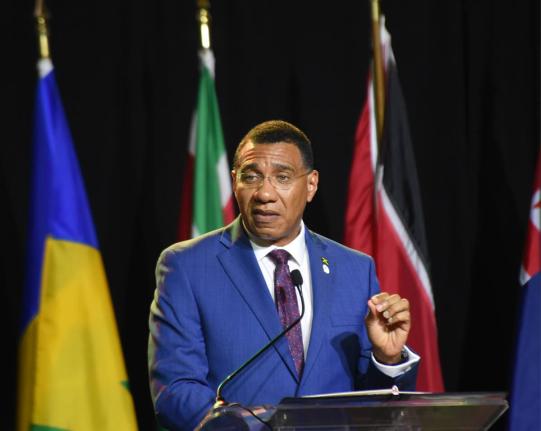
Andrew Holness

Jamaica’s Prime Minister Andrew Holness has declared that his Government will continue to “go hard on the criminals” and “eliminate” them from society, arguing that reducing crime is critical for Jamaica to achieve its full economic potential.

Speaking at Sunday night’s St Ann Chamber of Commerce Awards banquet at the Cardiff Hotel and Spa, Holness also urged citizens to reject the notion that criminals are modern-day Robin Hoods, the famous English folk hero who robbed from the rich to give to the poor.

He told business leaders and guests that shifting this mindset could improve Jamaica’s tourism product and lead to higher wages for workers in the sector.

“We will continue to go hard on the criminals; we will eliminate them from our society so we can get the full value of Jamaica!” declared Holness to loud applause.

“I want that to be unmistakable in its understanding. I am not ambivalent about it, and I want every Jamaican to be decisive about it; they [the criminals] are the ones that have kept us from realising our full potential,” he urged.

Holness argued that some Jamaicans still view criminal elements as protectors of communities or providers of justice.

“No, they’re not doing that! They are raping your daughters and killing your sons,” the prime minister said.

He pointed to recent crime data, noting that murders declined from 1,147 in 2024 to 673 in 2025 — a 43 per cent reduction in a single year. Holness told business leaders he expects the figure to fall even further in 2026.

“For the first time in 30 years, the murder rate is below a thousand… And we intend to bring the murder rate down even more, and I can tell you, once the murder rate goes all the way down in a sustained way, the value of Jamaican tourism is going to improve, and the value of production of the Jamaican tourism worker and their pay will improve,” Holness stated.

Earlier in his address, Holness compared tourism workers in Jamaica and Barbados, arguing that crime has reduced the value of Jamaica’s tourism industry and kept wages lower than those in Barbados.

“The hotel worker in Runaway Bay [St Ann] works just as hard as the hotel worker in Bridgetown [Barbados], but the Barbadian economy generates nearly three times the value per hour as our economy. They are not working three times as hard as us; they are working in a higher value version of the same industry,” Holness said.

He added, “The Barbadian worker isn’t working harder than persons who I saw serving quite efficiently and professionally here, but they earn more because they have a higher value product than us.”

Holness said one key factor behind Barbados’ higher-value tourism sector is lower crime levels.

“There are many reasons… I want to focus on one just now; Barbados has less crime than us,” he said.

The prime minister also argued that societal tolerance contributes to Jamaica’s crime problem.

“Why do we have more crime here? [There are] many reasons, but one of it is that we tolerate it as a people. We are ambivalent about it as a people! For some people who are involved in crime, it is because of some social injustice or social disenfranchisement…[but] we need as a people to be clear in minds that crime impacts our productivity, [and] crime destroys the value of our service and product,” he insisted.

Holness further contended that criminals are not simply disenfranchised youths, noting that money spent on illegal firearms could instead be used to build legitimate livelihoods.

“We must stop seeing the criminals as Robin Hoods and see them for what they are— a pestilence!” declared Holness.

“I can tell by the clap [that] my statement is true. Ambivalence! And until we get that out of our minds that we not dealing with angels, then we will continue to cuddle them unless we recognise that the criminals impact the tourism product and reduces the value we can get from it [and] we won’t grow and your wages will remain low, because the service that we offer is a much better product, but we can’t get the value out of it because there is this stigma,” Holness stated.

Haitian man accused of fraudulently obtaining Bahamian passport denies charges

A 36-year-old Haitian man has denied allegations that he fraudulently obtained a Bahamian passport and a National Insurance Board (NIB) card.

The accused, identified as John Doe, also known as Kohn Markenvens Louis, is alleged to have secured the documents on July 11, 2023.

Prosecutors claim that on April 10, 2023, he presented a false NIB card along with other fraudulent documents to the Passport Office in an attempt to obtain a Bahamian passport.

He was charged with possession of a false document, possession of fraudulent documents, uttering a false document, uttering a fraudulent document, and fraud by false pretenses.

Louis appeared before Acting Assistant Chief Magistrate Shaka Serville for arraignment, where he pleaded not guilty to the charges. He was remanded to prison, and the magistrate is expected to decide on bail pending trial on April 17.

Attorney Maria Daxon represented the accused, while Cordero Farrington prosecuted the matter.

Caribbean Airlines says operations continue normally amid closure rumors

Caribbean Airlines

Caribbean Airlines says it is continuing normal operations and is moving ahead with plans aimed at long-term sustainability, following recent public discussion sparked by a media report.

In a statement issued Tuesday, the airline’s Board of Directors firmly rejected rumours suggesting that Caribbean Airlines is facing closure, emphasizing that no such discussions have taken place.

The airline said it is actively reviewing its operations as part of ongoing efforts to strengthen the business and position the carrier on a more stable financial footing. These efforts, the statement noted, are focused on delivering reliable service and maintaining strong connectivity across its regional and international network.

Caribbean Airlines also confirmed that work on its audited financial statements is underway. In addition, recruitment for key senior management positions is progressing, a move aimed at strengthening leadership and supporting the airline’s long-term strategic direction.

The airline thanked customers, partners, and stakeholders for their continued confidence, assuring that efforts are being made to secure its long-term sustainability and continued service to the Caribbean region.

Customers seeking updates were encouraged to visit the airline’s official website and social media platforms for the latest information.

Happier on paper? Is life in Jamaica improving?

Jamaica’s recent climb to 49th place in the global happiness rankings — a notable jump from 73rd just a year prior — has sparked both pride and curiosity. On the surface, the improvement suggests a nation experiencing a meaningful uplift in well-being. Ranked ahead of regional neighbours, the Dominican Republic and Trinidad and Tobago, Jamaica’s performance reflects strong scores in social support, resilience, and interpersonal generosity.

However, beneath the optimism lies a more complex reality: Are Jamaicans truly happier, or simply enduring better?

The rankings, drawn from self-assessments, place heavy emphasis on how individuals perceive their own lives. In that context, Jamaica’s culture of resilience and community spirit plays a defining role. In fact, data from the 2025 report (covering 2022–2024) ranked Jamaicans as the most likely in the world to help strangers.

Yet, while these social strengths are undeniable, they coexist with persistent economic and structural challenges that complicate the narrative.

Signs of progress, but not for all

There is tangible evidence that some aspects of life in Jamaica are improving. According to the latest Survey of Living Conditions conducted by the Statistical Institute of Jamaica (STATIN) and the Planning Institute of Jamaica (PIOJ), more Jamaicans are now living in safer, more habitable homes. The island’s Housing Quality Index (HQI) rose to 80.5% in 2023, up from 75% in 2017 — an encouraging indicator of improved living standards and infrastructure at the household level.

However, these gains are tempered by troubling economic realities. The same survey revealed that fewer Jamaicans feel financially secure. Only 32.3% of households reported that their main source of income was reliable, down from 35.7% in 2021. Meanwhile, just over half — 50.8% — said their income could only meet basic needs, a noticeable increase from previous years.

This growing financial strain reflects a broader shift in how Jamaicans are navigating survival in a high-cost environment.

Earlier this year, Minister of State in the Ministry of Industry, Investment and Commerce, Delano Seiveright, underscored this shift, urging young Jamaicans to rethink traditional employment models. His assertion that “9-to-5 alone is not cutting it” speaks directly to the lived experience of many citizens who are juggling multiple income streams to stay afloat. With rising living costs, global competition, and evolving job markets, the notion of financial stability tied to a single job is increasingly outdated.

High taxes, uneven returns

Compounding these challenges is Jamaica’s high tax burden. With a tax-to-GDP ratio of 29% in 2023 — well above the regional average of 21.3% — the country ranks among the highest tax collectors in Latin America and the Caribbean.

Despite this, public sentiment often points to dissatisfaction with infrastructure and public services, raising questions about value for money. For many Jamaicans, the disconnect between taxation and tangible improvements in daily life remains a source of frustration.

Further fueling public debate is the salary adjustment for Prime Minister Andrew Holness. Following a restructuring, the Prime Minister’s salary increased by over 300% to approximately J$28.6 million annually, making it one of the highest among CARICOM leaders. Though initially declined amid backlash, the salary was later accepted and made retroactive to September 2025.

The contrast is stark. While the average Jamaican earns between JMD 150,000 and JMD 200,000 per month, and middle-class households often operate within JMD 300,000 to JMD 500,000, the gap between leadership earnings and everyday income continues to widen.

Perhaps the most telling statistic is not about income or housing, but migration. There are now more Jamaicans living abroad — over 3 million — than the approximately 2.8 million who remain on the island. This diaspora reality suggests that while Jamaicans may report higher levels of happiness, many are still seeking better opportunities elsewhere.

So, are Jamaicans truly happier?

Jamaica’s cultural strength — its sense of community, generosity, and optimism — continues to buoy its people, even in the face of economic hardship. Happiness, in this case, may not reflect comfort, but coping.

And perhaps that is the most Jamaican thing of all.