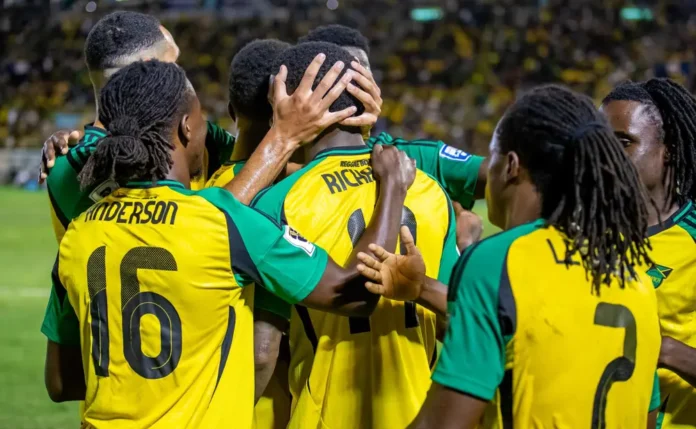
After nearly three decades of waiting, Jamaica national football team now find themselves 90 minutes away from rewriting history.

Their opponent: the formidable DR Congo national football team.
Kick-off: 4:00 p.m. (Jamaica time)
Their stage: Estadio Akron.
Their mission: secure qualification to the 2026 FIFA World Cup.

Victory would end a 28-year absence from football’s grandest stage and reset a wait that has stretched over 10,000 days since Jamaica’s lone appearance in 1998.
More than glory: A transformational prize
The stakes extend far beyond sporting achievement.
Qualification guarantees a minimum windfall of US$10.5 million (approximately J$1.6 billion), a financial injection that could reshape the future of the Jamaica Football Federation.

For a federation long challenged by limited resources, the implications are profound: improved infrastructure, investment in youth development, and greater financial stability across the national program.
For the players, the reward is equally compelling, global exposure, enhanced professional opportunities, and a place in Jamaican sporting history.
Underdogs and dangerous
Despite the magnitude of the occasion, Jamaica enters the contest as underdogs.

Interim head coach Rudolph Speid is fully aware of the challenge posed by a DR Congo side ranked higher and brimming with international experience, but he sees opportunity in that narrative.
“It doesn’t matter, rain or shine. We know what we have to do and we are going to do our best,” Speid said.
“They have been very active over the past two years and have done extremely well… But as you know, if ranking and strength of teams gave you wins, then none of us would be here. The game has to be played.”
He added pointedly: “When you play a football game, you have three results, a win, a loss or a draw… And I think it makes us more dangerous.”
Preparation, belief, and internal competition
“We have worked tremendously and sufficiently… we hope we get it right, even better [than New Caledonia],” Speid added.
The squad’s depth has also created what he described as “selection headaches,” with all 27 players impressing in training, an indicator of both internal competition and collective readiness.
That unity is echoed within the squad.
“It all comes down to the players, to the team,” said Ronaldo Webster. “We just need to work as one… follow the coach’s instructions and go out there and play our best football.”
A test of resolve, not style
Jamaica’s narrow 1-0 semi-final victory over New Caledonia may not have inspired widespread confidence, but inside the camp, the focus remains singular: results over aesthetics.
Captain Andre Blake made that clear.
“It’s going to be a tough game… but the next one, it doesn’t matter how, we just need to win the game.”
That pragmatic mindset reflects the nature of the occasion, where execution outweighs elegance, and resilience becomes the defining currency.
The Congolese challenge
Standing in Jamaica’s path is a disciplined and battle-hardened DR Congo side, who qualified for their only World Cup Finals in 1974 as Zaire, long before a change of name in 1997.
Guided by Sébastien Desabre, the team arrives with momentum, having lost just once in their last 10 matches and boasting victories over continental heavyweights.
Their squad features players developed across Europe, including talent from top leagues and clubs, blending athleticism, tactical structure, and experience.
Desabre’s message is clear: “We’re really fired up… everyone has really bought into the project… everyone is pulling in the same direction to achieve a common goal.”
He emphasized their collective identity: “We can make it tough… because we play as a unit: our forwards track back, our defenders push forward, and everyone pulls together as if they were soldiers going into battle for their country.”
Clash of paths, one destination
The journey to this final has shaped both teams differently.
Jamaica advanced through a tense, narrow victory, tested under pressure but resilient. DR Congo, by contrast, navigated a demanding qualifying route, emerging sharper from repeated high-stakes encounters.
Now, those paths converge in a single, defining contest.
The reward is immediate and immense.
The victor will advance to Group K of the World Cup, opening against Portugal national football team in Houston, before facing Colombia national football team in Guadalajara and Uzbekistan national football team in Atlanta.
But first, they must survive this final hurdle.
One game to define a generation
For Jamaica, the equation is brutally simple: win, and history is made, on the field and beyond it.
Lose, and the wait continues.
As Speid underscored, the weight of the moment is fully understood within the camp: “At this particular time, this is the most important game right now… Jamaica is expectant, and we want to give them something to smile about.”
Everything, legacy, pride, and possibility, rests on what happens next.