The two main political parties contesting St. Vincent and the Grenadines’ November 27 general election have signed the 2025 Code of Election Conduct, reaffirming their commitment to a peaceful and fair campaign season.
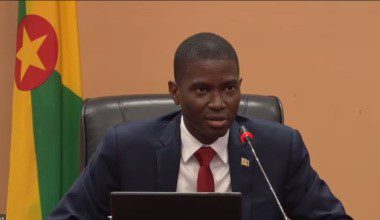
The ruling Unity Labour Party (ULP), represented by Augustine Ferdinand, and the opposition New Democratic Party (NDP), represented by chairman Daniel Cummings, signed the agreement on Tuesday with the National Monitoring and Consultative Mechanism (NMCM).
NMCM Coordinator Godfrey E. Samuel said this year’s code mirrors the one used in 2020, with minor grammatical updates and one notable addition — police protection for the Leader of the Opposition. “That was not in the 2020 code,” Samuel noted.
Ferdinand described the signing as an important step toward ensuring a stable election period. “We as political parties come together to sign this agreement, which is more or less signalling our agreement in having peaceful and fair elections in St. Vincent and the Grenadines,” he said, quoting Matthew 5:9: “Blessed are the peacemakers.”
He emphasized that while elections are inherently competitive, they should not be divisive. “We understand the importance of people exercising their democratic and fundamental rights … but we again emphasise that we must do it peacefully,” Ferdinand added.
Cummings, in his remarks, said the NDP remains “committed to the cause of SVG with peace at the centre,” and called for “a kinder and gentler society.” He contrasted the NDP’s respect for electoral outcomes with the ULP’s reaction to the disputed 1998 election, saying, “We respect the rule of law and made no attempt to disrupt our society.”
However, Cummings also pointed to what he called “the first infringement” of the code, claiming the ULP had scheduled a meeting at the same location as one previously approved for the NDP. “That is not nice,” he said, urging the ruling party to correct the issue.
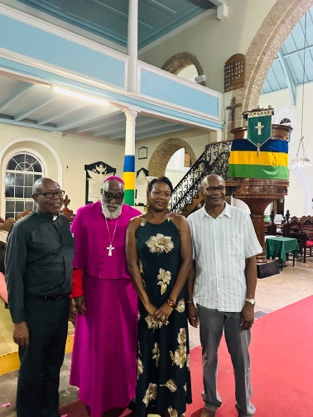
Bishop Gerard County, President of the St. Vincent and the Grenadines Christian Council, announced that the NMCM has opened an office at the Methodist Church Hall in Kingstown to handle reports or concerns during the election period.
With the code now in effect, the NMCM will dispatch monitors to observe campaign activities and the general election itself. According to Samuel, any breaches of the code will first be addressed privately with the offending party, and if necessary, through public statements.
The Government of Guyana has written off $1.5 billion in student loans in the first six months of 2025, according to the Ministry of Finance’s mid-year report tabled in the National Assembly on Monday.
The latest round of debt forgiveness brings the total value of loans cancelled under the student loan write-off programme to $2.8 billion since its launch in 2024. The initiative, which has benefited thousands of current and former students, complements the government’s move to make the University of Guyana (UG) tuition-free.
The report also highlighted that UG spent $6.5 billion on its operations in the first half of the year and received 11,600 applications from prospective students, reflecting growing interest in higher education opportunities.
Meanwhile, the Guyana Online Academy of Learning (GOAL) programme accounted for $1.4 billion in spending during the same period. So far, 9,741 scholarships have been awarded this year, bringing the total number of GOAL scholarships issued since its inception in 2021 to 39,499.
Florida is home to one of the largest veteran populations in the United States, with thousands of men and women who have proudly served and now call the Sunshine State home. From bustling cities like Tampa and Jacksonville to quiet coastal towns, veterans across Florida often face the same challenge—navigating the complex process of filing a VA disability claim. While the state offers numerous resources for veterans, understanding the federal VA system and its requirements can be overwhelming.
Filing a successful claim requires more than just paperwork; it demands clear evidence, medical documentation, and careful attention to detail. Each step, from determining eligibility to attending the Compensation and Pension (C&P) exam, plays a vital role in securing the benefits you’ve earned. Working with an experienced VA disability lawyer serving Florida can make this process smoother, ensuring your claim is complete, accurate, and positioned for the best possible outcome.
Understanding Eligibility
Before starting the claim process, ensure that you meet the qualification requirements. Veterans must have a diagnosis of a medical condition related to their military service. Such a link is also known as a service-connected disability. Knowing what exactly is required can help veterans prepare their claims with a better chance of success.
Gathering Necessary Documentation
A disability claim should always include documentation as an essential part of its success. Additionally, service records, such as discharge papers, are crucial for confirming military history.
Filling Out the Application
You are going to need to fill out VA Form 21-526EZ, the application for disability compensation. On this form, you will need to provide detailed information about the disability, including any symptoms you may experience and your treatment history. Accuracy is essential; poor or incomplete writing can cause delays. Veterans should not rush through any part to ensure that all sections are completed thoroughly.
Submitting the Claim
After the application is completed, it must be submitted to the VA. You can complete this process online on the VA’s official website or by submitting the forms to the office in your state. Be sure to retain copies of all documents submitted for your own records. Online submissions are usually handled more quickly than mail submissions.
Attending the C&P Exam
After you submit your claim, the VA may schedule a Compensation and Pension (C&P) examination. During this exam, a medical professional assesses the severity of your disability and its impact on your daily life. This assessment is a crucial part of the decision-making process. Veterans should attend the appointment and be prepared to discuss their condition openly and honestly with the examiner.
Following Up on the Claim
After the claim is submitted, please be patient. Processing claims at the VA can take months. You can track your claim online or by contacting the VA directly. Making this a regular habit helps you stay informed and address any potential issues before they arise.
Receiving the Decision
The VA will inform the veteran of its decision in writing once it has been made. You will receive a decision in this letter, along with the possible disability rating and, if applicable, the amount of compensation. Veterans can appeal the decision if it is not in their favor.
Considering an Appeal
Veterans are entitled to appeal if their claim is denied or their disability rating is less than they had anticipated. It’s beneficial to enlist the help of a veterans service organization or a VA claims attorney at this step.
Seeking Assistance
Navigating a VA disability claim can often prove convoluted, and having help can be a game-changer. There are service organizations for veterans that can help you prepare and file your claim free of charge. They have trained professionals who understand the intricacies of the process and can support you.
Staying Informed and Prepared
Veterans need to stay informed about changes in VA policies and procedures. Being aware allows for the effective filing of claims. Veterans must also maintain organized records of all medical treatments and any communication with the VA. This preparation may assist with subsequent claims or appeals.
Conclusion
Filing a VA disability claim takes time, planning, and a patient but persistent attitude. Knowing eligibility, acquiring proper documentation, and following the outlined steps can increase the likelihood of a positive result for veterans. Knowing the process and asking for help when necessary can also be beneficial for veterans in getting the help they need with VA benefits.
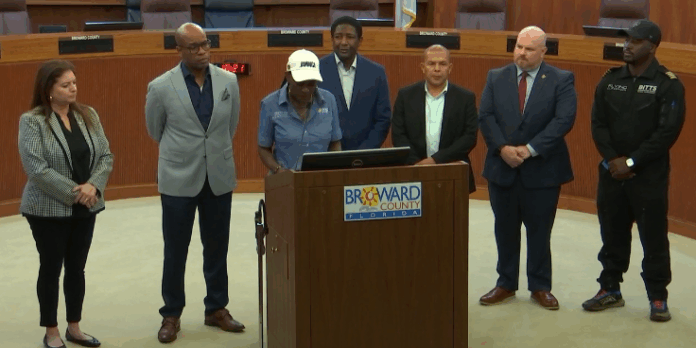
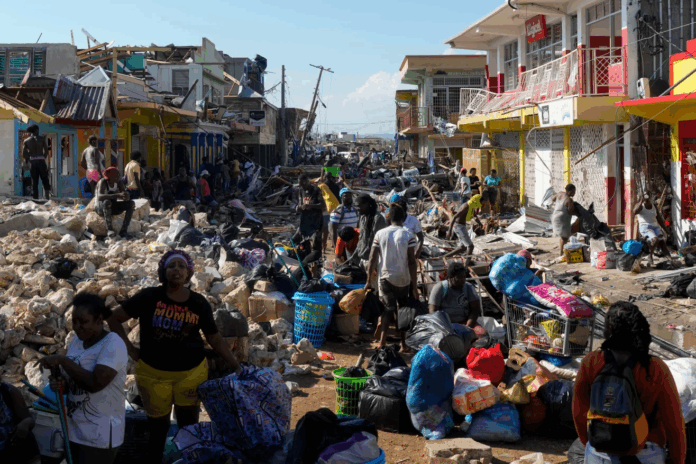
Jamaican-American Broward County Commissioner Alexandra P. Davis hosted a press conference on Wednesday with several community partners to discuss coordinated relief efforts in South Florida to help Jamaica and other Caribbean nations recover from Hurricane Melissa, the Category 5 storm that devastated parts of the island’s south coast and western region last week.
“We continue to stand in solidarity with our Caribbean neighbors and particularly the people of Jamaica,” Davis said. “I was raised in Jamaica and still have close family and friends on the island. Everybody survived, but they are traumatized. They have many needs. It’s not just a natural disaster—it’s a humanitarian effort that’s needed now.”
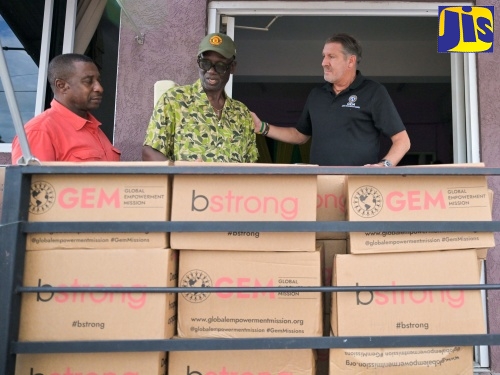
The Broward Office of Emergency Management is working closely with the Florida Division of Emergency Management, the Fort Lauderdale–Hollywood International Airport, and Broward municipal partners to send aid. Broward staff have also joined state volunteers at the Global Empowerment Mission warehouse in Doral to pack and load supplies headed to Jamaica.
Among those standing with Davis were community leaders and organizations rallying support through donations and volunteer efforts.
John Colombo, Vice President of the Florida Panthers Foundation and Community Relations, said their organization is holding collection drives for relief supplies and monetary contributions. “Our fans, we want to thank for supporting our efforts with our collection drives as well as financial support,” he said. “The Florida Panthers are very lucky to have a fan base that cares about its community, and we’re very thrilled to have partners that support even beyond our community. We’re very proud to be able to provide items in need to support those in need in Jamaica.”
Jamaican attorney Marlon Hill urged Floridians to give whatever they can, especially as the holidays approach. “I have an appeal to dedicate your Thanksgiving to Jamaica,” he said. “Give anything above zero to an organization you know is doing the work, along with any comfort items—tents, tarpaulins, air mattresses, hygiene items, and nourishment. Food is running out.”
Former Broward Mayor Dale Holness, who was also born in Jamaica, echoed that message: “If everyone makes a contribution, that will be very helpful to all.”
Captain Barrington Irving Jr., the Jamaican Guinness World Record holder recognized as the youngest person and first Black pilot to fly solo around the world, said airlift operations are already being arranged. “This will take a monumental effort,” he said. “One of the things we’ve focused on is trying to help get the supplies down to the island. We’re taking 50,000 pounds of cargo at a time on a Boeing 737-800 and forth from South Florida to Jamaica.”
The captain is doing so through his NGO, Experience Aviation, which has coordinated and delivered more than half a million pounds of humanitarian supplies, most notably during Hurricane Dorian in the Bahamas, Hurricane Helene in North Carolina, and several other disaster relief efforts across the region.
“We’ve had folks call and say, ‘Hey, I have a garage filled with items—I just don’t know how to get it there.’ The whole point is to get these items into the hands of people in the various communities. Our first two trips start next Monday and Tuesday and will continue through thanksgiving.”
Jeff Holness, a Jamaican-born Broward County School Board member representing District 5, said the school district is also joining the coordinated effort. “I was born in Jamaica—I grew up in St. Elizabeth—so what I’ll say is Broward County Schools have also joined relief efforts to make sure that we’re providing the necessary support to Jamaica, Haiti, parts of the Bahamas, and regions that have been affected,” he said. “We’ve partnered with BrightStar Credit Union, the Broward County Association of Student Councils, the Broward Council of PTAs, the Broward Education Foundation, the Broward Principals and Assistant Principals Association, and the Broward Teachers Union to support Jamaica.”
The county’s strong response reflects its Caribbean roots. Roughly 14.6% of Broward County residents are foreign-born from Caribbean nations, with about 118,000 residents of Jamaican ancestry, representing 6.1% of the county’s population—the largest Jamaican community in Florida.
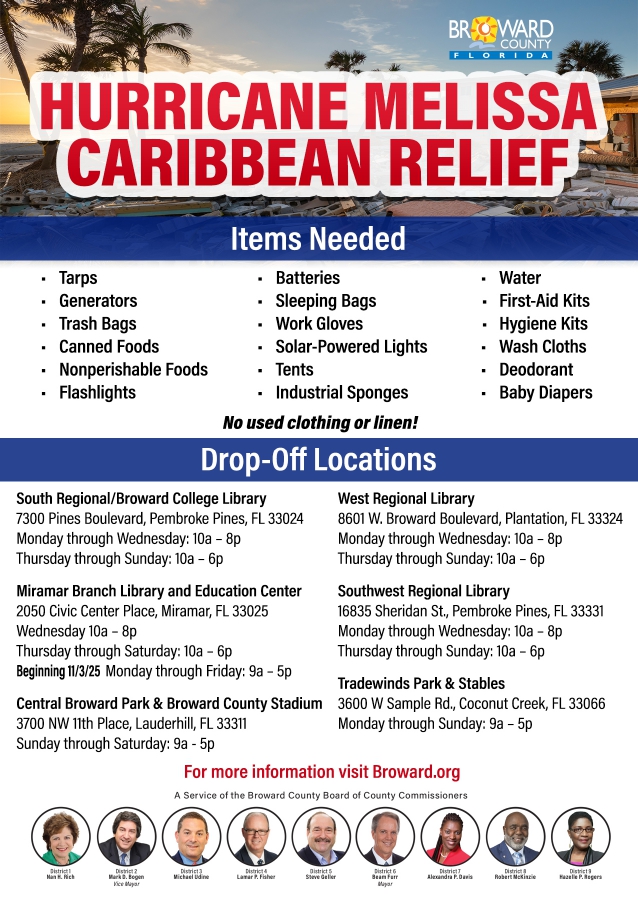
Donation drop-off locations have been set up at:
Broward County Libraries
South Regional/Broward County Library, Pembroke Pines: Mon–Wed 10 a.m.–8 p.m.; Thurs–Sun 10 a.m.–6 p.m.
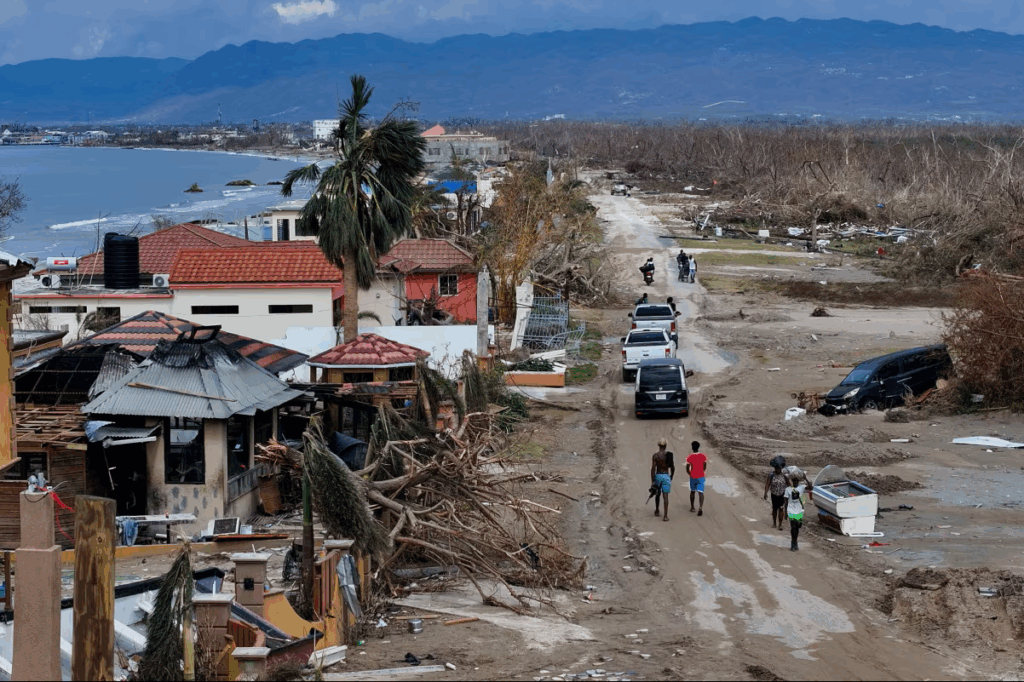
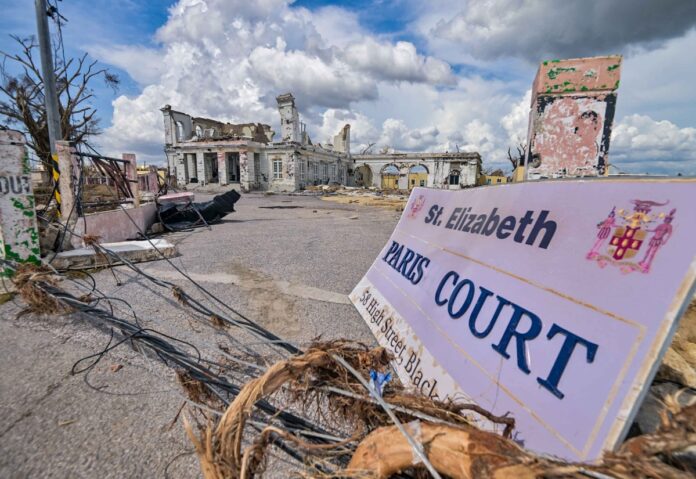
Community members sift through storm-tossed debris in Black River, Jamaica, days after Hurricane Melissa swept the coast. Photo Credit - Matias Delacroix
When Hurricane Melissa ripped across the Caribbean last week, it damaged roads and power lines and disrupted the way thousands of people earn a living.
In Jamaica, entire sections of St. Elizabeth, the country’s “breadbasket”, were flooded, threatening food supplies far beyond the parish itself. At one point, more than three-quarters of Jamaica’s electricity customers lost power as the JPS network took a major hit.
Heavy rains and flooding also occurred in Haiti and the Dominican Republic, killing dozens of people, washing out homes, and leaving families without basic resources and services. These are the kinds of climate shocks our region now faces almost every year.
But the real story unfolds after the storm has passed:
Farmers can’t replant because their pumps, seedlings, and investments are gone;
Vendors can’t sell because the market building or electricity is down;
Fishers can’t go out to sea because their boats and docks are destroyed;
Tourism and service workers lose shifts as hotels, ports, or tour sites repair storm damage.
One household’s “hidden” loss quickly ripples across entire communities. A farmer’s lost harvest means less produce in the market. A fisher’s broken boat means fewer fish on dinner tables. A vendor’s closed stall means fewer goods available to households. In other words, the livelihood loss of one household quickly becomes the hardship of many.
Drone image captures residents navigating down a flood-scarred street in Black River, Jamaica, as recovery begins following Hurricane Melissa. Photo Credit – Maria Alejandra Cardona
Those are real economic losses. And they fall hardest on the people working informally, the very people our food systems and local markets depend on.
National governments are responding. They clear roads, restore power, reopen schools, and, in Jamaica’s case, the Prime Minister outlined immediate relief and early recovery priorities in his October 27 national address about Hurricane Melissa. Shelters were opened across affected communities; evacuation orders were enforced for flood-prone areas; and security forces were deployed to maintain order. The government also activated a price-control order to prevent gouging on essential goods, while the Ministry of Agriculture and Fisheries prepared a recommended price list to stabilize markets.
Some J$400 million was allocated for emergency drain-cleaning and constituency mitigation, with additional support to farmers and fishers to help restart production. The Ministry of Labour and Social Security and the JDF were tasked with coordinating national relief, while the Ministry of Health launched mosquito-control operations to reduce post-storm disease risk. And, importantly, Jamaica’s disaster-risk financing instruments — the National Natural Disaster Risk Fund, the Contingency Fund, and other insurance/credit instruments — were activated to ensure quick access to response funds.
But even strong national action can’t quickly cover thousands of small, scattered losses, the vehicles that washed away, the market stall roofs that collapsed, the small poultry sheds that drowned, or the weeks of income lost as a result. That gap is exactly what the Caribbean Policy Development Centre (CPDC)’s 2025 research on Climate and Disaster Risk Financing and Insurance (CDRFI) found across five Caribbean countries: 79% of organizations serving vulnerable people had no disaster budget, and 80% weren’t even collecting regular member fees — so when a Melissa-level storm hits, there’s no local pot or social safety net to turn to.
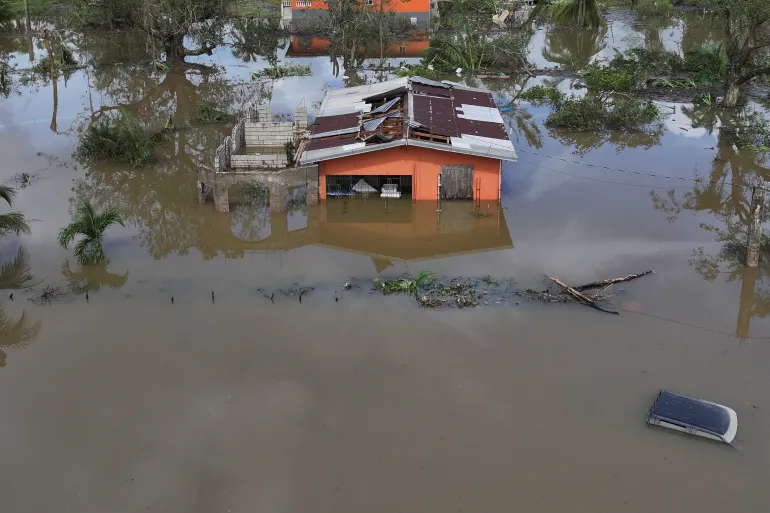
An aerial view shows widespread flooding in St. Elizabeth, Jamaica, after Hurricane Melissa made landfall. Photo Credit – Maria Alejandra Cardona
That is why CPDC argues for meso-level CDRFI. It is a model that uses the institutions people already trust (credit unions, cooperatives, community-based organizations) to deliver money faster and more fairly after a shock. Instead of waiting months for a national programme to reach a disaster-affected area, local community groups could:
Get a quick payout because the storm met a trigger (parametric insurance),
top it up for people who lost more than the average (indemnity insurance), and
use its own small reserve to help members restock, repair, or even relocate to keep earning (community savings fund).
This is not a replacement for government aid and resources. We absolutely need big public systems for roads, electricity, ports, hospitals, and schools. But Hurricane Melissa showed, again, that people also need a community-level financial shield to protect their income, food supply, and dignity while national systems get back up.
Last year, it was Beryl. This year it’s Melissa. Next year, it will be another name. The climate threat over the Caribbean is now permanent. The question for the region is: will we keep rebuilding from zero every season, or will we build financial systems that let farmers, fishers, vendors, tourism, and other informal workers bounce back faster?
Every time families are forced to abandon their livelihoods, the Caribbean loses not only income but also knowledge, traditions, and community strength. Protecting livelihoods isn’t just about money; it’s about protecting who we are as a people. CPDC has started that conversation with evidence from Antigua and Barbuda, Barbados, Dominica, Grenada, and Jamaica. Caribbean media, CSOs, governments, and financial cooperatives are invited to read the research and join the regional discussion on practical, people-centred disaster finance via the CPDC Risk Resilience Hub.
Our region is now at the point where we need to turn disaster lessons, from Hurricane Melissa and every storm before it, into long-term protection.
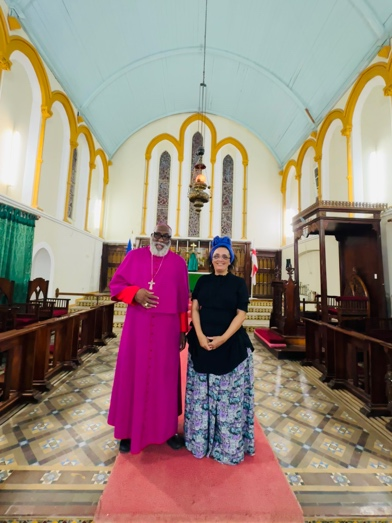
The Right Reverend C. Leopold Friday, Bishop of the Windward Islands and Desirée Baptiste, author/performer of Incidents in the Life of an Anglican Slave
The one-woman monologue play “Incidents in the Life of an Anglican Slave” left a profound impression on the Very Reverend Tim Stratford, Dean of Chester Cathedral, who described it as a “powerful” experience that made “the hairs on the back of my neck stand up.” Canon Reverend Dr. Michael Clarke, principal of Barbados’s Codrington College, saw the play in its 2023 debut and called it “thought-provoking” and “moving.”
Across the spectrum of reactions, audiences continue to engage with the play by London-based Caribbean writer Desirée Baptiste, particularly as it confronts the Anglican Church’s historical involvement in human bondage in the Caribbean, including at Codrington College, where enslaved people owned by the Church’s missionary arm were branded.
Having been performed in Edinburgh, London, Oxford, Cambridge, Chester, Northampton, and Barbados, ‘Incidents’ is now touring the Diocese of the Windward Islands, thanks to collaboration between the playwright and the Very Reverend C. Leopold Friday, Bishop of the Diocese.
Last month, the “holy trinity” of Caribbean performances began in St. Vincent & the Grenadines, ahead of the nation’s 46th Independence anniversary. The play was staged inside the historic St. George’s Anglican Cathedral, the Diocese’s Mother Church, drawing historians, judges, members of the Anglican communion, and the general public. A lively Q&A followed. In his welcome address on 22 October, Bishop Friday stressed the importance of exploring history through the “creative arts.”
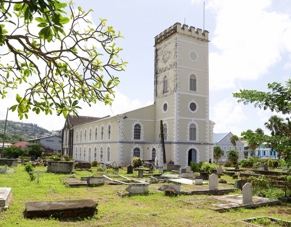
St. George’s Anglican Cathedral in Kingstown, SVG, built in 1820, is the ‘Mother Church’ of the Diocese of the Windward Islands and home to several memorials to colonial administrators and enslavers. Image credit: Kingsley Roberts
The tour now moves to Grenada, with a performance and Q&A scheduled for Wednesday, November 12, 2025, at St. George’s Parish Church. Baptiste called the Grenada debut “very special,” noting her late father—a historian at UWI—from whom she inherited her passion for history, was Grenadian. She also highlighted recent research revealing the British monarchy’s direct involvement in Caribbean slavery, with a focus on Grenada.
The Grenada debut of Desirée Baptiste’s ‘Incidents in the Life of an Anglican Slave’ takes place on 12th November 2025
‘Incidents’ draws on a 302-year-old letter from an anonymous enslaved Virginian “mulatto” to the Archbishop and King George I, requesting freedom. Believed to be the first letter written by an enslaved person in the British Empire, it resides in the Church of England archives. Baptiste’s play imaginatively extends the letter’s story, taking the narrator from Virginia to the Caribbean, marking the first creative response to a Church of England archive item housed at Lambeth Palace Library.
Performing in Anglican spaces such as St. George’s Cathedral in Kingstown, home to memorials for colonial administrators and enslavers, was not new for Baptiste. Still, she found it particularly poignant to stand mid-performance on Alexander Leith’s memorial—a Scotsman “celebrated” for killing St. Vincent’s Garifuna leader, Joseph Chatoyer, during the Second Carib War.
Gratitude remains Baptiste’s central takeaway from the Caribbean tour. “Especially,” she said, “the fact that we have been able to make this mini tour happen without help from the UK Mother Church.” Gordon Jump, Programme Director of the Church of England Church Commissioners, noted that although the Commissioners profited from historic involvement in the African slave trade, their Fund for Healing, Repair and Justice is still under development.
Left to Right: The Venerable Junior Ebenezer Ballantyne, Archdeacon of St. Vincent and the Grenadines; The Right Reverend C. Leopold Friday, Bishop of the Windward Islands; and SVG Archdeaconry members Leslie McKenzie and Steve Francis
Undeterred, Baptiste and the Diocese of the Windward Islands, with the Archdeaconries of SVG, Grenada, and St. Lucia, have staged the mini tour. She emphasized:
“What we have been able to achieve, by making the necessary sacrifices so that we could bring this compelling story to a Caribbean public for free, shows that we can do the important ‘Repair’ work of healing via history-telling ourselves, right here in our Caribbean islands.”
Fishermen at the Ocho Rios Fishing Village in St. Ann return boats to the water following the passage of Hurricane Melissa on October 28. Photo: JIS
Prominent Jamaican food technologist Dr. André Gordon has sounded an urgent warning about the devastating toll Hurricane Melissa has taken on Jamaica’s food supply chain, describing the impact on the island’s agricultural heartland as “severe and devastating.”
“The breadbasket, the production heartlands of Jamaica have been basically wiped out,” Dr. Gordon told Caribbean National Weekly recently.
“Westmoreland, St. Elizabeth, and Clarendon have been decimated. Not just people’s lives and homes, but the agricultural production in those areas has been severely impacted.”
Dr. Gordon, a National Medal of Science and Technology recipient and founder of Technological Solutions Limited (TSL) in Kingston, said the hurricane has crippled food production in some areas that supply the island and international markets.
Dr. Andre Gordon, founder of Technological Solutions Limited (TSL)
“It’s going to take a while for people to first get themselves in a place of comfort,” he said. “Some efforts have started for replanting, but most people are trying to figure out how they’re going to survive.”
Fisheries and food exports crippled
In addition to the destruction of farmlands, Dr. Gordon revealed that the country’s fisheries sector has also been “severely affected,” particularly along the south coast.
“From Bluefields to Alligator Pond, Rocky Point, and Negril, a lot of destruction has taken place,” he said. “Jamaica produces and exports a significant amount of fisheries products, and that sector is in crisis.”
The hurricane’s blow to Jamaica comes just months after the agricultural export sector began to recover from last year’s Hurricane Beryl, which caused widespread damage.
“The sector had just started to recover in August and September,” he explained. “But with Melissa hitting Clarendon, St. Elizabeth, and Westmoreland as badly as it has, the crop is going to be decimated. It’s going to be extremely difficult for people overseas to get products like ackee.”
Dr. Gordon expressed hope that producers in St. Catherine, St. Andrew, and St. Thomas, who may have escaped the worst of the storm, can fill some of the void.
“Even if they’ve lost some of the crop, I’m hoping they’ll be able to recover much more quickly,” he said. “But it’s going to be challenging.”
Health risks from contaminated water
Melissa’s impact extends way beyond the agricultural sector. Dr. Gordon cautioned about widespread water contamination in western parishes due to damaged sewer lines and flooded farms.
“Even streams, rivers, and water sources became contaminated with sewage and waste,” he said. “There is a real risk of getting E. coli and other coliforms that cause waterborne illnesses.”
He urged Jamaicans in the affected western parishes to rely only on bottled or treated water, emphasizing that many public water sources could be unsafe.
“Whenever you have these kinds of events, the Ministry of Health issues warnings because they cannot quickly identify which water sources are contaminated and which are not,” he said.
Relief measures and the fight against scammers
Dr. Gordon praised the Ministry of Finance’s decision to waive import duties and General Consumption Tax (GCT) on essential goods brought in for relief efforts.
“It’s a very good move,” he said. “In past disasters, people seeking help were frustrated by the cost of duties. This waiver makes it easier for the diaspora and aid organizations to help.”
He also warned Jamaicans at home and abroad to beware of scammers exploiting the disaster.
“Everybody wants to help, but we have to be careful,” he cautioned. “Please ensure that any donation goes through reputable organizations like the Jamaica Manufacturers and Exporters Association (JMEA), the Private Sector Organisation of Jamaica (PSOJ), or the Jamaica Information Service (JIS). If the website doesn’t end with .gov.jm, don’t trust it.”
TSL’s role in recovery
Dr. Gordon said his company, TSL, will once again step forward to help rebuild Jamaica’s agricultural and agro-industrial base.
“When Hurricane Ivan hit in 2004, we played a major role in revitalizing and restructuring the agricultural, agro-industrial, and fisheries sectors through the Jamaica Business Recovery Program,” he recalled.
“We’ll be contacting the authorities to see how we can help structure a program to get production back—not just as it was before, but better. We must use this opportunity to build more resilient agricultural systems and help farmers access local hotels and overseas markets,” he added.
He also noted that damage to packaging and supply imports will likely slow the recovery.
“Even products like jerk seasonings and sauces will be in short supply because their supply chains have been disrupted,” he said. “The Port of Kingston only just reopened, so it will take time.”
A call to the diaspora
Dr. Gordon ended with an emotional appeal to Jamaicans overseas.
“You all love your country, and this country loves you,” he said. “This is an opportunity to help Jamaica build back better—to fix broken homes and broken lives, and help people recover mentally and spiritually. Even a kind word or any little assistance can make a difference.”
He urged professionals in the diaspora with specialized skills to get involved.
“Now is the time to contribute. Let’s build a stronger Jamaica for the future, so that if we ever face another disaster like this, we are better prepared to survive and recover.”
Christine King, a Guyanese-American attorney and Chairwoman of the City Commission, has won a second term as Miami’s District 5 commissioner, securing more than 84% of the vote in preliminary results Tuesday night.
King defeated challengers Marion K. Brown, a construction executive, and Frederick Bryant, a retired teacher and community activist.
Born in Guyana and raised in Miami from the age of five, King has dedicated her career to public service. Before running for office, she served as Chief of Constituent Services for a Miami-Dade County Commissioner and later as an executive with the Community Action Agency (CAA). She earned her Juris Doctor from Nova Southeastern University and practiced law before becoming President and CEO of the Martin Luther King Economic Development Corporation, where she oversaw programs like “Wheels to Work,” designed to help families overcome transportation barriers.
First elected in 2021, King made history as the first Guyanese-American elected to Miami’s government and the first woman to be named Chairwoman of the City Commission. She represents a diverse district encompassing Liberty City, Little Haiti, Model City, Overtown, Wynwood/Edgewater, and the Upper East Side. Her mission has been to ensure District 5 is known for its culture, vibrancy, and diversity rather than poverty or crime.
During her first term, King spearheaded initiatives to address housing, climate, and community services. She launched the First-time Homebuyer Program, co-sponsored legislation to continue the Emergency Rental Assistance Program, and invested over $750,000 in programs supporting employment, education, and wealth-building for District 5 residents. She also supported the Miami Forever Carbon Neutral program, aimed at achieving carbon neutrality by 2050, and championed efforts to combat homelessness through the Functional Zero initiative and partnerships with Lotus House.
King has been unafraid to take strong stances on contentious issues. This summer, she was one of two commissioners to vote against Miami entering an immigration enforcement agreement with ICE.
Tuesday’s election confirms strong support for King’s leadership and her vision for District 5. Meanwhile, in District 3, the race will head to a runoff between Republican candidates Frank Carollo and Rolando Escalona.
Caribbean-American leaders across New York City maintained strong support in Tuesday’s General Election, with several incumbents easily securing re-election. The results reflect the continued influence of the city’s Caribbean immigrant community, which has long been a key part of New York’s political and cultural landscape.
In Brooklyn’s District 46, Haitian-born Democratic Council Member Mercedes Narcisse, an incumbent and registered nurse, captured 24,622 votes, or 67.9 percent, with Republican Athena Clarke receiving 10,012 votes, or 27.6 percent, and Guyanese-born Conservative candidate Dimple Willabus obtaining 1,643 votes, or 4.5 percent. Narcisse said she was “deeply humbled and grateful to the people of the 46th District for once again placing their trust in me to serve as their council member.”
Brooklyn’s District 45 saw incumbent Farah Louis, daughter of Haitian and Bahamian immigrants, re-elected with 31,611 votes, or 84.7 percent. Republican Joshua received 4,248 votes, or 11.4 percent, and Hatem El-Gamasy, running as an “Other” candidate, received 1,464 votes, or 3.9 percent.
In District 35, Democratic incumbent Crystal Hudson, whose grandmother hailed from Jamaica, secured 53,011 votes, or 93.0 percent. Conservative Benny Rosenberger received 3,056 votes, or 5.4 percent, and Hector Robertson, running as an “Other” candidate, received 933 votes, or 1.6 percent.
District 42’s incumbent Chris Banks, whose mother is from Trinidad and Tobago, won re-election with 22,277 votes, or 95.8 percent. Davon Phillips, the “Other” candidate, received 975 votes, or 4.2 percent. Meanwhile, Haitian-born Rita Joseph, representing Brooklyn’s 40th District, ran unopposed and retained her seat.
With 90 percent of ballots counted, New York City Democratic Public Advocate Jumaane Williams, son of Grenadian immigrants, garnered 1,362,196 votes, or 72.9 percent, while Republican Gonzalo Duran received 465,113 votes, or 24.9 percent, and Independent Martin Dolan obtained 42,314 votes, or 2.3 percent.
Historic Mayoral Win
New York City Mayor-elect Zohran Mamdani, whose own immigrant experience has shaped his political vision, celebrated the city’s diverse population in his victory speech. “Yemeni bodega owners, Mexican abuelas, Senegalese taxi drivers, Uzbek nurses, Trinidadian line cooks and Ethiopian aunties,” he said.
Mamdani will be the first Muslim mayor, the first mayor of South Asian descent, the first foreign-born mayor in nearly 50 years, and the youngest mayor elected in over a century. He defeated former Governor Andrew M. Cuomo and Republican Curtis Sliwa to become the 111th mayor of New York City. “New York will remain a city of immigrants, a city built by immigrants, powered by immigrants. And as of tonight, led by an immigrant,” Mamdani declared.
The elections underscore the enduring impact of Caribbean-American leaders across New York City, even as the city prepares to be led by a historic mayor who celebrates its immigrant roots.
The Office of Disaster Preparedness and Emergency Management (ODPEM) has been reassigned under the Office of the Prime Minister (OPM) to enhance logistical coordination with the Jamaica Defence Force (JDF) in the aftermath of Hurricane Melissa. The reassignment takes effect immediately.
Prime Minister Andrew Holness announced the move on Tuesday during a ministerial address in the House of Representatives, emphasizing the need for greater efficiency in disaster response.
“ODPEM is the central agency for the government’s disaster response. They work with all critical agencies in government, the private sector, international aid organizations, and multiple governments,” Holness said. “However, the response to Hurricane Melissa will require significant logistical experience.”
The Prime Minister noted that the JDF is already providing logistical support to ODPEM and the Ministry of Labour and Social Security, particularly in areas where communities are isolated or difficult to access.
“Given the nature of response needed for current relief efforts and the upcoming reconstruction, it’s important that ODPEM operate with even greater levels of collaboration,” Holness said.
He added that the realignment “establishes a virtually single point for emergency logistics and further tightens coordination with relief partners. It’s all about speed.”
The new arrangement is expected to accelerate the delivery of relief supplies to the most affected communities and help restore normalcy more quickly.
AUCKLAND, New Zealand — New Zealand will enter their five-match T20 International series against the West Indies this week, missing a host of frontline players, as injuries and retirements force major changes to their line-up.
Explosive opener Finn Allen (foot), express pacers Lockie Ferguson (hamstring) and Ben Sears (hamstring), allrounder Glenn Phillips (groin), and seamer Adam Milne (ankle) have all been ruled out through injury. Adding to the list of absentees, former captain Kane Williamson will be unavailable following his recent retirement from the T20 format, announced on Sunday.
Fast bowler Matt Henry has also been rested, with selectors opting to preserve him for the upcoming ODI and Test series against the Caribbean side.
Santner takes charge again
With several senior figures missing, all-rounder Mitchell Santner will once again assume leadership duties. The squad features a blend of seasoned campaigners and rising talent, including the returning Kyle Jamieson and leg-spinner Ish Sodhi, while uncapped pacer Nathan Smith is poised for a potential debut.
Coach Walter eyes momentum ahead of World Cup
Head coach Rob Walter welcomed the challenge of facing a powerful West Indies unit, noting the importance of the series as final preparation before next year’s T20 World Cup.
“It’s great to have five opportunities to take on a dangerous side like the West Indies,” Walter said. “I know the team is looking forward to getting into the rhythm of a full series and building some momentum following the rain-affected start to the summer.”
Walter acknowledged that the World Cup looms large on the horizon but stressed that maintaining focus on home performances remains key.
“The T20 World Cup is coming closer and I know it will be on people’s minds,” he added. “But we need to make sure our focus is on this series at home and playing well in front of our fans.”
New Zealand squad: Mitchell Santner (captain), Michael Bracewell, Mark Chapman, Devon Conway, Jacob Duffy, Zak Foulkes, Kyle Jamieson, Daryl Mitchell, Jimmy Neesham, Rachin Ravindra, Tim Robinson, Tim Seifert, Nathan Smith, Ish Sodhi.
ST JOHN’S, Antigua — Seasoned fast bowler Kemar Roach is poised for a return to international duty after being named among nine players invited by Cricket West Indies (CWI) to a two-week High-Performance preparation camp, forming part of the build-up to the upcoming three-match Test series against New Zealand.
Roach, 37, joins Tagenarine Chanderpaul, Tevin Imlach, Anderson Phillip, Johann Layne, Kevlon Anderson, John Campbell, Ojay Shields, and Kavem Hodge for the camp, which aims to sharpen skills and readiness ahead of the long-format showdown in December.
Roach set to reinforce bowling unit
With his inclusion, the veteran seamer appears likely to reclaim his spot in the Test squad for the series scheduled from December 2 to 22. Roach last represented the West Indies in January against Pakistan and remains one of the region’s most successful fast bowlers, having captured 284 wickets in 85 Tests — the fifth-highest tally among all West Indian pacers.
His presence will bring invaluable experience to a developing bowling attack expected to face demanding conditions in New Zealand, where control, discipline, and endurance often decide contests.
Camp to refine skills and adaptability
The camp, which runs from November 4 to 18 at the Coolidge Cricket Ground (CCG) in Antigua, will emphasize technical precision, tactical discipline, and mental adaptability to handle New Zealand’s unique playing environment.
The program will be led by Ramesh Subasinghe, head coach of the West Indies Academy, with Rohan Nurse serving as assistant coach and overseeing tactical and technical refinement. Additional support will come from Jamal Smith, CWI’s senior talent manager, and Shane Dowrich, developing pathway coach, who will coordinate performance drills and developmental assessments.
Bascombe: ‘Focused, purposeful preparation’
CWI Director of Cricket Miles Bascombe underscored the importance of the camp as a targeted preparation platform for both emerging and established players.
“This camp is designed to give players a focused opportunity to prepare for the specific challenges of playing in New Zealand,” Bascombe explained. “For the batsmen, it’s about targeted work on areas where they’ve shown vulnerability and adapting to the conditions they’ll face. For the bowlers, it’s about managing their workloads effectively and identifying the lengths and areas that have proven successful in New Zealand.”
He added that the initiative goes beyond conditioning — it’s about building cohesion and confidence ahead of the demanding overseas series.
“It’s a practical, purposeful camp – one that allows the group to refine key aspects of their game while building cohesion and clarity ahead of the tour,” Bascombe continued. “The goal is to make the most of this preparation window so the players are ready to compete with confidence and intent.”
A strategic step toward revival
With Roach’s experience anchoring the group and several young prospects pushing for selection, the High-Performance camp signals CWI’s continued effort to bridge development and competitiveness as the West Indies seek to reassert themselves in the Test arena.
AUCKLAND, New Zealand — Fresh from a commanding 3-0 series victory over Bangladesh, West Indies white-ball captain Shai Hope believes his side carries both confidence and conviction into their five-match T20 International series against New Zealand, which bowls off Wednesday.
That clean sweep in Dhaka marked just the Caribbean side’s second bilateral T20I series win in nine attempts, snapping a frustrating run of losses to Nepal, Pakistan, and Australia. Now, with renewed belief, the Windies aim to rewrite history against the fourth-ranked Black Caps — a team they have not beaten in a T20I series since 2012.
‘A great confidence booster’
Speaking on the eve of the series, Hope said the team’s morale was soaring and that their Bangladesh success had provided invaluable momentum ahead of the challenging assignment in New Zealand.
“Coming off that 3-0 victory that we had in Bangladesh is a great confidence booster for us as a team,” Hope said. “It’s about continuing to challenge ourselves and see where we’re at as a unit while building toward the World Cup.”
The skipper emphasized how the players took pride in triumphing under difficult subcontinental conditions, a feat that underscored the team’s growing resilience.
“You have to take a lot of pride, especially going into conditions that you may not have faced ever in your career,” he added. “The success we’ve had says a lot about the strength of the group. It’s a big confidence lift heading into this series.”
Hope, who has led the side’s white-ball resurgence, said he expected the team’s batters and bowlers to relish the more familiar, faster surfaces of New Zealand after the spin-friendly pitches of Bangladesh.
“It’s a place I’m sure the batters and even the bowlers will be happier playing on,” he said. “Hopefully we can turn things around in New Zealand and build on that success.”
Adapting to Kiwi conditions
While buoyed by their recent triumph, Hope cautioned that conditions in New Zealand would pose an entirely new challenge — one that would test adaptability and tactical discipline.
“Slightly different conditions, maybe totally different conditions,” he noted. “But as we all know, one of the biggest aspects of being a professional cricketer is the ability to adapt.”
He added that success in the series would depend on how quickly his players could read the local pitches, boundary dimensions, and bowling strategies.
“I don’t expect New Zealand bowlers to just put it in the slot for the shorter straight boundaries,” Hope said with a grin. “It’s about understanding what you’re going to get and forming the right plans to be successful — whether with bat or ball.”
Focus on consistency and growth
Looking ahead, Hope said the team’s mission extended beyond just competing — it was about proving consistency and the ability to win away from home against elite opposition.
“On the back of that success in Bangladesh, it’s about trying to repeat,” he stressed. “We want to be a very good team, and it’s about consistency. If you want to be the best, you have to beat the best in their home territories — and that’s a box we’re determined to tick.”
With momentum, belief, and renewed direction under Hope’s leadership, the West Indies now face the test of translating promise into performance in unfamiliar territory.
Minister of Local Government and Community Development, Hon. Desmond McKenzie (centre); Mayor of Kingston, Councillor Andrew Swaby (left), and Founder/President of non-profit organisation, Global Empowerment Mission (GEM), Michael Caponi, examine boxes of food and supplies donated by the entity to aid 50 persons at the Desmond McKenzie Transitional Centre for the Homeless in downtown Kingston. The items were handed over on Friday (October 31).
In the aftermath of Hurricane Melissa, which left massive destruction across Jamaica, the island’s diaspora in the United States has responded with overwhelming support, Jamaica’s Ambassador to the United States, Major General (Retired) Antony Anderson, said last Friday.
Speaking at a press briefing at the Jamaican Embassy in Washington, DC, Anderson highlighted the scale and diversity of the relief efforts. “I have received several calls for health missions to go to Jamaica as the diaspora rallied quickly and ramped up support for Jamaica. This is not confined only to individuals but charitable organisations also who have also ramped up their outreach,” he said.
Anderson stressed that as the needs in Jamaica continue to grow, now is the time for the diaspora, friends of Jamaica, and international partners to come together. He noted that several governments, multilateral organizations, non-governmental organizations, and congressional and state representatives have reached out to offer assistance.
The U.S. government has already deployed four helicopters to Jamaica, with another four on the way. Search and rescue teams from Virginia and California are on the ground assisting and conducting assessments in collaboration with the Jamaican government, which will inform further U.S. support. Anderson said the embassy is establishing a database of skilled volunteers to better direct relief efforts. “The rescue operation will morph into rebuilding,” he said.
Several Jamaican diaspora organisations in the U.S. have set up donation points and fundraising initiatives. Jamaicans Abroad Supporting Jamaicans At Home (JAH JAH) Foundation has joined forces with the Organization of International Development (OID) to raise funds and secure supplies for the island.
Private-sector efforts are also contributing. Through the Vincent HoSang Family Foundation, Caribbean Foods Delight has raised US$20,000 to provide hardware vouchers, grocery assistance, and direct cash aid to affected families. Golden Krust Caribbean Bakery aims to raise US$250,000, using its stores across the U.S. to collect donations for hurricane victims.
The Jamaican Consulate in New York has set up a donation drop-off point, and donors can also purchase essential goods via Amazon, which will be sent directly to the consulate. In California, several Jamaican organisations have united to raise US$500,000 to support a targeted medical project.
Political leaders have joined the relief push. New York City’s outgoing mayor, Eric Adams, has encouraged residents to support the island, while American Friends of Jamaica announced a US$1 million matching fund to double contributions through its official channels.
In Florida, Broward County is appealing to residents and businesses to assist Caribbean nations affected by the storm. “Victims of Hurricane Melissa throughout the Caribbean need and deserve our support,” said Broward County Mayor Beam Furr. Drop-off locations include multiple Broward County Libraries and parks, with specific hours set for donations of tarps, water, flashlights, tents, nonperishable food, solar-powered lights, and other essentials. Used clothing and linens are not being requested.
Jamaican-American District 7 County Commissioner Alexandra P. Davis emphasized the urgency of the initiative, saying, “The devastation that Hurricane Melissa caused in the Caribbean is heartbreaking and it is our duty to help families in desperate need of support.”
Government-led relief efforts have also gained momentum. Donations to the Government of Jamaica’s Hurricane Melissa Relief Fund, made through the official website supportjamaica.gov.jm, are approaching US$1 million. Jamaica’s Minister of Education, Skills, Youth and Information, Senator Dr. the Hon. Dana Morris Dixon reported that as of 10:33 p.m. on Sunday, November 2, contributions had reached US$728,000 and J$38 million. “We’re getting to the US$1 million mark on that site,” Dr. Morris Dixon declared.
International support continues to grow. The United Kingdom has pledged an additional £5 million in emergency humanitarian funding for Jamaica and the wider Caribbean, supplementing £2.5 million announced earlier in the week. The aid includes more than 3,000 shelter kits and 1,500 solar-powered lanterns for families without electricity or damaged homes, with distribution coordinated through the World Food Programme and the Red Cross.
The United States has announced an initial US$11 million to support immediate relief, including emergency food supplies for 40,000 people, six water treatment systems producing 4,000 litres per hour, and emergency shelter. Additional assistance has come from Spain, Panama, El Salvador, Colombia, and international organizations including World Central Kitchen, Samaritan’s Purse, and Project HOPE.
As Jamaica continues to grapple with Hurricane Melissa’s aftermath, the combined efforts of the diaspora, governments, and international organizations highlight a powerful show of solidarity, aiming to provide immediate relief and support the island’s longer-term recovery.
The Grenada government says it will not enter into any agreement that could violate regional, domestic, or international law, as discussions continue over a U.S. request to install radar equipment at the Maurice Bishop International Airport (MBIA).
Prime Minister Dickon Mitchell, addressing Parliament on Tuesday, said Washington had requested a response within a specific timeframe, but his administration could not yet provide one. “For the simple reason that…from a technical point of view, we are not in a position to satisfy ourselves as to safety and other technical requirements, as to whether or not such equipment [fits] properly optically at the airport,” he explained.
Mitchell emphasized that Grenada has no military and that cooperation with the United States must remain within the framework of law enforcement, domestic legislation, and international law.
The prime minister also noted that public debate has intensified around the U.S. request. He reminded lawmakers that Grenada already maintains ongoing security cooperation with the U.S. and regional partners in combating drug trafficking, human trafficking, and related crimes.
“Sometimes the cooperation does extend to the U.S. Southern Command, which is the military arm of the U.S.,” Mitchell said. “So cooperation with the U.S. is ongoing and permanent in our case.”
He added that while some aspects of the radar proposal are part of broader security collaboration, the government could not publicly discuss operational details “because we don’t want criminals to know what some of the arrangements for addressing crime are.”
Mitchell described the ongoing public debate as proof that the government recognized from the outset that the proposal was sensitive. He pointed out that MBIA, as a civilian airport, is “not equipped to treat with military-type operations,” and that radar installation could disrupt normal activity.
Technical assessments are still being conducted, Mitchell said, noting that U.S. officials have already evaluated potential sites. “They have done so, and after having done so, they would have indicated that there were two sites that were interested in… They have come back and are interested, perhaps in one site.”
Last month, Grenadians held a peaceful protest opposing the U.S. plan. Former foreign affairs minister Peter David told the “Peace March,” organized by the Grenada Coalition Zone of Peace and Concerned Citizens, that the issue transcends politics.
“We are here demanding that our region be maintained as a zone of peace,” David said. “We are not here to fight down anybody… we say Grenada first, the Caribbean first. This is not a partisan issue, this is an issue of sovereignty and integrity for the people of Grenada.”
The request comes amid broader U.S. efforts to bolster its presence in the Caribbean and off the coast of South America as part of its anti-drug trafficking operations. Washington has confirmed several maritime bombings in recent years as part of that campaign.
A resurgence of cholera in Haiti’s West department is underscoring the urgent need for coordinated, long-term action to restore basic water and sanitation systems, Human Rights Watch (HRW) said Wednesday.
The outbreak, part of a seasonal surge during the rainy period, is spreading through Port-au-Prince and its surrounding areas amid the near collapse of the capital’s health infrastructure and worsening insecurity.
Between January 1 and October 30, 2025, Haitian health authorities recorded 2,852 suspected cholera cases, 186 confirmed cases, and 48 deaths. More than one-third of suspected cases are in children under nine, according to government data. After 11 weeks without new infections, health officials have confirmed that cholera is once again spreading.
“Cholera is once again threatening thousands of lives in Haiti because people lack access to the most basic services: clean water, sanitation, and medical care,” said Nathalye Cotrino, senior Americas researcher at Human Rights Watch. “Haitians need serious government and international efforts to address the outbreak and avoid more preventable deaths.”
After more than three years without a single case, cholera reappeared in Haiti in late 2022. The return of the disease revives painful memories of the 2010 outbreak that killed nearly 9,800 people and infected over 820,000 after sewage from a United Nations peacekeeping base contaminated a local river. Although the UN acknowledged moral responsibility in 2016, the country’s fragile infrastructure and lack of investment in clean water and sanitation continue to leave Haitians vulnerable.
“Stagnant water, broken sewage lines, and the accumulation of trash across the city create ideal conditions for outbreaks to spread whenever the rains come,” said Diana Manilla Arroyo, Head of Mission for Médecins Sans Frontières (MSF) Holland in Haiti. “On top of that, a lot of the country’s infrastructure was destroyed in the 2010 earthquake.”
Only a quarter of Haitian households have access to handwashing facilities with soap, and 70 percent lack improved sanitation systems, according to the United Nations. Heavy rainfall from Hurricane Melissa has further increased the risk of bacteria spreading to non-chlorinated water sources.
The outbreak is being compounded by escalating violence and insecurity. Armed groups now control much of the country, blocking key roads, cutting off humanitarian aid, and isolating entire communities. The UN estimates that over 1.4 million people have been displaced this year, many living in overcrowded settlements without access to clean water or toilets — ideal conditions for cholera transmission.
Access to healthcare remains limited. Only 11 percent of health facilities in Port-au-Prince with inpatient capacity are fully operational, the UN reports. While residents in wealthier areas can seek treatment in private hospitals, those living in gang-controlled neighborhoods such as Cité Soleil and lower Delmas often cannot travel safely or afford care.
The latest outbreak has reached Pétion-Ville, one of the capital’s more affluent neighborhoods and home to many diplomatic offices, which had largely avoided previous waves of cholera.
HRW urged Haiti’s transitional government and its international partners to repair the national water and sewage network, ensure humanitarian access to high-risk areas, and restore public health institutions.
Despite worsening conditions, countries such as the Dominican Republic, the United States, the Bahamas, and the Turks and Caicos Islands have continued deporting Haitians. The International Organization for Migration reported that more than 225,000 people were returned to Haiti between January and October 2025.
“People should not be deported or otherwise returned to Haiti, where overlapping humanitarian, security, and public health crises endanger lives,” HRW said. “They face a high risk of violence with no effective access to protection or justice.”
“This cholera outbreak is being fueled by years of institutional neglect and the near collapse of essential services,” Cotrino added. “Foreign governments should be doing all they can to help Haiti put an end to cholera.”
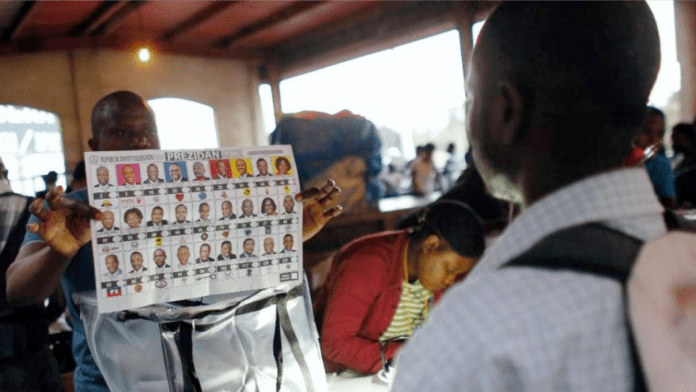
A voter holds up a chart of the candidates of the elections
Haiti’s Provisional Electoral Council (CEP) is pressing ahead with technical preparations for future elections — including drafting an electoral decree and recruiting election agents — even after declaring that it’s “impossible” to hold a vote under the country’s current conditions.
The CEP said the draft decree will outline the rules and procedures for organizing elections once the country is safe and stable enough to ensure a credible process.
“After the publications, we will be underway,” CEP President Jacques Desrosiers said. “But for now, we still do not know how much money we will need for the elections.”
The proposed decree would define eligibility criteria, polling organization, and ballot-counting procedures. Political parties and civil society groups have until November 10 to submit written feedback before the document is sent to the Transitional Presidential Council (CPT) for publication in Le Moniteur, Haiti’s official gazette.
Desrosiers said the CEP is also preparing an electoral calendar and budget plan. While the government has pledged to fund the process, international partners may also contribute, though no commitments have been finalized.
The joint electoral fund managed by the United Nations Development Program (UNDP) currently holds about $63 million, Desrosiers noted. On October 17, the CPT announced the disbursement of nearly $65 million for the elections, including 3 billion gourdes—about $23 million—earmarked for political party support in the 2025–2026 national budget.
CPT President Laurent Saint-Cyr said the funds would help electoral institutions operate, deploy staff, and cover logistics. He reaffirmed that holding credible elections remains a national priority.
“Haitians must be able to freely choose their leaders in a transparent process,” Saint-Cyr said. “We are ready to engage in dialogue with all those who want to help the country achieve that goal.”
Despite these efforts, the security situation remains dire. Nearly 90% of Port-au-Prince is under gang control, with armed groups expanding into towns like Montrouis and Désarmes in the Artibonite region. More than 1.4 million people remain displaced and unable to return home.
Adding to the uncertainty, gang leader Jimmy “Barbecue” Chérizier, who heads the “Viv Ansanm” coalition, posted a video warning that no elections would take place without the gangs’ consent — underscoring the fragile environment facing any political transition.
For now, the CEP continues its work — drafting plans, holding consultations, and preparing for elections that, by its own admission, cannot yet be held.
At just 27 years old, Bryan Calvo has made history as the youngest mayor not only in Hialeah but in the entire state of Florida.
Calvo won decisively on Tuesday, earning 52.9% of the vote — or 9,210 ballots — ushering in a new political chapter for one of South Florida’s largest cities. His victory signals voters’ appetite for change and a fresh approach to leadership.
Born and raised in Hialeah, Calvo represents a new generation of city leadership. A graduate of Harvard University with a degree in political science and a law degree from Florida International University, he began his political career at 23, becoming the youngest city council member in Hialeah’s history. During his tenure, he gained a reputation for pushing back against tax and fee increases and questioning decisions he said were not in residents’ best interests.
His often-public clashes with former Mayor Esteban Bovo over budget priorities, water rates, and government transparency defined his reform-minded image.
Running on a “Hialeah First” platform, Calvo promised to cut taxes and water fees, eliminate political pensions, fight corruption, and protect condominium owners from fraud. He also vowed to end property taxes for seniors 65 and older and create specialized units to target money laundering and financial crimes.
“This victory belongs to every family that has worked hard and refused to give up on this city,” Calvo said during his victory speech Tuesday night. “Hialeah chose transparency over corruption and results over rhetoric. My commitment is to restore integrity to City Hall and ensure government works for everyone, not just the well-connected few.”
Hialeah, which has 90,167 registered voters, saw a turnout of 19.4% in the election.
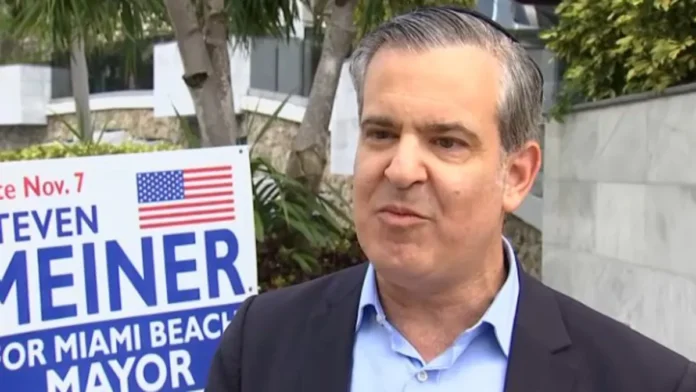
Incumbent Miami Beach Mayor Steven Meiner has secured a second term, narrowly defeating City Commissioner Kristen Rosen Gonzalez by just over 350 votes in Tuesday’s election.
According to official results, Meiner earned 51.2% of the vote, while Rosen Gonzalez finished with 48.8%.
Celebrating his victory at a supporter’s home in Mid-Beach, Meiner credited his re-election to his focus on public safety and homelessness during his first term.
“I think our residents saw that I am focused on the issues,” Meiner said. “My sole goal, my sole mission — our sole mission, my family, our team — is to make Miami Beach the best and safest city in America, and we’re getting there, and we’ve got to keep the momentum going.”
At her election night event at the Cardozo Hotel in South Beach, Rosen Gonzalez conceded shortly before 7:30 p.m. “We did the best we could,” she said. “I’m proud of the campaign that we ran.”
Meiner, 54, emphasized his record on law and order, including efforts to reduce crime and manage spring break crowds. He highlighted statistics showing declines in major offenses and reminded voters of his administration’s achievements in an email sent Tuesday morning.
“You have the opportunity to re-elect a mayor who has delivered real results in just two years — more than many thought possible,” Meiner wrote.
Before becoming mayor in 2023, Meiner served as a city commissioner. He is eligible to serve up to three consecutive two-year terms.
Rosen Gonzalez, first elected to the Miami Beach City Commission in 2015 and re-elected in 2021, was term-limited this year. She previously ran unsuccessfully for Congress in 2018 and lost narrowly to Meiner in a 2019 City Commission runoff.
Miami’s mayoral race is headed to a runoff between Miami-Dade County Commissioner Eileen Higgins and former Miami City Manager Emilio Gonzalez after neither candidate secured a majority of votes in Tuesday’s election.
As of 10 p.m., Higgins led the field with 36% of the vote—more than 13,000 ballots—while Gonzalez trailed with 19%, receiving just over 7,000 votes.
Both contenders bring extensive political experience to the race. Higgins has centered her campaign on restoring trust in City Hall and tackling Miami’s affordability challenges, while Gonzalez has positioned himself as a candidate for change.
The two have also drawn high-profile endorsements—Higgins from Miami-Dade Mayor Daniella Levine Cava and Gonzalez from Florida Gov. Ron DeSantis.
Earlier this year, Gonzalez successfully sued the city to prevent officials from delaying the election until 2026, a move the commission had attempted.
At their respective election-night gatherings, both candidates expressed optimism about the upcoming runoff.
“They know me from my work, and that’s what I am going to bring to City Hall,” Higgins said. “There’s not going to be drama, right? We’ve had all this drama and people yelling and all these corruption cases and scandals. That’s going to stop. There will be no drama, there will be no yelling, just hard work every day on behalf of the people.”
Gonzalez, meanwhile, pointed to his persistence and commitment to voters. “It’s been a lot of fun. I campaigned hard, I got the message out, and we needed to do something different—our residents need us to do something different,” he said. “Just the fact that I had to sue the city, we wouldn’t be here today, and that says a lot about my commitment to this community.”
A Miami-Dade Sheriff’s Office deputy was hospitalized early Wednesday after crashing a marked police vehicle into a palm tree, authorities confirmed.
According to the sheriff’s office, the crash happened around 3:25 a.m. near Northwest 22nd Avenue and 74th Street. Investigators said the on-duty deputy was heading north on 22nd Avenue when the vehicle struck a palm tree and overturned.
The deputy, who suffered cuts to the upper body, managed to exit the vehicle before being taken to a nearby hospital by Miami-Dade Fire Rescue. Officials said the deputy was listed in stable condition.
No additional details have been released as the investigation continues.
I live in Jamaica, where we just experienced the worst hurricane in our history. Hurricane Melissa — a Category 5 monster — tore through the island, leaving at least 32 people dead so far, and dozens more in Haiti.
I’m from rural Jamaica — Mandeville — but I spent much of my childhood in Black River, St. Elizabeth. Today, Black River is “ground zero.” It’s barely recognizable. The roads are gone. The streets have no houses left standing. The seaside community where my brothers and I used to walk as children has vanished under debris. My brother’s house is completely destroyed.
People are sleeping on tarpaulins or on scraps of clothing salvaged from the ruins. Entire communities are cut off — from food, water, and even the police. I’ve heard stories of bodies trapped under rubble, and no one can reach them.
A day after the storm passed, I finally heard from one of my brothers. He had moved further inland before the hurricane made landfall. He told me he was safe. He managed to save his important documents and a week’s worth of clothes. But that was it. He had plans to move around for work before this, but those plans are gone now. He has nothing.
When I hung up the phone, I broke down. I cried — bawled, really — and I haven’t stopped. But after the tears came anger.
Because this is not our fault.
Not Jamaica’s. Not the Caribbean’s. Not the Global South’s.
And yet, every year, we bear the consequences.
Small island states like ours contribute almost nothing to global emissions, yet we face the brunt of the climate crisis — rising seas, stronger hurricanes, longer droughts, and endless rebuilding.
Last year, when Jamaica was hit by Hurricane Beryl, the United States Agency for International Development (USAID) donated $4.5 million in humanitarian assistance for affected countries. USAID coordinated disaster response across the region. But one year later, that agency — which once symbolized global partnership — no longer exists.
This time, I didn’t know what kind of relief effort to expect. But to my surprise, the world has rallied around us. The UN, the World Food Programme, and CARICOM countries have stepped up. So have others — the UK, Spain, Panama, El Salvador, Colombia — and organizations like World Central Kitchen, Samaritan’s Purse, and Project HOPE.
Even the U.S. announced $11 million in assistance. And while I am deeply grateful, I can’t ignore the bitter irony.
The same U.S. president who has spent months calling climate change a “hoax” — who told the United Nations that it’s “the greatest con job in history,” and dismissed scientists who make climate predictions as “stupid people” — is now sending aid to help clean up a disaster made worse by the very crisis he denies exists.
And that’s the problem.
Why does the Global North prefer to spend billions repairing the damage of climate change rather than admit its role in causing it — and work to fix it at the source?
Every time another hurricane flattens our homes, destroys our towns, and shatters our sense of safety, we hear promises of “aid,” “assistance,” and “rebuilding.” But what we truly need is justice — climate justice.
This is why, when I see Barbados’ Prime Minister Mia Mottley standing on the world stage, demanding accountability from the world’s biggest polluters, I feel like a proud daughter. She is speaking for all of us in the Caribbean who are tired of watching our futures wash away in the rain.
Still, amid the heartbreak, I have hope. The solidarity shown after Hurricane Melissa — from neighbors, volunteers, and international partners — has been heartwarming. It reminds me that the world is paying attention.
And Jamaica, as always, is resilient. We will rebuild, we will recover, and we will rise again.
But resilience is not a substitute for justice. We cannot keep rebuilding what the world keeps breaking.
The time for denial is over. The time for climate action — real, systemic, global action — is now.
The Fathers’ Association of Trinidad and Tobago (TFATT) is urging urgent legislative reforms after data over a five-year period revealed that one in every three men tested was not the biological father of the child they believed to be theirs.
“Between January 2020 and September 2025, 440 tests were conducted on men who were told they were the biological fathers of their children,” TFATT president Rhondall Feeles told reporters. “Out of those, 143 men, about 33 per cent, were proven not to be the biological fathers. That means one in every three men tested was not the father of the child they were raising. Can you imagine with a ratio of one in every three, how rampant this can be?”
Feeles highlighted cases in which men faced legal and financial consequences for children who were not biologically theirs. He recalled the case of Marlon Thompson, who paid TT$35,000 in maintenance for a child later proven not to be his. Although the maintenance obligation was eventually removed, Thompson still faced a warrant and potential imprisonment until a High Court judge intervened two years later.
Another case cited involved a 31-year-old man in 2019 who discovered during a maintenance and custody hearing that the two children he had been supporting were not biologically his. “What they care about is that the daughter they held, the son they held, the relationship they held, the trust they had in the other party is no longer there,” Feeles said, emphasizing the emotional impact over financial obligations.
The TFATT is pushing the government to revisit recommendations from the 2018 Joint Select Committee, which called for mandatory DNA testing before child maintenance orders are granted. In an October 7 letter to Attorney General John Jeremie, the association asked for legislation to make paternity testing mandatory, criminalize intentional deception of a man regarding a child’s paternity (labelled paternity fraud), and provide compensation and counselling in cases of proven fraud.
Feeles said while Jeremie expressed interest, the process would take time. Consequently, the TFATT requested in an October 14 letter to then-Chief Justice Ivor Archie that DNA tests be required for all existing and future maintenance cases, and that cases of deliberate deception allow compensation, counselling, and police investigation. A response from the Chief Justice Chambers on October 17 stated that the matter was under consideration.
Feeles has now called on newly appointed Chief Justice Ronnie Boodoosingh to continue pursuing the initiative, stressing the need for legal reforms to protect men and families from paternity fraud.
The Antigua and Barbuda Defence Force (ABDF) has dismissed reports of unauthorised American military activity on the island, clarifying that Canadian military officials are present solely for planning and preparatory exercises ahead of the Commonwealth Heads of Government Meeting (CHOGM) next year.
In a statement, the ABDF said there has been “no confirmation or authorisation of American soldiers conducting surveys or operations within the city of St John’s or any other part of the island.” It added that the Canadian military personnel are “part of ongoing collaborative planning and preparatory exercises in support of CHOGM 2026,” emphasizing that the partnership strengthens local readiness, coordination, and security planning for the high-profile international event.
The defence force urged the public to rely on official ABDF communications for verified information and to avoid spreading unconfirmed reports.
Meanwhile, Commonwealth Secretary-General Shirley Botchwey arrived in Antigua and Barbuda for the CHOGM planning meeting. “It is a pleasure to be in Antigua and Barbuda as we take the first steps on our shared journey towards CHOGM 2026,” she said. She added that she looks forward to engaging with leaders, young people, and communities to “celebrate the spirit of collaboration” and build momentum for a summit that delivers tangible benefits across the 56 Commonwealth member states.
During her visit, Botchwey will meet with Governor General Sir Rodney Williams and Prime Minister Gaston Browne. Antigua and Barbuda’s High Commissioner to the United Kingdom, Karen-Mae Hill, said, “Hosting CHOGM 2026 presents tremendous opportunities for Antigua and Barbuda, from strengthening trade and investment to building new partnerships across the Commonwealth. The Secretary-General’s visit helps set the stage for a successful summit that will deliver real benefits to our people.”
Hurricane Melissa, the strongest storm ever to hit Jamaica, has caused preliminary damage estimated between US$6 billion and US$7 billion—roughly 28 to 32 per cent of the country’s 2024/2025 GDP, or nearly J$1 trillion, Prime Minister Dr. Andrew Holness told Parliament on Tuesday.
Melissa, which slammed into Jamaica’s agricultural heartlands and tourism corridors, has left at least 32 dead in the island nation, while Haiti recorded 43 deaths and 13 missing after days of torrential rain and flooding. In Haiti, rivers overflowed, nearly 12,000 homes were flooded, and communities were cut off from drinking water. In Jamaica, more than 30 communities remain isolated due to damaged roads and bridges.
Holness described the storm as “on the very edge of what is physically possible in the Atlantic Ocean, powered by record sea temperatures,” noting that seismographs hundreds of miles away registered its passage. He warned that short-term economic output could fall by 8 to 13 per cent, particularly in the most affected parishes, and that the costs would push up Jamaica’s debt-to-GDP ratio.
Economic and Sectoral Impact
The storm’s devastation has been felt across key sectors:
Agriculture: Farmers face heavy losses as crops are destroyed and livestock operations recover. Food prices may rise due to the impact on production in critical parishes including St Elizabeth, Manchester, and Westmoreland.
Tourism: Mayor of St. Ann’s Bay Michael Belnavis reported that at least 2,000 hotel workers in the parish have lost their jobs since Melissa struck. Major hotel brands including Sandals and Hyatt have been forced to announce closures across the island. Thousands of tourism workers are temporarily out of employment, and recovery will require targeted support to restore capacity and confidence.
Small and Medium Enterprises: Retail, manufacturing, services, and creative industries sustained significant losses, with liquidity and recovery support needed to rebuild inventories, repair facilities, and restart operations.
Government Response and Recovery Measures
Holness outlined a series of relief and recovery initiatives:
Housing: Over 116,000 structures were damaged, with “severe or catastrophic damage” in affected parishes. A building support programme will allocate $10 million to each of Westmoreland, St Elizabeth, St James, Hanover, and Trelawny; $5 million to St Ann and Clarendon; and $3 million to all other constituencies.
Mortgage Relief: NHT mortgagors in hardest-hit parishes will receive an automatic six-month moratorium. A $3.5 million home improvement loan and special grants up to $500,000 are also available.
Tax Relief: The government extended exemptions on customs duties and General Consumption Tax for relief shipments until the end of December. Items covered include solar panels, inverters, Starlink satellite internet kits, and other emergency equipment to restore power and communications.
Economic Restart: Jamaicans in unaffected areas are urged to resume economic activity to offset revenue losses from storm-hit parishes.
Holness emphasized the importance of climate-resilient rebuilding: “Every repaired bridge, re-roofed home, and rebuilt road must be designed for the storms of tomorrow, not the storms of yesterday.”
Security and Humanitarian Concerns
The Prime Minister acknowledged calls for curfews and emergency measures amid reports of looting and attacks on relief personnel but stressed that security operations are being carefully planned to avoid conflict with humanitarian efforts. Special measures are being implemented along routes transporting relief and at storage sites for supplies.
Looking Ahead
Holness said the government is mobilizing regional allies, development agencies, and the private sector for recovery funding, while continuing efforts to provide immediate essentials such as food, water, and medical support. He also waived import taxes on relief equipment to speed up recovery, urging Jamaicans to share resources with affected communities: “If you can buy 2 Starlinks and send one to a family or community, do it. If you can buy solar batteries and solar panels and give it to a community or household, please do so.”
The scale of Hurricane Melissa’s destruction has underscored both Jamaica’s vulnerability to intensifying storms fueled by climate change and the urgent need for resilient infrastructure, effective disaster planning, and international support.