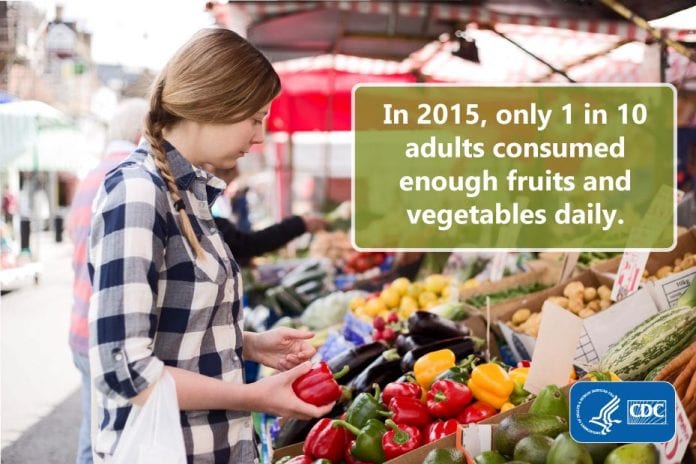
Men, younger adults, and those in poverty are consuming the fewest fruits/vegetables according to the CDC.

Just 1 in 10 adults meet the federal fruit or vegetable recommendations, according to a new study published in CDC’s Morbidity and Mortality Weekly Report (MMWR).

Depending on their age and sex federal guidelines recommend that adults eat at least 1½ to 2 cups per day of fruit and 2 to 3 cups per day of vegetables as part of a healthy eating pattern. Yet in 2015, just 9 percent of adults met the intake recommendations for vegetables, ranging from 6 percent in West Virginia to 12 percent in Alaska. Only 12 percent of adults met the recommendations for fruit, ranging from 7 percent in West Virginia to 16 percent in Washington, D.C. Results showed that consumption was lower among men, young adults, and adults living in poverty.
Very few Americans
“This report highlights that very few Americans eat the recommended amount of fruits and vegetables every day, putting them at risk for chronic diseases like diabetes and heart disease,” said Seung Hee Lee Kwan, Ph.D., of CDC’s Division of Nutrition, Physical Activity and Obesity, lead author of the study. “As a result, we’re missing out on the essential vitamins, minerals, and fiber that fruits and vegetables provide.”
Reduces risk of illness and death
Seven of the top 10 leading causes of death in the United States are from chronic diseases. Eating a diet rich in fruits and vegetables daily can help reduce the risk of many leading causes of illness and death, including heart disease, type 2 diabetes, some cancers, and obesity.

The findings indicate a need to identify and address barriers to fruit and vegetable consumption. Previous studies have found that high cost, limited availability and access, and perceived lack of cooking/preparation time can be barriers to fruit and vegetable consumption.
Strategies to increase consumption
The CDC Guide to Strategies to Increase the Consumption of Fruits and Vegetables suggests 10 strategies to increase access to fruits and vegetables, including these:
- Start or expand farm-to-institution programs in childcare, schools, hospitals, workplaces, and other institutions.
- Improve access to retail stores and markets that sell high quality fruits and vegetables.
- Ensure access to fruits and vegetables in cafeterias and other food service venues in worksites, hospitals, and universities.
To address other barriers, families can save time and money by chopping extra fruit or vegetables at one time and freezing the extra or choosing frozen or canned fruits and vegetables at the store. For more tips on convenient and affordable ways to eat a healthy diet, please visit www.choosemyplate.gov.
“Families can benefit from having healthy foods available wherever they live, learn, work, and play,” said Ruth Petersen, M.D., director of CDC’s Division of Nutrition, Physical Activity, and Obesity. “Communities, worksites, schools, hospitals, and other institutions can work together to support healthy eating for all Americans.”
CDC researchers analyzed data from the 2015 Behavioral Risk Factor Surveillance System to estimate the percentage of each state’s population meeting the intake recommendations by age, sex, race/ethnicity, and poverty-income ratio for the 50 states and District of Columbia (DC).
To learn more about how CDC works to make healthy eating and active living accessible for all Americans, visit the Division of Nutrition, Physical Activity and Obesity.