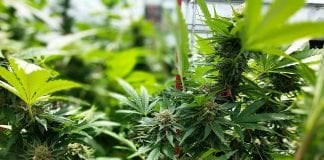
Florida’s medical marijuana law includes an exception to the ban on cannabis on school grounds. State Statute 1006.062 requires each district school board to adopt a policy and a procedure that allows a student who is a qualified patient with a medical marijuana card to use the product on campus.

For a student being treated with medical cannabis, using the medication at school is tightly restricted. Only the student’s caregiver can administer the drug, and that individual (usually a parent or guardian) must be registered with the Florida Department of Health. The medication must also be taken in a designated location and at a specific time. Smokable products are not allowed.
However, not all school districts have implemented policies as required by state law. Some cite concerns that doing so would risk federal funding because marijuana is a Schedule 1 drug and remains illegal at the federal level regardless of its use for medical reasons.

Sgt. Kyle Johnson, a K-9 officer with the Taylor County Sheriff’s Office, works as a resource officer in a school district that has not created a policy to accommodate students who are medical marijuana patients. At Taylor County High School, where he is stationed, he says there have been a couple of incidents of kids bringing medical marijuana on campus, but they took it from a family member and were not using it for its intended medicinal purpose.
“We conducted an investigation and charged them accordingly,” he says.
Sgt. Johnson says he randomly brings a drug-sniffing dog on campus and walks it through classrooms and parking lots, a practice that has “greatly deterred the use of marijuana on campus.”
“We actually had a senior a couple years ago that we’d done a vehicle walk in the parking lot, and we found some misdemeanor amount marijuana. At that point, he was fixing to graduate, hoping to go to college. So, I took my discretionary tactics on that. I let the school handle the discipline action without filing [criminal] charges on him,” he says. “He came back about a year later and hugged my neck because he actually went on to college and was able to pursue his degree without having any trouble because of that. He paid his punishment through the school.”
Concerns from health professionals
Recreational marijuana use among students is a pressing health concern for Tamara Pryor, who has been working for the last 17 years as a school nurse in Illinois. She is also a recognized expert in cannabis, nutrition, wellness, and holistic healing.
“They don’t know what’s in the product. They don’t know how much THC is in it, which is the compound of the cannabis plant that gets you high. And I’ve also found that a lot of our students are using the vapes and for me as a nurse, oil, and lungs don’t mix. And then where are they getting it? These products aren’t being tested for heavy metals and pesticides and molds or other drugs,” says Ms. Pryor.

Sgt. Johnson adds that while serving with the Taylor County Sheriff’s Office drug task force he found pot dealers spraying marijuana with roach spray to produce a more potent high.
Students taking cannabis gummies and other products
The popularity of CBD and Delta-8-infused products that look like candy raises the likelihood of students bringing them on campus disguised as snack foods.
“Gummies, they’re a hot thing because they look like normal candy, like a gummy bear or a gummy worm,” says Ms. Pryor, who has had experience with students who consumed too many edibles.
“If they overdose on edibles [containing THC], that could take six to eight hours and even longer, some even 24 hours or more, for that to leave their system. So, they’re feeling pretty horrible for a long time,” she says.
Ms. Pryor suggested that students should be taught about the endocannabinoid system, which she referred to as the “master control system for all of the other systems in our bodies,” to help protect them against depression and anxieties, two of the reasons she and Sgt. Johnson say students cite for using marijuana.
“You can actually produce your own endocannabinoids based on what you eat, your nutrition, exercise, meditation, and breath work. So, you can help your body manage your depression and your anxiety,” she says.
Visit https://bit.ly/conversationsoncannabisaugust2023 to watch MMERI’s Conversations on Cannabis Virtual Forum featuring school resource officer Kyle Johnson and school nurse Tamara Pryor talking about lawful and unlawful cannabis use among students in K-12 schools.