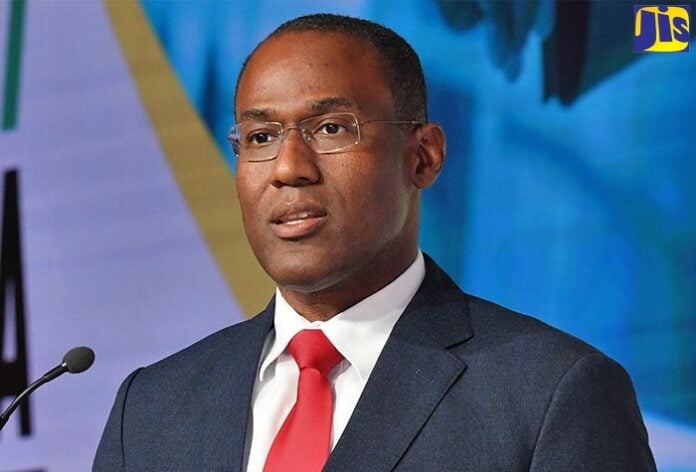
Most Jamaicans, understandably, felt a sense of pride at last week’s news that Dr. Nigel Clarke, the nation’s Minister of Finance, has been appointed by the International Monetary Fund (IMF) as a deputy managing director.
This is a highly prestigious position within the IMF, and notably, it is the first time a Jamaican has held this role, despite other Jamaicans previously holding senior positions within the organization. While Clarke deserves congratulations and well-wishes for this significant milestone in his career, it is impossible to overlook the irony surrounding his appointment.
Jamaica became a member of the IMF in February 1963 and soon after received a standby agreement for special drawing rights—a loan of US$10 million. For many Jamaicans unfamiliar with the IMF’s operations, this membership was seen positively. It was hoped that access to loans from the IMF, along with other institutions like the World Bank and the International Development Bank (IDB), would alleviate the nation’s financial challenges.

Although Jamaica experienced relative economic growth in the 1960s, the 1970s presented increasing difficulties, particularly after 1972 when the government began implementing nationwide social reforms aimed at creating a more egalitarian society. Unfortunately, this period coincided with rising global oil prices and increased costs for raw materials and consumer goods imported by Jamaica. Facing mounting national debt and a negative balance of payments, the government under Michael Manley sought to address the economic issues without resorting to IMF assistance. This reluctance stemmed from concerns about the IMF’s track record of imposing policies that often undermined social development programs in developing countries.
The IMF’s approach, likened to a vast spider’s web, involves offering loans to manage national debt and balance of payments, but with stringent conditions. These conditions often require structural adjustments—essentially the reduction of social programs and implementation of harsh economic measures like currency devaluations and wage freezes. The IMF’s goal with these adjustments is to reduce national debt, frequently at significant social costs.
The need to secure an IMF loan ultimately derailed the Manley government’s plans for socio-economic reform. The trap of the IMF’s conditions is evident: there is often little alternative for developing nations like Jamaica when faced with excessive international debt. As a result, in countries under IMF agreements, wealth becomes more concentrated among the few, while poverty and inequality persist. Successive Jamaican governments since the 1970s have had to turn to the IMF to manage national debt, resulting in underpaid teachers, police officers, nurses, and other essential public servants, a deteriorating healthcare system, and pervasive poverty and despair among Jamaican youth.

For the past six years, Nigel Clarke, a highly accomplished individual with a Rhodes Scholarship and a Doctor of Philosophy in Numerical Analysis, has served as Jamaica’s Minister of Finance and Public Service. During his tenure, Clarke has rigorously implemented IMF-mandated reforms, aiming to reduce Jamaica’s national debt to as close as possible to 60 percent of Gross Domestic Product (GDP). His success in this area has made Jamaica a model for the IMF’s belief that national debt can be managed in accordance with its stringent terms, albeit at great cost to many Jamaicans.
The IMF’s recognition of Clarke’s performance as Finance Minister is reflected in his new executive role within the organization. However, this advancement raises questions about the future of developing countries grappling with national debt and social inequalities. If there is hope that Clarke’s new position will influence the IMF to relax its harsh policies, such expectations may be overly optimistic. As he assumes his role within the IMF, Clarke will likely become enmeshed in its established practices.
Thus, while Nigel Clarke’s appointment is celebrated, it carries a sense of irony reminiscent of the historical paradox where a field slave, through exceptional service, was elevated to a prestigious position in the Great House while fellow slaves continued to endure harsh conditions in the fields.