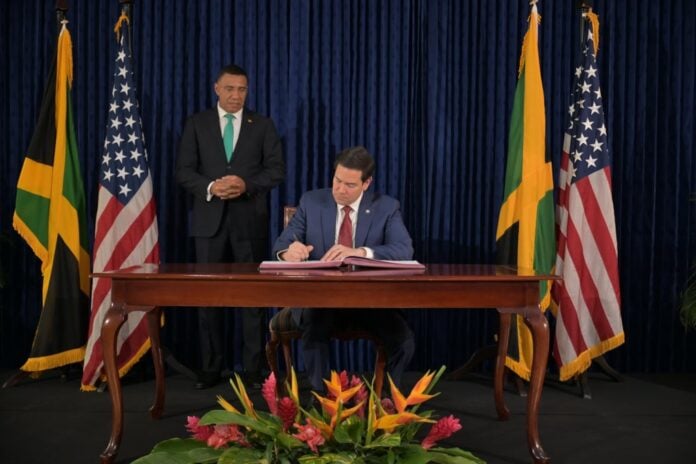
U.S. Secretary of State Marco Rubio arrived in Jamaica today for high-level discussions with Prime Minister Andrew Holness and senior government officials. Among the key topics on the agenda was the issue of travel to Jamaica, especially in light of the United States recently upgrading its travel advisories for Trinidad and Tobago to Level 3 and Haiti to Level 4.
Last year, the U.S. State Department issued a travel advisory for Jamaica, urging Americans to reconsider visiting due to rising crime and concerns over “unreliable medical services.” The advisory was met with disappointment by many Jamaican officials.
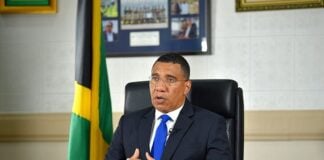
During a joint press conference following the discussions, Holness highlighted the significant progress Jamaica has made in tackling crime. “We discussed significant progress that we’ve made in bringing down all major crimes and that Jamaica is safer today than at any point in the last two decades. In fact, crimes against visitors represent less than 0.01% of the more than three million visitors to Jamaica annually. We are committed to working collaboratively to ensure that travel advisories reflect the current realities and promote travel to Jamaica,” Holness said.

He also reaffirmed Jamaica’s commitment to strengthening its partnership with the United States. “Jamaica remains committed to fostering a partnership with the United States, one that is grounded in mutual respect, shared values, and collective ambition for a strong and more resilient future.”
Rubio hails Jamaica’s crime reduction
Rubio praised Jamaica’s efforts in reducing crime and acknowledged the country’s deep ties with the United States, particularly through the Jamaican diaspora in Florida. “In my home state of Florida, there are about 800,000 to 1 million Jamaicans who call the U.S. home, just in that state. It’s a very vibrant community,” he noted.
He also addressed concerns regarding U.S. travel advisories and indicated that his department would reassess Jamaica’s current status.
“We did talk about tourism because it’s a significant part of your economy. We pledged to go back and reevaluate the travel advisories as they currently stand to ensure that they do reflect the reality of the new numbers, because you’ve made impressive progress in your general numbers overall when it comes to the murder rate and so forth. We need to analyze that and just ensure that the status we’re currently in accurately reflects and takes into account the progress you’ve already made this year and last year, which is one of the highest numbers in terms of reduction that we’ve seen in the region.”

Earlier this month, National Security Minister Dr. Horace Chang stated that Jamaica could be on track to record fewer than 1,000 murders in a single year for the first time in recent history, as the country’s homicide rate continues to decline. According to Chang, as of March, Jamaica had seen a 30.7% decline in murders since the start of the year—a record-breaking reduction. Prime Minister Holness also revealed that February 2025 saw Jamaica record just 47 murders—the lowest monthly figure in 25 years.
Beyond crime and tourism, the discussions between Holness and Rubio also covered trade, security, the global war on gangs, and foreign aid.
During his visit, Rubio is also expected to meet with Haitian officials to discuss strategies for addressing the escalating gang violence in the nation. Additionally, he will hold talks with Barbados Prime Minister Mia Mottley and Trinidad and Tobago’s newly sworn-in Prime Minister Stuart Young, focusing on the country’s energy sector and economic trajectory.
As part of his regional tour, Rubio will also visit Guyana and Suriname, with an emphasis on energy development and security partnerships.