Addressing the United Nations in 1963, Emperor Haile Selassie famously said, “Until the philosophy which holds one race superior and another inferior is finally and permanently discredited and abandoned; until there are no longer first class and second class citizens of any nation; until the color of a man’s skin is of no more significance than the color of his eyes; until the basic human rights are equally guaranteed to all without regard to race; until that day, the dream of lasting peace and world citizenship and rule of international morality will remain but a fleeting illusion, to be pursued but never attained.”

Selassie’s words are still very relevant today. But while the perpetuation of racial or ethnic superiority continues globally, it doesn’t mean the solution to this dismal situation is the perpetuation of blatant evil by any race, or people, on another.
The Israel-Palestine conflict
In 1947 the United Nations recommended the partition of then British-controlled Palestine into separate Jewish and Arab states. However, the British left the region in 1948 without acting on the separation.

In May 1948, the state of Israel was founded and recognized by the US. Immediately after there were wars between Israel and its Arab neighbors, over the Palestinians’ right to coexist peacefully as an independent state neighboring Israel.
Sadly, as more Israelites migrated to Israel following the Jewish Holocaust perpetuated by Germany in World War II, the wars between Israel and the Arabs over Palestine became more frequent and intense.
Throughout these years from 1948, Israel has grown to consider itself more powerful and superior to the increasingly marginalized Palestinians.
Today it seems most of the world, including the Caribbean, believes the solution to peaceful coexistence between Israel and Palestine is the creation of the separate states of Israel and Palestine.
Although the UN Security Council passed Resolutions supporting the two-state solution and the “right of the Palestinian people to self-determination,” the closest there has been a semblance of the two-state solution was with the Oslo Accords.
The Oslo Accords
The Oslo Accords – Oslo I Accord signed in Washington DC in 1993, and Oslo II Accord in Egypt in 1995 – marked the beginning of the Oslo Process.

The Oslo Process began with negotiations in Oslo, Norway, resulting in the recognition of Israel by the Palestinian Liberation Organization (PLO), and the recognition by Israel of the PLO as the representative of Palestinians and a partner in bilateral negotiations.
The Oslo Accords created the Palestinian National Authority which was given responsibility for conducting limited Palestinian self-governance over parts of the West Bank and Gaza Strip. However, the Oslo Accords didn’t create a separate Palestinian state.
The rise of Hamas: From militant group to political power
Many Palestinian militant groups, including a fledging group called Hamas, opposed the Accords. The opponents believed Palestinians were being marginalized by Israel and wanted a distinct Palestinian State. Militants, like Hamas, wanted Palestine to be the only state, not willing to recognize the state of Israel.
Having its origins in Egypt’s Muslim Brotherhood, Hamas saw the PLO as too compromising with Israel. It adopted a fierce nationalistic and violently active approach marked in the late 1990s and early 2000s by suicide bombings and other attacks against Israel.
Forming itself into a political group Hamas won several seats in the Palestinian Parliament in 2006, defeating the more centrist Fatah party. Subsequent clashes between Hamas and Fatah led to Fatah’s defeat by Hamas in 2007. Since then, Hamas has governed the Palestinian Gaza Strip, although not having similar power in the Palestinian West Bank. Since Hamas took control of Gaza, Israel has imposed a severe economic blockade on the territory and tried sealing its borders with Gaza.
Palestinians believe Israel has treated Gaza like an inferior slum. Some have criticized Israel as acting with ethnic superiority and using apartheid tactics against Palestinians in Gaza.
The humanitarian crisis: A Consequence of the Conflict
The extremely dense Gaza population of over 2 million is dependent on Israel for food supply, water, electricity, and other basic amenities. Although not exactly popular in Gaza, Hamas has tried transforming the region into a breeding ground of hatred, and violent retaliation against Israel.
Despite appeals from several in the international community, Israel hasn’t made any clear indications, especially in recent years, to negotiate the two-state solution, or make life easier for Palestinians in Gaza, or even the West Bank.
But the latest actions by Hamas to invade Israel’s territory adjacent to Gaza, and slaughter hundreds of Israelis, including children, women and elderly cannot be condoned.
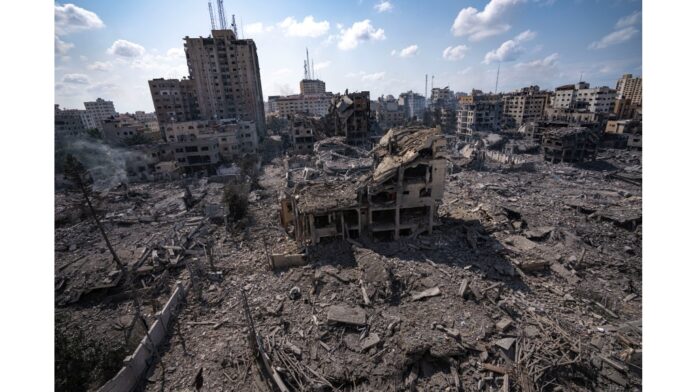
Televised reports from Israel of the actions of Hamas are displays of sheer evil. Slaughtering innocent Israeli citizens isn’t the answer to ensuring Palestine is allotted peaceful co-existence as an independent neighbor of Israel. The evil incursion by Hamas into Israel will certainly spark aggressive vengeance against Hamas.
Israel will now seek to eliminate Hamas, but with Hamas embedded among the people, innocent Palestinians will be killed. This is now a case of evil spawning more evil.
Escalating tensions
None can predict how this unfortunate situation will end.
Hamas’ actions will certainly set back Palestine’s quest for statehood in process since 1947.
Since Hamas’ attack on Israel, global sympathy is now placed with Israel. It will be difficult, if not impossible, for any external force, to mediate an agreeable settlement between Israel and Palestine in the aftermath of these evil attacks.
Using evil is not, cannot be, the resolution of conflicts between people, or international disputes.