UN warns Haiti at critical juncture as gang violence threatens election plans
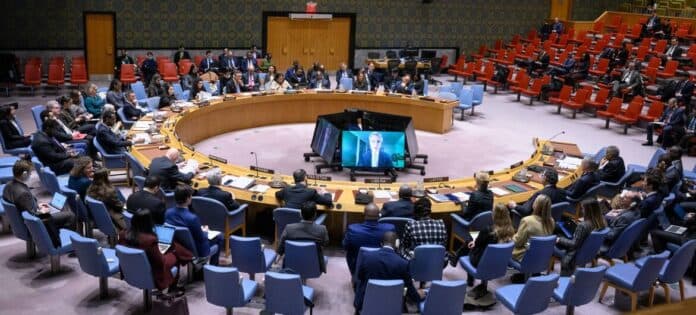
UN Photo/Loey Felipe The Security Council meets on the situation in Haiti.
Key Points(5)
- “[Haiti’s] transition stands at a critical moment,” said Carlos Ruiz Massieu, the Secretary-General’s Special Representative and Head of the UN Integrated Office in Haiti (BINUH), as he briefed the 15-member Council.
- The international community’s engagement in Haiti is longstanding.
- From 2004 to 2017, the UN deployed its Stabilization Mission in Haiti (MINUSTAH), which was succeeded by an Integrated Office in Haiti (BINUH).
- However, the country continued to be plagued by violence.
- In October 2023, the Council authorized the deployment of a Multinational Security Support — largely populated by Kenyan troops — which officially transitioned to a Gang Suppression Force through the adoption of Council resolution 2793 (2025) last September.
Haiti is facing a critical moment as it attempts to restore security and move toward elections amid persistent gang violence, political instability and a worsening humanitarian crisis, the United Nations Security Council heard on Monday.
Senior UN officials told the 15-member council that while Haiti has made some progress toward restoring democratic governance, armed gangs continue to pose the country’s greatest challenge, leaving millions displaced and struggling with food insecurity.
“[Haiti’s] transition stands at a critical moment,” said Carlos Ruiz Massieu, the UN secretary-general’s special representative and head of the UN Integrated Office in Haiti (BINUH).
Ruiz Massieu said Haiti’s transitional authorities had recently adopted a revised electoral decree and reached agreement on an electoral budget, creating a foundation for renewed momentum. However, he said the next priority is the establishment of a credible and realistic electoral calendar.
“The Haitian people have been waiting for far too long,” he said, urging the international community to ensure that recent progress translates into meaningful improvements in the lives of citizens.
The UN official warned that insecurity remains the most serious threat to Haiti’s political transition, with women and children bearing a disproportionate share of the impact from gang violence.
He said security concerns must not become a reason to delay elections, adding that the full deployment of the Gang Suppression Force (GSF) remains essential to creating conditions for a credible electoral process.
Gang Suppression Force Begins Operations
Jack Christofides, the special representative for the GSF, said the multinational force has begun operations after establishing its headquarters, command structure, intelligence systems and rules of engagement.
The force has opened its first forward operating base, launched regular patrols and carried out operations targeting gang infrastructure in parts of Port-au-Prince.
Christofides highlighted a June 21 operation in Tabarre, where the force detained suspects, removed gang barricades and destroyed hundreds of Molotov cocktails. He also said recent operations led to the seizure of weapons and ammunition and the dismantling of improvised incendiary device caches.
However, he cautioned that Haiti’s security crisis would not be resolved quickly.
The GSF was created to replace the smaller, Kenyan-led Multinational Security Support mission and has been authorised to support Haitian authorities in combating armed groups and restoring security.
UN Warns Crisis Is More Than Security Issue
Monica Juma, executive director of the United Nations Office on Drugs and Crime (UNODC), said Haiti’s crisis cannot be viewed solely as a security problem, describing it as a governance crisis driven by organised crime.
She said gangs are increasingly attempting to control not only territory but also transportation routes, economic activity and governance systems.
Juma said the crisis also has regional implications, involving illegal firearms trafficking, cocaine smuggling, migrant trafficking and maritime criminal networks.
She stressed that security operations must be accompanied by stronger courts, prisons, police institutions and financial investigations.
“Without this, security gains will be but temporary,” she said.
International Community Calls for Broader Response
Several countries told the council that while the deployment of the GSF represents progress, lasting stability in Haiti will require more than military and security measures.
France said restoring security remains Haiti’s “absolute priority” and is necessary for advancing the political transition and holding elections.
Denmark called for strict adherence to international law and urged strong oversight and transparency in the operations of the GSF.
The Dominican Republic’s Foreign Affairs Minister Roberto Álvarez Gil raised concerns about the gap between the force’s authorised strength of 5,550 personnel and the approximately 1,000 troops currently deployed.
“Time is not on Haiti’s side,” he warned, urging the international community to accelerate support for the mission.
Haiti Says Progress Is Being Made
Haiti’s Foreign Affairs Minister Raina Forbin told the council that the country is making progress toward restoring security, constitutional order and democratic governance, despite significant challenges.
“We are closer than we’ve been in years to restoring security and holding elections that are free, credible, inclusive and participatory,” she said.
Forbin highlighted efforts by Haitian authorities to strengthen security institutions, including the training of police personnel, recruitment into the armed forces, the reactivation of the National Disarmament, Dismantlement and Reintegration Commission and judicial reforms aimed at improving accountability.
She said two specialised courts have also been established to address mass crimes, sexual violence and serious financial crimes.
Forbin urged the international community to maintain its support, warning that progress remains fragile.
“Now is not the time to back down,” she said, calling for continued partnership to help Haiti move toward peace, stability and democratic renewal.