Jamaican government no longer funding diagnostic services for critically ill patients
Key Points(5)
- The project focuses on key areas negatively impacting the health sector’s ability to respond timely to the health care needs of the public patients.” One of the key areas of focus is diagnostic radiology services.
- The EHCSD Project was started in 2019 with the aim of assisting hospitals without diagnostic radiology equipment.
- He also announced that the health ministry’s budget increased from $60 billion to $145 billion over eight years.
- This is a record-breaking 241 percent increase.</p> <p class="" data-start="2076" data-end="2348">Minister Tufton told journalists, “Jamaica, right now, in terms of public health, doesn’t have a money problem.
- I am prepared to say that without apology.
A whistleblower at a Western hospital blasted the Jamaican government, stating that it has depleted its budget, which covers diagnostic radiology service fees at private institutions like Radiology West, preventing patients' access to CT scans.
Under the Jamaican government’s Enhancing Healthcare Services Delivery Project (EHCSD), often referred to as ‘assistance forms,’ patients have access to free diagnostic radiology services at private institutions like Radiology West—one of the facilities paid by the Jamaican government to offer free diagnostic services to patients and known as the leading diagnostic imaging facility providing “compassionate care” in the West.
According to the Ministry of Health and Wellness’ website, the implementation of the EHCSD project aims to reduce “waiting times for services such as admissions, as well as reducing hospital length of stay. The project focuses on key areas negatively impacting the health sector’s ability to respond timely to the health care needs of the public patients.” One of the key areas of focus is diagnostic radiology services. The EHCSD Project was started in 2019 with the aim of assisting hospitals without diagnostic radiology equipment. The project is a partnership between the public and private sectors, with 16 private service providers across the island providing national coverage of participating health facilities.
A report by the Jamaica Information Service, an executive news agency of the Jamaican government, confirmed that up to March 2023, the project helped over 120,000 persons obtain free diagnostic services.
Budget depletion
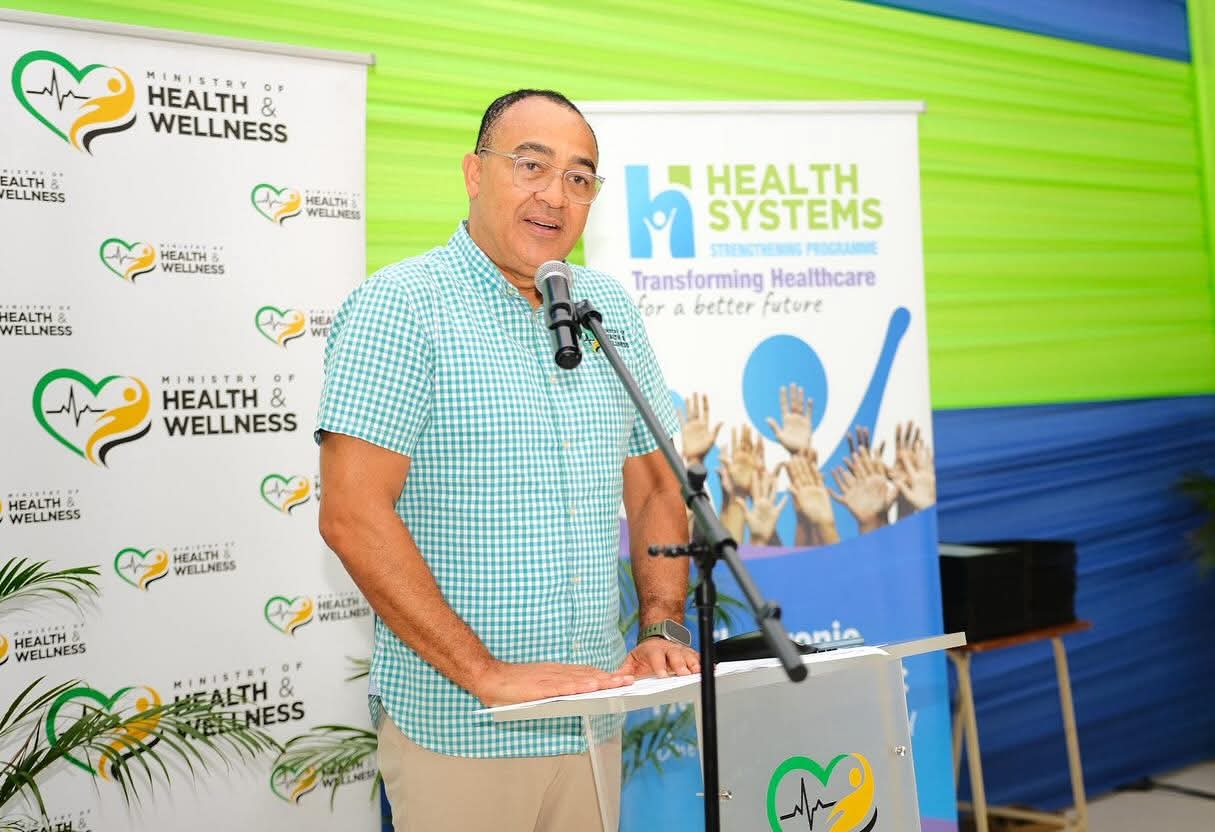
In October 2024, Minister of Health and Wellness, Dr. Christopher Tufton, at a press conference regarding facility issues at the Bustamante Hospital for Children, bragged that money is available to address issues plaguing Jamaica's health sector. He also announced that the health ministry’s budget increased from $60 billion to $145 billion over eight years. This is a record-breaking 241 percent increase.
Minister Tufton told journalists, “Jamaica, right now, in terms of public health, doesn’t have a money problem. I am prepared to say that without apology. As it relates to the basic necessities of public health … diagnostic and basic stuff, we don’t have a money problem.”
Regardless of this budget increase and Tufton’s confident assertion, the Jamaican government has discreetly limited its funding in order to control its financial obligation to private institutions offering diagnostic services. This has resulted in a longer wait time for patients to receive treatment at the hospital, as well as patients having to pay large sums of money to fund CT scans.
According to a registered nurse at a Western hospital, *Hannah Jackson, “There is currently a longer wait time for patients who require diagnostic radiology services.” She explained this is because patients are forced to pay high costs in order to obtain CT scans at private institutions like Radiology West.
An internal memo dated December 13, 2024, with the subject line "EHCSD Budget Depletion," sent from the customer care unit to a Western hospital’s management, sanctioned hospitals to categorize cases as emergency or life-threatening, or non-emergency, so that they can be prioritized. The report stated, “Due to near completion of the program’s budget, we regret to inform you that effective immediately, only emergency cases will be considered for assistance under this program.”
However, Nurse *Jackson said she has not seen any emergency case prioritization at the hospital. She explained they stopped the program entirely.
“Mi want this to be exposed. They are doing damage control. They are no longer using assistance forms at all. Them all have to find new place . They even had to send a patient to St. Ann because the place stopped accepting them,” Jackson said.
One customer service representative from a Western hospital called his “boss” mid-interview to ask whether or not he could disclose information regarding updates on Radiology West’s non-acceptance of assistance forms from patients. He was warned not to disclose the information.
Denying patients compassionate care
According to the nurse, *Jackson, an ambulance transporting a critically ill patient from the hospital to Radiology West in St. James for diagnostic testing was forced to turn back and return the patient to the hospital. Radiology West was compelled to terminate its acceptance of patients in need of care because the facility can no longer accept assistance forms. The institution called the hospital while the patient was being transported to inform them of this change.
Representatives from Radiology West did not deny that this happened but refused to speak much on the matter. The report from one representative is that patients are denied compassionate care at the facility due to matters outside their control.
“We no longer accept assistance forms due to matters outside our control. You have to do with cash,” the representative explained.
However, Nurse *Jackson explained that the reason for Radiology West's rejection of patients is that the Jamaican government cannot afford to pay the facility for its services.
“Government is not paying, so the facility operators stopped services to patients,” she revealed.
*Patrice Dunkley, a friend of a patient who was admitted to hospital, said the same thing. “The government decided to stop paying for it, they claim they don’t have enough funds.” Dunkley started investigating why her loved one could not get government funding for a CT scan in February and learned this.
Delayed treatment and expensive fees
Treatment to alleviate patients’ critical conditions is delayed because of the Jamaican government’s lack of funding for radiology services. Obtaining a CT scan at a private institution can cost up to 100,000 JMD.
Twenty-six-year-old Paul Smith* is being treated for a gunshot wound to his leg. He is unable to walk and move freely because he has a broken arm and a bullet embedded in his thigh. He was told by his doctor that he needed to find $100,000 in order to obtain a CT scan by the end of the week. This is because the doctor needs to ascertain how to move forward with the treatment of his gunshot wound.
*Smith complained about how difficult it has been to source the $100,000. He said his family is trying to sell a car, but they have not found a buyer. They are also searching for a facility that offers the CT scan at a more reasonable price.
“Mi cannot find it [$100,000] at the moment. A nuh any and anybody can find $100,000,” *Smith asserted.
He said the long wait has been a stumbling block, and he is displeased with the current lack of funding for CT scans.
“Only thing leff fi do a just the CT scan so that them can move on. It kinda mek mi feel down because mi have mi business fi deal with. Mi feel disappointed knowing that the government usually deal with it and it stop. It’s just overwhelming fi know seh something wah did a give free, we affi start pay fi it right now,” he expressed.
Aquiah Taylor, parent of six-year-old patient Kian Gordon, who was admitted for dizziness, vomiting, and fainting and told by physicians to obtain a CT scan, said provisions should be made to lessen the pressure on the patients and their families.
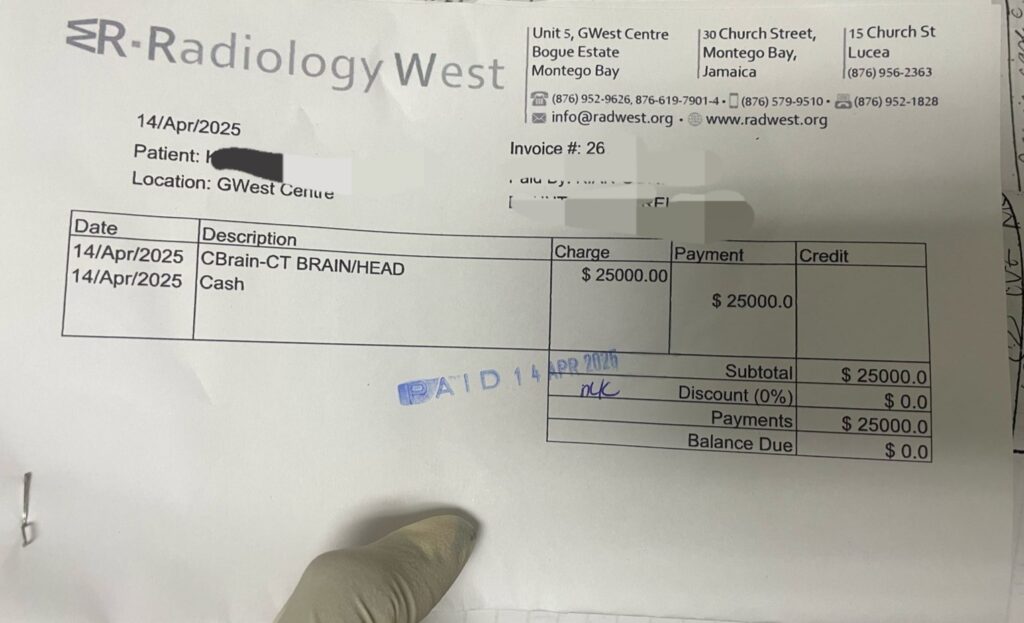
“$25,000 mi end up pay. In the country, it’s that bad? Come on man. At least pay a percentage of it. Is not everybody can afford it,” Taylor said.
Representatives from the Compassionate Care Department of the WRHA explained that assistance forms are given based on the patients’ condition. This is a new policy introduced discreetly.
“They are operating on an emergency care basis. At this time, they are only dealing with emergency situations, so life and death,” the representatives said.
WRHA explained this is done because of limited funding, and it has been going on for months.
Patients can get funding on the basis that their condition is “life or death,” and they obtain this through the Customer Care Department within the hospitals. The process includes completing a Diagnostic Radiology Services Request Form or the EHCSD form, which needs to go through three levels of approval, first by the physician. It should also be signed by a consultant, then ultimately by a senior medical officer, director of patient affairs, or the chief executive officer of the hospital. According to WRHA, additional documents may be required, and all documents should certify that the patient is in an emergency situation before diagnostic testing can be done.
Through the EHCSD project, the Jamaican government covers over 61 CT scans, over 60 MRI tests, close to 90 X-rays, 51 types of ultrasounds, fluoroscopy, mammograms, histopathology, angiography, and endoscopy.
Health crisis in Western Jamaica
According to its website, the Western Regional Health Authority (WRHA) prides itself on maintaining “the reputation of being the forerunner in the provision of quality health care in the island.” Despite this—and behind the strategic communication from the public relations manager at WRHA, Shavelle Mayler, and the rehearsed responses from the compassionate care and customer service representatives across the hospitals and at WRHA—a crisis is being hidden in the West, as critically ill patients experience delayed care and are forced to cover expensive diagnostic radiology service fees.
With the rehabilitation and redevelopment project at Cornwall Regional Hospital, the only Type A hospital in Western Jamaica, and one of two on the island, still underway since its lengthy renovation project started in 2017, coupled with the current health ministry’s money problem, healthcare in Western Jamaica is indisputably struggling.
A Jamaica Gleaner report in March revealed that the CT scan machine at Cornwall Regional Hospital is not being used due to the lack of a backup battery, forcing cancer patients to deal with the emotional and financial stress of having to obtain CT scans at private institutions.
In March, Opposition Spokesperson on Health, Dr. Alfred Dawes, described the issues within the hospitals—including challenges at Cornwall Regional Hospital—as a crisis, but Minister Tufton fired back, calling it an exaggeration.
Editor's Note: Names marked with an asterisk (*) have been changed to protect the identities of individuals interviewed for this story.