Caribbean faces critical health worker shortage, PAHO warns
Key Points(5)
- The Caribbean is among the regions most affected by a widening shortage of health workers, according to a new report from the Pan American Health Organization (PAHO).
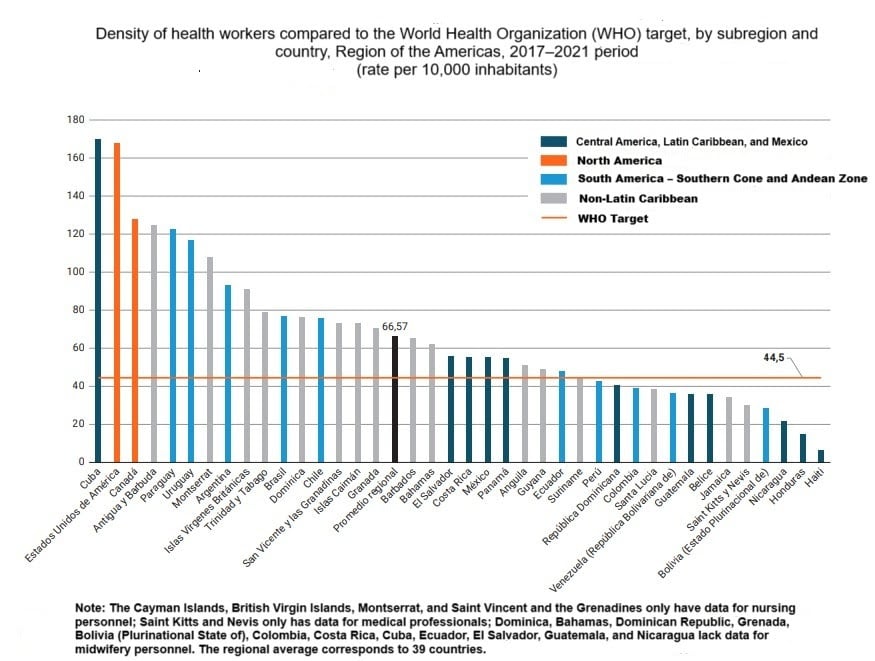
- Haiti, with only 6.38 health workers per 10,000 population, is at the bottom of the regional scale.
- Lucia, Dominican Republic, and St.
- Kitts and Nevis also fall below the WHO benchmark of 44.5.
- These figures reflect deep structural inequalities that, if left unaddressed, could severely compromise access to essential health services.
The Caribbean is among the regions most affected by a widening shortage of health workers, according to a new report from the Pan American Health Organization (PAHO).
The report, The Health Workforce in the Americas: Regional Data and Indicators, reveals that 14 out of 39 countries in the Americas—including several in the Caribbean—do not meet the World Health Organization’s (WHO) minimum threshold of 44.5 health professionals per 10,000 people.
Haiti, with only 6.38 health workers per 10,000 population, is at the bottom of the regional scale. Jamaica, Belize, St. Lucia, Dominican Republic, and St. Kitts and Nevis also fall below the WHO benchmark of 44.5. These figures reflect deep structural inequalities that, if left unaddressed, could severely compromise access to essential health services.
“The health workforce is the backbone of our health care systems; without health care workers, it is simply not possible to speak of universal access or universal coverage,” said PAHO Director Dr. Jarbas Barbosa. The Americas, he added, face a projected shortfall of between 600,000 and 2 million health workers by 2030.
While the regional average stands at 66.57 health workers per 10,000—comfortably above the WHO target—Caribbean nations tell a more troubling story. In contrast to Haiti and others struggling to meet the standard, Cuba emerges as a leader, with one of the highest densities in the entire hemisphere—over 160 health workers per 10,000 people.
PAHO attributes these disparities to a combination of factors: limited training capacity, an aging workforce, and especially migration, which continues to drain the Caribbean of qualified professionals. The report also highlights the unequal distribution of workers within countries, which often leaves rural or marginalized communities underserved.
Midwifery, for instance, shows a relatively strong presence in English-speaking Caribbean nations like Antigua and Barbuda, but remains underdeveloped elsewhere in the region. Data on community health workers, key to delivering care in low-resource settings, is available in only a handful of Caribbean countries. And while nurses—who make up the majority of the region’s health workforce—are predominantly female, many Caribbean nations report nurse-to-population ratios far below the regional norm.
Dr. James Fitzgerald, Director of PAHO’s Department of Health Systems and Services, called the report a “compass” for governments. “With strong information systems and technical cooperation, we can train more professionals and bring them to where they are most needed,” he said.
To address the looming crisis, PAHO is calling for targeted investment in training programs, better working conditions, and strategies to retain talent, particularly in underserved areas. The organization also recommends strengthening health workforce data systems to guide evidence-based policymaking.
“The challenge is not just to have more health professionals,” Dr. Barbosa concluded, “but to ensure that they are where they are most needed and that they have the right skills to meet the demands of the population.”