Palm Beach County officials announced that warming centers will open Thursday morning to provide relief for unsheltered residents as a surge of unseasonably cold weather settles across South Florida.
The county, working in partnership with community organizations, will open two locations where individuals can seek shelter from the cold:
Salvation Army Center of Hope, 1577 N. Military Trail, West Palm Beach, will be open from 7 a.m. to 9 a.m.
The Lord’s Place, 2808 N. Australian Avenue, West Palm Beach, will be open from 8:30 a.m. to 4 p.m.
Residents who need assistance with transportation to either warming center are encouraged to call 211 for support.
County officials said Palm Beach County will continue to monitor weather forecasts from the National Weather Service and will open additional shelters or warming centers as necessary in the coming days.
The cold snap follows the arrival of much colder air that began impacting South Florida—including Miami and Fort Lauderdale—starting Monday night, in the wake of a historic winter storm that affected large portions of the central and eastern United States. According to the Climate Prediction Center, there is an elevated probability of well below-average temperatures across South Florida throughout the week.
Forecasters are calling for colder overnight lows, reinforcing cold fronts through midweek, and the possibility of a stronger Arctic blast next weekend. If that system materializes, it could bring some of the coldest temperatures seen in Miami and Fort Lauderdale in more than 15 years, marking an unusually cold end to January and start to February for the region.
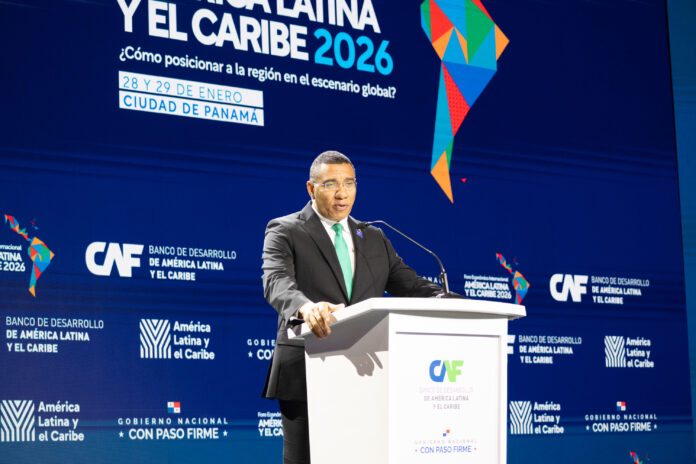
Jamaica’s Prime Minister, Andrew Holness, on Wednesday called on Latin America and the Caribbean to position itself more assertively as a central force in the global economy, urging the region to move beyond what he described as a long-standing narrative of vulnerability.
Speaking at the opening ceremony of CAF’s second International Economic Forum in Panama City, Holness told an audience of regional and international leaders, policymakers, investors, and development partners that the region faces a defining choice: to shape global change or be shaped by it.
“For too long, our region has been described primarily through the language of vulnerability,” Prime Minister Holness said. “But vulnerability is not destiny. We are not peripheral to the global system; we are central to its stability, sustainability, and future growth.”
Holness pointed to Latin America and the Caribbean’s strategic geography, youthful populations, natural resources, food-producing capacity, renewable energy potential, creative industries, and resilient democratic institutions as key strengths. He said harnessing these advantages requires stronger regional coordination and clearer alignment on shared priorities.
“We must articulate clearer regional positions on climate resilience, supply-chain diversification, digital inclusion, and sustainable energy,” he stated. “We must move from fragmented national initiatives to aligned regional priorities. And we must shift from reacting to global change to anticipating it, helping shape the standards and partnerships of the next decade.”
The Jamaican leader outlined three imperatives to advance the region’s economic standing: a competitiveness agenda focused on connectivity, logistics, energy security, and digital transformation; institutional readiness grounded in credible and predictable frameworks; and a renewed diplomatic and economic posture that deepens engagement with both traditional partners and emerging markets.
Drawing on Jamaica’s experience, Holness said sustained fiscal discipline, institutional reform, and macroeconomic stability have strengthened the country’s ability to absorb shocks and recover from crises. He cited Jamaica’s response to Hurricane Melissa—a Category Five storm that struck months ago and caused significant damage and economic losses—as an example of resilience supported by strong institutions and continued international confidence.
Holness also used the forum to invite investors and development partners to engage with Jamaica’s expanding pipeline of bankable projects in sectors including infrastructure, logistics, energy, manufacturing, tourism, and the digital economy. He encouraged participants to see Jamaica not just as a market, but as a platform for regional growth, supported by macroeconomic stability and a predictable, investor-friendly environment.
As part of the forum’s programme, CAF has organized a Jamaica Investment Forum in collaboration with the Government of Jamaica, aimed at attracting investment to support the island’s rebuilding drive.
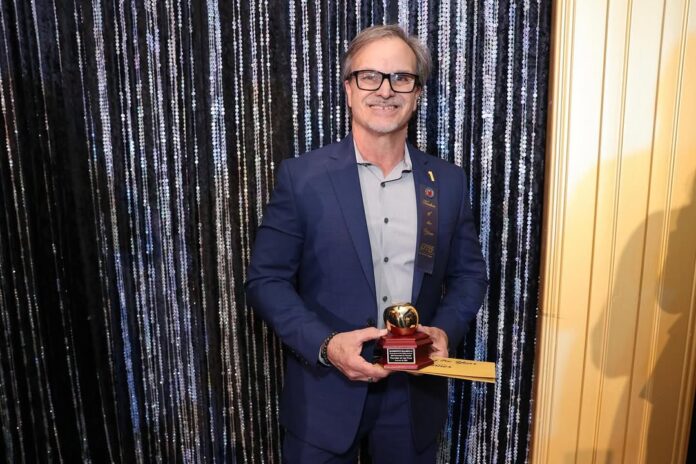
Veteran educator Roberto Rabelo and first-year standout Kristian Jose Luciano were named Miami-Dade County Public Schools’ top teachers for 2027 during an awards ceremony held this evening at the DoubleTree by Hilton Miami Airport & Convention Center.
Rabelo, a social studies and civics teacher at South Miami Middle Community School, was named the district’s Francisco R. Walker Teacher of the Year, the highest honor awarded by M-DCPS. A 37-year classroom veteran, Rabelo has built a reputation for mentoring students and fostering both academic success and personal growth.
Rabelo traces his decision to become an educator to his mother, who cared for his brother, Lazaro. His teaching career began at Kensington Park Elementary School — the same school his brother attended — where he was recognized as Rookie Teacher of the Year in 1993.
At South Miami Middle, Rabelo founded the DWOW Mindset of Success — “Do What Others Won’t”, an approach that has delivered measurable academic gains. In one year, Civics End-of-Course exam scores rose from 64% to 83%, surpassing results from advanced classes.
Beyond academics, Rabelo is known for emphasizing social-emotional learning. Often referred to as the school’s “Social Learning Guru,” he launched student-led initiatives such as The Power of One and ICLK (Inspiring Compassion, Love, and Kindness), both of which promote community service and positive school culture.
The Teacher of the Year runner-up was Dale J. Adamson, a robotics and engineering teacher at Howard D. McMillan Middle School.
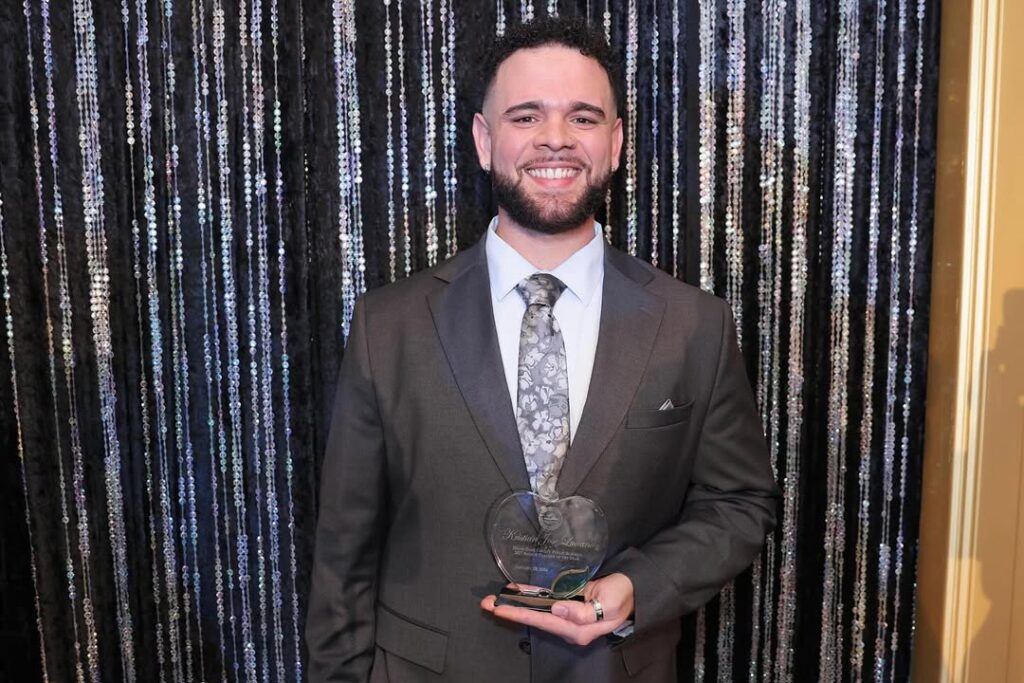
The district also recognized its top new educator, naming Kristian Jose Luciano, a social studies teacher at Homestead Middle School, as M-DCPS 2027 Rookie Teacher of the Year.
Luciano teaches seventh- and eighth-grade students and is known for blending high expectations with compassion, drawing on personal experiences to motivate students. His impact has been reflected in student outcomes, including a 14-percentage point increase in Civics End-of-Course exam scores in 2025.
In addition to serving as Social Studies Department Chair, Luciano sponsors the school’s National Junior Honor Society chapter and mentors fellow educators. He also volunteers as a Guardian ad Litem, advocating for children in the foster care system.
The Rookie Teacher of the Year runner-up was Katherine Ocejo, a kindergarten teacher at Ernest R. Graham K-8 Academy.
Signature sponsors for the event included Educational Federal Credit Union, United Way Miami and Kendall Toyota, which will present the Teacher of the Year with a new vehicle. Additional partners included United Teachers of Dade, the Miami-Dade County Council of PTAs/PTSAs, the Dade Association of School Administrators, Univision and Fox-Mar Photography.
Trinidad-born rapper Nicki Minaj openly declared herself President Donald Trump’s “number one fan” on Wednesday, using a Treasury Department event to praise the former president and urge supporters to defend him against “smear campaigns.”
Flashing her signature glittery, two-inch nails, Minaj, 43, held Trump’s hand on stage and told the audience, “I am probably the president’s number one fan, and that’s not going to change.” She added that critics and online detractors only motivate her to show stronger support. “The hate or what people have to say, it does not affect me at all,” she said. “It actually motivates me to support him more.”
The hip-hop star, known for her fierce independence and chart-topping hits such as Super Bass and Beez in the Trap, received a kiss on the cheek from Trump before delivering her remarks. “We’re not going to let them get away with bullying him,” Minaj told the crowd. “And you know, the smear campaigns, it’s not going to work. He has a lot of force behind him and God is protecting him. Amen.”
Minaj’s appearance came as she contributed hundreds of thousands of dollars to the newly launched “Trump Accounts” for children, federal investment accounts seeded with $1,000 for each newborn. Speaking about the initiative, Minaj emphasized financial literacy: “[There’s] almost nothing greater than teaching financial literacy to young people,” she said. Reflecting on her own upbringing, she added, “I got out of high school and I thought everything was just going to be smooth sailing, but I realized quickly, ‘No, I have to work.’ I had to figure things out on my own if I wanted to live a certain way. And that’s what I did. But if I had access to something like this, my whole life would have been different.”
Trump, 79, returned the admiration with a compliment of his own, joking about Minaj’s nails: “I am going to let my nails grow, because I love those nails.” The pair held hands on stage for roughly 30 seconds as Kevin “Mr. Wonderful” O’Leary of Shark Tank also addressed the audience.
Though Minaj never endorsed Trump in his three presidential campaigns, she has publicly praised him in the past, including last year for defending Nigerian Christians facing violence from Islamic extremists.
Hours after taking the stage, the rapper shared a photo on X showing her holding a gold card featuring Trump’s face, his signature, and the words “45th & 47th President of the United States.”
The card closely mirrors the branding of Trump’s Gold Card initiative — an immigration program launched by executive order in September 2025 that gives wealthy foreigners a fast-track route to U.S. residency and citizenship in exchange for a $1 million federal contribution.
Wednesday’s event marked a highly visible show of support from the pop culture star, blending politics, celebrity, and advocacy for youth financial empowerment.
Governor of Maryland Wes Moore (right), who is of Jamaican heritage, escorts Mrs. Sonia Ward, the widow of Jamaican Ambassador Curtis Ward, into the sanctuary of St. Andrew Apostle Catholic Church in Silver Spring, Maryland, before the commencement of the memorial service for the late Ambassador Ward. At left is the mother of Governor Moore, Mrs. Joy Moore. Photo by Derrick A Scott.
Hundreds of mourners defied sub-freezing temperatures, journeying from near and far to pack Saint Andrew’s Apostolic Catholic Church in Silver Spring, Maryland, last Saturday to pay final tribute to Ambassador Curtis “Rustie” Ward — distinguished attorney, diplomat, and tireless champion of the Caribbean diaspora whose voice resonated from the corridors of the United Nations to the living rooms of Jamaicans scattered across the globe.
The gathering reflected the remarkable breadth of Ambassador Ward’s influence. Heading the list of mourners were Jamaica’s Ambassador to the United States, His Excellency Antony Anderson; Maryland Governor Wes Moore (who is of Jamaican heritage); and members of the diplomatic corps, who filled the pews alongside presidents and members of various diaspora organizations and Caribbean nationals from every walk of life — a testament to a man whose impact transcended the formal boundaries of his diplomatic portfolio.
A son of St. Elizabeth who carried Jamaica to the world
Tributes painted a portrait of a man whose journey from Treasure Beach to the world stage never diminished his connection to home. Former Prime Minister P.J. Patterson’s tribute, read at the service by Ms. Franciene Chin, captured this duality with characteristic eloquence, describing Ward as “a son of Treasure Beach who carried the best of our nation to the world stage, and who never forgot where he came from or whom he served.”
Patterson recalled appointing Ward as Ambassador and Deputy Permanent Representative to the United Nations with special responsibility for Security Council Affairs in 1999, noting that Jamaica had needed “someone of high intellect, unwavering principle, and endowed with masterly command of international law.” Ward proved himself precisely that during Jamaica’s tenure on the Security Council from 2000 to 2001, helping to navigate the global response to the September 11 attacks and drafting critical counter-terrorism resolutions.
“Jamaica has lost a noble avatar,” Patterson declared. “Let us strive to honour his memory by perpetuating the exemplary standards of truth, courage, and service that Curtis Ward embodied throughout his remarkable life.”
Speaking truth without fear
Opposition Leader Mark Golding’s tribute illuminated the personal dimension of Ward’s influence. Golding revealed, in a message read publicly by Ibrahim “IB” Konteh, Vice President of the People’s National Party (PNP) Patriots, that Ward had corresponded with him via WhatsApp on a daily basis since Golding became PNP President in 2020, offering counsel that helped shape his thinking on critical issues.
“He understood power, but he was never impressed or overwhelmed by it,” Golding shared. “He understood influence and always used it responsibly.”
Golding noted that Ward’s commitment to uplifting public understanding continued until his final hours, describing him as “a trusted and powerful voice for reason, justice, and proportionality in global affairs.” The Opposition Leader also credited Ward with playing a major role in the success of the PNP’s Diaspora Tour of the U.S. Eastern Seaboard in 2022.
Jamaica’s Ambassador to the United States, His Excellency Antony Anderson, conveyed condolences in a letter to the widow, Mrs. Sonia Ward.
Jamaica’s Ambassador to the United States, His Excellency Major General (Ret’d) Antony Anderson. Convey words of comfort to Mrs. Sonia Ward, the widow of Ambassador Curtis Ward.
“The Caribbean, academic, and legal communities throughout the Washington, D.C., Maryland, and Virginia area have indeed suffered a profound loss,” Ambassador Anderson wrote. “Ambassador Ward’s life was distinguished not only by devoted service to Jamaica, but also by his steadfast contributions to the Caribbean and the wider international community. A champion of diaspora engagement, he served with dedication on the Maryland Commission on Caribbean Affairs, where he advanced the social, cultural, and economic interests of Caribbean people. In every role, he represented Jamaica with distinction, integrity, and pride.”
Family and community remember
The most poignant moments came from Ambassador Ward’s daughters — Myesha, Tamara, and Sone Kareem — who shared intimate reflections on a father whose public service never overshadowed his devotion to family. Their tributes reminded mourners that behind the lawyer, diplomat, and analyst was a man who understood, as those close to him noted, that “the true measure of a life is not found solely in accomplishments or accolades, but in the values lived out daily, the love given freely, and the integrity maintained consistently.”
The diaspora community Ward championed so fiercely was well represented among those offering tributes. Rev. Larry Walker, Executive Director of the Governor’s Office of Community Initiatives, spoke of Ward’s lasting impact. Irwine Clare Sr., Co-founder and Managing Director of Caribbean Immigrants Services, captured what made Ward irreplaceable:
“He was one of our top servants in the global space — a person who was in the right place at the right time, and who was prepared to speak frankly on many issues when many others were afraid to do so.”
Rick Nugent, President of the Jamaica Association of Maryland, joined Larry Sindass, Founder and President of Caribbean Nation Television; Chris Gardiner, Co-founder of the Caribbean American Organization; and Venice Mundle Harvey, former Co-Chair of the Caribbean American Advisory Group, in honouring a man who believed that Jamaica does not end at its shores.
Children of the late Ambassador Curtis Ward, daughters Myesha, Tamara Sone, and son Kareem Ward, pay glowing tribute to their father.
Honours for a life of service
Governor Moore personally presented Mrs. Ward with a citation. She was also presented with citations from U.S. Congresswoman Yvette Clarke, Washington, D.C. Mayor Muriel Bowser, and other dignitaries — formal recognition of a partnership that sustained Ambassador Ward through decades of service.
Governor Moore’s citation praised Ward for his leadership and integrity, describing him as “someone who embodies the true meaning of public service,” and noting that he had personally benefited from Ward’s guidance while acknowledging his decades of service to the Caribbean community.
Attorney Gabriel Christian delivered the eulogy, weaving together the threads of a life that spanned continents and touched countless souls — from the Free Place Scholar of 1957 who believed he had to give back what he had gained, to the elder statesman whose analysis helped shape understanding of an increasingly complex world.
As mourners filed from the church into the Maryland afternoon, they carried with them the memory of a man who proved that courage and principle need not yield to convenience or power.
Ambassador Ward is survived by his widow, Sonia Ward, and his daughters, Myesha, Tamara, and Sone Kareem.
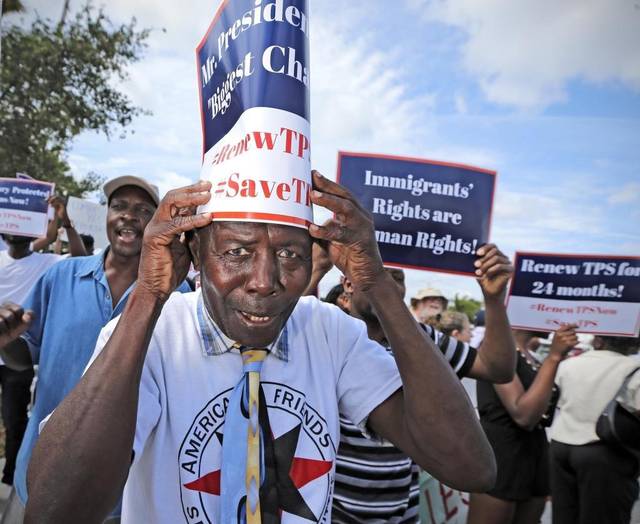
Temporary Protected Status (TPS) for Haitian nationals living in the United States is scheduled to expire on Feb. 3, 2026, raising concerns for hundreds of thousands of people who have relied on the humanitarian immigration programme for years.
The Department of Homeland Security (DHS) announced in late 2025 that it would terminate Haiti’s TPS designation, concluding that Haiti no longer meets the qualifications for the programme and that allowing Haitian nationals to remain temporarily in the United States is “contrary to the national interest.” Under that decision, around 330,000–350,000 Haitian nationals currently holding TPS are expected to lose their legal status and work authorisation if they do not secure another lawful immigration status by the February deadline.
TPS was first granted to Haitians after the devastating 2010 earthquake and has been repeatedly extended in response to conditions including natural disasters, political instability and prolonged gang violence.
A federal court ruling in 2025 blocked an attempt by DHS to end the programme early, keeping protections in place through Feb. 3, 2026. Advocates and legal experts say those protections are now set to expire unless further legal action or policy changes occur.
Community impact and responses
The looming expiration has already sparked fear and uncertainty within Haitian diaspora communities across the U.S. In South Florida, for example, many Haitian residents have expressed anxiety about losing legal status and being forced to choose between returning to Haiti — where violence and insecurity persist — or attempting to find alternative immigration pathways.
Lawmakers have also raised alarms. In Massachusetts, U.S. Senator Ed Markey and Representative Ayanna Pressley criticised the move, warning that letting TPS lapse could disrupt families and undermine contributions by Haitian nationals working in essential sectors such as healthcare and elder care.
Rep. Pressley has pushed a discharge petition in the U.S. House of Representatives aimed at forcing a floor vote on legislation to extend TPS for Haitian nationals for three years, arguing that Congress should act if the executive branch does not.
Legal and policy context
TPS is a form of humanitarian relief that allows nationals of designated countries to live and work in the United States when their home countries are experiencing conditions that make safe return impossible. Ending the programme means TPS holders would lose their protection from deportation and their right to work unless they qualify for another form of status, such as asylum, family-based visas, or employment-based immigration categories.
The DHS notice to the Federal Register makes the Feb. 3, 2026, termination date official, and legal experts say Haitian TPS holders should begin planning for possible changes now — including checking eligibility for other immigration options or seeking legal assistance.
With the deadline approaching in just over a week, advocates and legal groups are continuing to challenge the termination in court and push for legislative action. Meanwhile, Haitian TPS holders and their families are preparing for uncertainty, with many worried about the potential consequences for their livelihoods and futures if protections are not extended.
Minister of Culture, Gender, Entertainment and Sport, Hon. Olivia Grange (right), is joined by inaugural Reggae Month Ambassador and Recording Artiste, Etana (centre),and Managing Director of J. Wray and Nephew Limited, Daniel Caron, at the official launch for Reggae Month 2026, at the J. Wray and Nephew corporate office in New Kingston, on January 21.
Reggae singer Etana has been named the first official Reggae Month Ambassador as Jamaica prepares to mark the 17th anniversary of the declaration of February as Reggae Month.
The announcement was made on Wednesday, Jan. 21, during the official launch of Reggae Month activities at J. Wray and Nephew Limited’s head office in New Kingston, hosted by the Ministry of Culture, Gender, Entertainment and Sport.
Culture Minister Olivia Grange said Etana’s appointment reflects the continued emphasis on reggae’s cultural impact and its role in shaping future generations of Jamaican music.
More than 60 events have been registered with the Reggae Month Secretariat for this year’s celebrations, which officially begin on Sunday, Feb. 1, with a church service at Fellowship Tabernacle on Fairfield Avenue in Kingston. The day will also include a tribute to the late Dennis Emmanuel Brown, the Crown Prince of Reggae, at Heroes Park.
Minister Grange also announced that the annual Bob Marley Tribute Concert will be held on Feb. 6 at Emancipation Park, with Stephen Marley making a special appearance. “He will be the featured Marley at the celebration but the concert will [also] bring together overseas acts… . They will be standing alongside our local talent in a powerful reminder that reggae is global but its soul remains Jamaican,” she said.
As Reggae Month continues, Dancehall Week will run from Feb. 22 to March 1, while the next generation of reggae artistes will be highlighted at the Young Reggae Ambassadors showcase in Negril, Westmoreland, on Feb. 24. Minister Grange said initiatives such as Children of the Icon and Young Reggae Ambassadors are critical to ensuring the future of the music.
“As more senior pioneers of Jamaican music pass on, it is important that we promote and highlight the next generation,” Grange said. “We want to ensure that when we leave, we leave the music in good hands.”
Several events are also planned for western Jamaica, including the Waves One Love Jerk Fest and MoBay Reggae Night in St. James.
Minister Grange noted that this year’s celebrations mark several milestones, including eight years since reggae music was inscribed on UNESCO’s Representative List of the Intangible Cultural Heritage of Humanity, 10 years since Kingston was designated a UNESCO Creative City, and 17 years since Reggae Month was officially proclaimed.
“This year, we celebrate eight years since our music has been inscribed by UNESCO… so we have a lot to celebrate. Reggae is Jamaica’s heartbeat and an important force in global culture,” she said.
She added that the Month’s observance comes at a challenging time for the country and the wider world, underscoring reggae’s healing power.
“Our reggae music is therapy; we turn to this music in the good and in the bad times. The rhythm, our rhythm, and the lyrics provide relief and inspiration,” Grange said.
The full schedule of Reggae Month activities is available on the Reggae Jamaica App, which can be downloaded free from the App Store and Google Play.
UN Photo/Loey Felipe The Security Council meets on the situation in Haiti.
The Security Council–endorsed United Nations Support Office in Haiti is on track to deliver assistance for the Haitian people, according to UN Spokesperson Stéphane Dujarric.
Speaking on Wednesday, Dujarric said the office, which was established through a Security Council resolution in September, will provide support to Haiti’s newly formed Gang Suppression Force as well as the UN’s political mission in the country, the United Nations Integrated Office in Haiti (BINUH).
Dujarric reported that Stephen McOwan has been selected as interim director of the Support Office and joined approximately 37 staff members who are already operational in Port-au-Prince, having arrived over the weekend.
He also noted that a second office was established last week in Santo Domingo, the capital of the neighbouring Dominican Republic, to provide logistical support, including resources, financial services and travel coordination. The Dominican Republic will also serve as a designated medical evacuation location, should the need arise.
In terms of operational capacity, Dujarric said the first air asset—a helicopter—has now arrived in Port-au-Prince. Additional equipment is expected to be delivered from the UN Logistics Base in Brindisi, Italy, as well as from the United Nations’ recently closed mission in Iraq, UNAMI.
The Support Office is intended to strengthen international assistance to Haiti amid ongoing security challenges and efforts to restore stability in the country.
CARICOM Chair, the Honourable Dr Terrance Drew, is scheduled to make an official visit to Trinidad and Tobago this week, where he will meet with Prime Minister, the Honourable Kamla Persad-Bissessar, and members of her administration.
The visit, dated Jan. 28, forms part of Dr Drew’s ongoing efforts to hold face-to-face discussions with regional leaders on CARICOM priorities and regional cooperation.
Dr Drew will be accompanied by CARICOM Secretary-General Dr Carla Barnett.
The meeting in Port of Spain follows recent engagements under the Chair’s outreach initiative. Last week, Dr Drew and Dr Barnett met with the new Prime Minister of St Vincent and the Grenadines, Dr the Honourable Godwin Friday, in Kingstown.
Regional context and recent developments
Trinidad and Tobago’s relationship with CARICOM has gained heightened attention recently amid broader regional discussions on security, economic cooperation, and strategic partnerships. In late 2025, Prime Minister Persad-Bissessar signalled a significant shift in the country’s foreign policy, stating that Trinidad and Tobago will realign its approach and pursue new partnerships beyond the region while emphasising national security priorities.
At the same time, Trinidad and Tobago continues to play a constructive role in CARICOM’s economic and integration agenda. The country has been actively involved in efforts to strengthen the CARICOM Single Market and Economy (CSME), which aims to deepen regional trade, labour mobility and economic resilience.
Trinidad and Tobago has also called for more effective collaborative measures against transnational crime, urging CARICOM and other regional partners to strengthen joint actions to address narcotics trafficking, human trafficking and related challenges affecting the region.
With these developments in the background, Dr Drew’s visit underscores efforts to maintain dialogue and cooperation within CARICOM, even as member states navigate shifting geopolitical and domestic priorities.
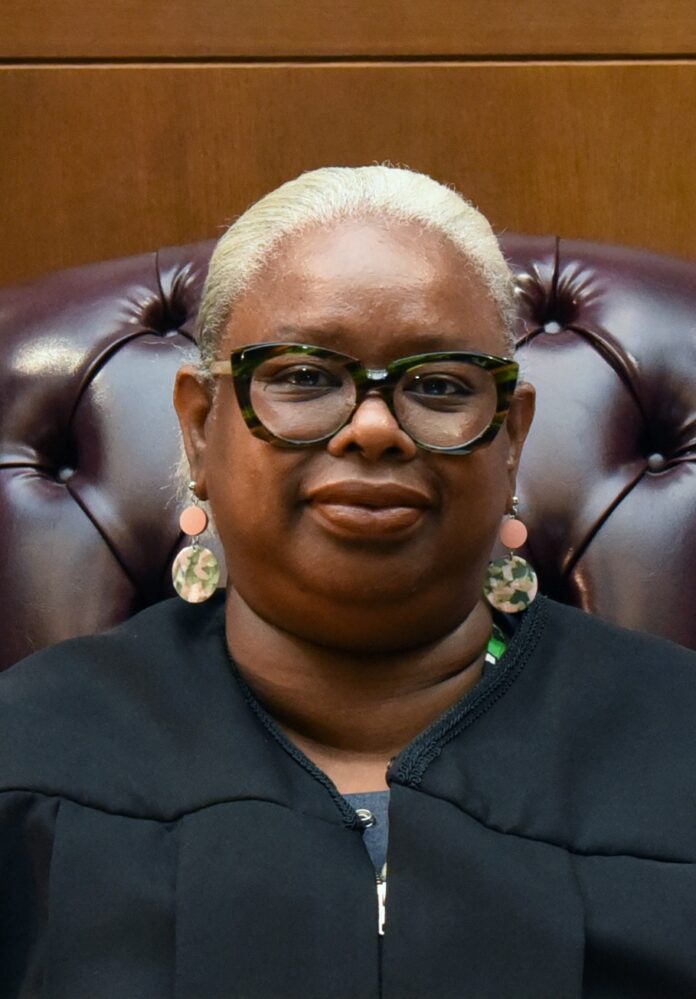
Judge Lisa Ottley. Eagle file photo by Caroline Ourso.
Trinidadian-American Justice Lisa S. Ottley has been elevated to the New York State Supreme Court’s Appellate Division, Second Department, serving Kings County (Brooklyn), marking a major milestone in her judicial career.
Her appointment was announced on Jan. 15 by Gov. Kathy Hochul, who said the designation would strengthen New York’s Appellate Courts with judges who bring deep legal experience and a strong commitment to justice.
“Today, I’m strengthening New York’s Appellate Courts by announcing the designations of two women whose legal expertise, judicial temperament, and commitment to justice will ensure New York’s laws are applied fairly and correctly,” Hochul said.
“With the appointment of Justice Ottley and Justice Ryba, our courts will continue to uphold the public trust and serve as places of integrity and justice for all New Yorkers,” she added.
Since 2023, Justice Ottley has served as an associate justice of the Appellate Term of the Supreme Court, where she oversaw civil matters and jury trials in Kings County. From 2016 to 2023, she presided over guardianship cases and a wide range of trials before assuming her Appellate Term role.
Elected to Civil Court in 2008, Justice Ottley was appointed supervising judge in 2019, leading the Trial Assignment Part. She became the first African American supervising judge of the Kings County Civil Court. Prior to becoming an Acting Supreme Court Justice, she handled Civil and Family Court matters and Criminal Court arraignments in Kings County.
Beyond the bench, Justice Ottley serves on the Guardianship Advisory Committee and participates as a lecturer and committee member at the Judicial Institute. She is a former adjunct professor at Long Island University’s Brooklyn Campus and Kingsborough Community College. A graduate of Temple University School of Law, she is also a life member of Alpha Kappa Alpha Sorority, Inc., the first African American sorority, founded in 1908 at Howard University. Throughout her career, she has mentored new judges, aspiring attorneys, and young lawyers.
Reacting to her elevation, Brooklyn Democratic Party Chair and Assembly Member Rodneyse Bichotte Hermelyn praised the appointment.
“We are proud to recognize Brooklyn’s own Hon. Lisa S. Ottley’s elevation in the Appellate Division of the Supreme Court, Second Department, as an additional justice,” Bichotte Hermelyn told Caribbean Life.
Justice Ottley, speaking to Caribbean Life on Jan. 17, described the moment as both humbling and affirming.
“First, let me say that God is awesome! Having faith that is strongly rooted and people who support you is wonderful,” she said.
“From the start, the Kings County Democratic Leader, Rodneyse Bichotte-Hermelyn, has been an advocate and voice for my elevation to the Appellate Division, Second Department,” Justice Ottley added. “It was her leadership, hard work, and dedication, along with the support of the Kings County Democratic District Leaders, who were committed and joined together as a unified party, to inform the governor that they had a candidate they wanted to see elevated to the Appellate Division.”
“I am extremely grateful for the support and look forward to continuing this next chapter in my career,” she continued. “Not being a stranger to hard work, due diligence, and commitment to being the best that I can be, I look forward to what is ahead.”
She said her experience and community focus will guide her work on the appellate bench.
“The Appellate Division Second Department is a dedicated bench of highly intelligent jurists who work hard,” Justice Ottley said. “My never-ending commitment to the community and experience on the bench will continue to be an asset in facing this new challenge.”
“It is an awesome feeling to know that my work ethic and focus have moved me forward to the next and exciting phase in my professional life,” she added. “No doubt, it will be challenging, but, at the same time, fulfilling. A big shout out to Assembly Member and District Leader Nikki Lucas, who has been an avid supporter since 2008.”
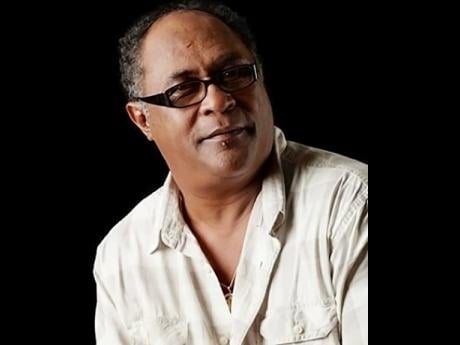
Tom Tavares-Finson, the Jamaica Labour Party’s longest-serving representative on the Electoral Commission of Jamaica (ECJ), will retire from the post effective Saturday, January 31, bringing to an end two decades of service to the country’s electoral oversight bodies.
His departure concludes 20 years of work on both the Electoral Advisory Committee (EAC) and the ECJ, where he played a role in shaping several key reforms to Jamaica’s electoral framework.
“It has been a profound honour and privilege to be entrusted with serving for an extended time at a Commission which is at the centre of nation’s democratic processes,” Tavares-Finson said in a statement on Wednesday. He added, “I take particular pride in my contributions to the development and implementation of the Electronic Voter Identification system, the Political Party Registration process, Campaign Finance Regulations, and the broader enhancement of Jamaica’s democratic legal and electoral framework.”
Tavares-Finson was first appointed to the EAC in 2005 by then Jamaica Labour Party leader Bruce Golding and subsequently appointed to the ECJ in 2006.
“I remain grateful to him for the opportunity to represent the Jamaica Labour Party in this important capacity,” he said of Golding.
Following Golding’s tenure, Prime Minister Dr Andrew Holness continued Tavares-Finson’s appointment to the Commission. Over the years, Tavares-Finson served as a party representative during five General Elections, in addition to multiple Local Government Elections and by-elections.
Reflecting on his time at the ECJ, Tavares-Finson acknowledged the leadership and colleagues he worked alongside. “It has been a genuine privilege to serve alongside distinguished chairpersons, including Professor Errol Miller, Dr Herbert Thompson, the Hon Dorothy Pine-McLarty, and the Hon Earl Jarrett,” he said. “I have also been fortunate to collaborate with dedicated colleagues from both major political parties including Danny Buchanan, DK Duncan, and Dr Aundre Franklin, as well as the many committed Jamaicans who have served as selected members and directors of elections.”
He also expressed gratitude to the staff of the Electoral Office of Jamaica and the ECJ, “whose unwavering commitment has ensured the growth, integrity, and enduring strength of this vital national institution.”
Tavares-Finson offered “special appreciation” to Prime Minister Holness, noting the principle that guided his tenure.
“When he re-appointed me to the ECJ, his clear instruction was that Jamaica and its democracy must always come first, before any individual or political party consideration. That guiding principle has shaped my entire tenure. I have never had reason to depart from it,” he said.
“The ECJ has grown from strength to strength. It is a vital pillar of Jamaica’s democratic process which must be preserved. Jamaica and our democratic process must come first, always,” he added.
Prime Minister Holness has since acknowledged Tavares-Finson’s decision to retire from the Commission, commending his long-standing contribution to the country’s democratic institutions.
“Tom has been among the Jamaica Labour Party’s representatives on the Electoral Commission of Jamaica for almost twenty years. He has offered dependable, committed, wise and professional counsel to the Commission, which is worthy of high commendation,” Holness said in a statement on Wednesday.
“Tom has been a reliable and distinguished champion for democracy, fairness and integrity in the exercise of Jamaica’s electoral processes. As a nation, we are grateful to Tom for his impeccable and committed service to the Commission, which is an institution that is vital to the good functioning of our democracy,” he continued.
Holness also noted that Tavares-Finson will remain active in public life. “We look forward to his continued service to his country via the Senate, and the wise counsel he offers as one of the country’s leading attorneys-at-law and a highly respected elder statesman.”
Lost In Time Festival (LIT), the globally inspired event founded by reggae heavyweight Protoje, returns for its third edition with a two-day staging on February 28 and March 1, 2026, at Hope Gardens in Kingston. The immersive, multi-stage festival continues to redefine Jamaica’s live music scene—uniting world-class performances, art, food, and culture in one unforgettable experience.
Protoje headlines Night One, while Chronixx takes over Night Two for his first live performance following the release of his album Exile. Other confirmed artists include Lila Iké, Tanya Stephens, Mortimer, Tessanne Chin, Yeza, Iotosh, and Joby Jay on Saturday, Feb. 28; and Jesse Royal, Jah 9, Naomi Cowan, Royal Blu, Dyani, and Dahvid Slur on Sunday, March 1.
“It feels special to be part of a reggae festival in the capital of reggae’s birthplace. I’m honored to continue the tradition this year,” says Protoje. Co-Founder LeAnn Ollivierre adds, “It’s a love letter to Jamaican music, culture, and community—a feeling we hope stays with you long after the festival ends.”
Rolling Stone has called LIT “a window into the present state and the future of reggae and dancehall,” a reputation cemented during its 2023 edition, which drew over 8,000 attendees and featured performances from Jah Lil, Khalia, Runkus & Royal Blu, Sevana, Samory I, Ras I, Jah 9, Romain Virgo, Jesse Royal, Lila Iké, Protoje, and surprise acts like Yohan Marley, Agent Sasco, Masicka, and Popcaan.
A portion of proceeds from LIT 2026 will benefit Hurricane Melissa relief through the Lost In Time Foundation and American Friends of Jamaica. For founders LeAnn Ollivierre and Oje Ollivierre (Protoje), both natives of the hard-hit parish of St. Elizabeth, the initiative is deeply personal and community-driven.
Inspired by Protoje’s years of international touring, Lost In Time stands out with multiple stages, punctual programming, and a thoughtfully curated lineup. The festival blends music, culinary excellence, interactive art installations, fashion, and culture into a fully immersive experience. The 2026 edition will feature two main stages, sound system culture, craft vendors, and curated food from Jamaica’s celebrated chefs and restaurants, transforming Kingston into a creative mecca.
LIT 2026 will also kick off Protoje’s Spring 2026 tour across Europe and the U.S., supporting his forthcoming album, The Art of Acceptance.
Tuesday’s election in Florida City, Miami-Dade County, produced no outright winners in the mayoral or commission races, sending all three contests to runoff elections.
Voters were choosing a new mayor to replace Otis Wallace, who has led the city for more than 40 years. The mayoral contest included Israel J. Andrews, Alphonso D. Bryant, Sharon “Sheep” Smith-Butler, Charlotte Thompson and Walter P. Thompson Sr.
Charlotte Thompson led the field with 39% of the vote, followed by Sharon Smith-Butler with 26%, meaning the two will face off in a runoff to determine Florida City’s next mayor.
Two city commission races will also move to runoffs. For one seat, Ronda Ferguson Cobb and Richard Brown Jr. emerged as the top vote-getters, while Trina Wilborn and James Brady will compete for the second seat.
Outgoing Mayor Wallace, 74, reflected on the city’s future and the challenges facing Florida City’s immigrant community. “In Florida City we have a substantial immigrant community. People that work thankless jobs. Now when they go home they have to worry about if someone is gonna snatch them and their families up. I didn’t think we’d see that in America,” he told WLRN.
Florida City, with a population of about 13,000, has a significant foreign-born population — roughly 35% — and nearly 63% of those residents are non-U.S. citizens. Nearly half of the city identifies as Hispanic or Latino, and more than half of households speak Spanish at home.
Wallace, re-elected multiple times since first taking office in 1984, has been described as Florida City’s “Mayor for Life” due to the city’s lack of term limits.
State election crimes investigators were sent this week to the Broward County Supervisor of Elections headquarters in Fort Lauderdale as part of a probe into marijuana-referendum petitions processed by the office, officials confirmed.
According to the South Florida Sun Sentinel, investigators dispatched by the administration of Gov. Ron DeSantis arrived at the elections office on Monday and remained there through Tuesday. The Broward Supervisor of Elections Office said that investigators were expected to return on Wednesday.
In a statement, the elections office said there is “no indication” that the office itself or Broward County Supervisor of Elections Joe Scott is under investigation.
Scott said the inquiry is focused on petition circulators who were terminated by Smart & Safe Florida, the group backing the proposed marijuana referendum, over allegations of petition fraud.
“A letter dated January 24, 2026, from the Secretary of State referenced issues related to petitions collected for the marijuana initiative,” Scott said. “That correspondence was subsequently clarified by a letter sent the following day from the Office of the Statewide Prosecutor, which makes clear that the targets of the investigation are circulators who were terminated for petition fraud by Smart & Safe Florida.”
Scott said his office is cooperating fully with state authorities.
“My team and I are doing our part by providing information requested by the authorities. Our office remains committed to serving the people of Broward County with the transparency they expect from us,” he said.
The proposed marijuana referendum seeks to amend Florida’s Constitution to legalize recreational marijuana for adults 21 and older. Gov. DeSantis has publicly opposed the measure.
State officials have not announced whether any charges have been filed in connection with the investigation.
Reggae Land has unveiled what organisers are calling one of the largest reggae and dancehall lineups the United Kingdom has seen in a generation, with more than 120 artists set to perform across seven stages at the Milton Keynes National Bowl on August 1 and 2.
The 2026 staging will be headlined by Vybz Kartel, Shenseea and Shaggy, alongside the exclusive world debut of The King & The Royals—a supergroup uniting dancehall icon Beenie Man with Grammy-winning reggae group Morgan Heritage. The announcement marks Kartel’s first appearance at the festival and Shenseea’s Reggae Land debut.
Other major acts include Tarrus Riley, Barrington Levy, Konshens, Mr Vegas, Super Cat, Inner Circle, Third World and Jah9, with performers spanning roots reggae, dancehall, dub, jungle and carnival-inspired sounds.
Organisers say the festival, now in its sixth year, will be its biggest yet, featuring two new stages, expanded production and an expected attendance of up to 100,000 people over the weekend. Since relocating to the National Bowl, Reggae Land has grown into a large-scale celebration of Caribbean culture, incorporating food villages, rum bars, markets, museum-style spaces and immersive décor alongside live performances.
Saturday’s Main Stage will be led by the debut performance of The King & The Royals, supported by appearances from Tarrus Riley, Barrington Levy, Konshens and Kranium. On Sunday, Kartel will headline the Main Stage, joined by Shenseea, Shaggy and Super Cat.
Additional stages will spotlight roots and conscious reggae, sound system culture, high-energy dancehall, carnival crossover sounds and dub music, with performances from artists such as Sanchez, Alborosie, Richie Spice, T.O.K, Stylo G, Ding Dong, Mad Professor, Aba Shanti I and David Rodigan.
The local media fraternity is mourning the death of veteran broadcaster Walter Charles “Bob” Clarke, a respected and influential voice in Jamaican radio for more than five decades. Clarke died early Tuesday at the Port Maria Hospital in St Mary. He was 75.
Clarke had been admitted to hospital for treatment of a medical condition. He was best known for his long association with IRIE FM in Ocho Rios, where he hosted the popular Sunday programme Memories, which earned him a loyal national following. He later continued his broadcasting career in Montego Bay and remained on air until recently.
In recognition of his outstanding contribution to Jamaica’s entertainment and broadcasting industry, Clarke was awarded the Order of Distinction.
Minister of Culture, Gender, Entertainment and Sport Olivia Grange said she was saddened by Clarke’s passing, describing him as a household name across Jamaica.
“Bob Clarke was a household name across Jamaica because of his affable personality and his passion for Jamaican music,” Grange said in a media statement on Tuesday.
The minister recalled working closely with Clarke during the establishment of IRIE FM in the 1990s, noting his pivotal role in the development of the island’s first 24-hour reggae radio station.
She also highlighted Clarke’s willingness to promote local artistes and his lasting contribution to broadcasting and the music industry.
Grange extended condolences to Clarke’s family, friends and colleagues, as tributes continue to pour in from across the media and entertainment sectors.
Prime Minister Mottley, a strong advocate for heritage tourism and cultural restoration, noted, “CAF has been responsible for a number of loans that have positively impacted the lives of Bajans
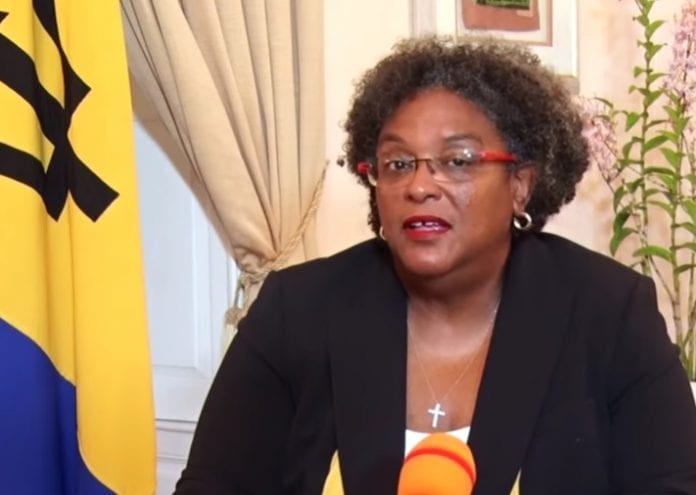
Prime Minister Mia Amor Mottley has invited observer missions from CARICOM and the Commonwealth to monitor Barbados’ general election scheduled for February 11, reaffirming the government’s commitment to a free and fair poll.
Mottley said letters were sent to the secretaries general of both organisations following public comments by Leader of the Opposition Ralph Thorne, who raised concerns about the preparedness of the Electoral and Boundaries Commission (EBC) and the integrity of the electoral process.
Her comments came after nomination day on Tuesday passed smoothly, with electoral officials reporting no incidents at nomination centres across the island. Nomination centres closed at 3 p.m., and officials said the process was orderly and trouble-free.
Candidates from five political parties filed nominations to contest the February 11 election. They include the governing Barbados Labour Party (BLP), the opposition Democratic Labour Party (DLP), Reform Barbados, Friends of Democracy (FOD), and the People’s Coalition for Progress (PCP), an alliance comprising the New National Party (NNP), United Progressive Party (UPP) and the Conservative Barbados Leadership Party (CBLP).
Following the nomination exercise, Mottley reiterated that international observers would be present for election day and assured Barbadians that the process would be conducted in accordance with the law.
She was responding to claims by DLP leader Ralph Thorne, who questioned the accuracy of the electoral list and the integrity of the electoral system. The Prime Minister rejected those assertions, insisting that the Electoral and Boundaries Commission is operating within the law and that the state is fully prepared to administer the poll.
According to publicly available information, more than 80 candidates representing approximately nine political parties were nominated, along with one independent candidate.
Both the Barbados Labour Party and the Democratic Labour Party will contest all 30 constituencies. Friends of Democracy has nominated 12 candidates, while the People’s Coalition for Progress has indicated it will contest half of the seats.
The Trinidad and Tobago government suffered a major legislative setback Tuesday night after the Senate voted down a controversial bill that would have granted sweeping authority to the Prime Minister and National Security Council to declare high-crime communities as special security zones with expanded police and military powers.
The Law Reform (Zones of Special Operations) Special Security and Community Development 2026 Bill failed to secure the required three-fifths majority in the Upper House, after it did not receive the support of a single Independent Senator. With the State of Emergency set to expire on January 31, the defeat means the government will be unable to implement its proposed Zones of Special Operations (ZOSO) framework, which it said was critical to sustaining gains made against criminal networks during the emergency period.
When the vote was finally taken after four sittings of the Senate, all 15 government senators voted in favour of the bill. Fourteen senators voted against it, including six opposition senators and eight of the nine independent senators, while Independent Senator Courtney Mc Nish abstained.
Ahead of the vote, Attorney General John Jeremie told the Senate that the government would not be accepting any amendments to the bill’s 28 clauses, citing time constraints with the State of Emergency due to expire within days.
“We are maybe 72 hours away from the end of the State of Emergency, and we wish to have something in place by then,” Jeremie said, adding that there was insufficient time to properly debate nearly 50 amendments proposed by independent and opposition senators.
Independent Senator Anthony Vieira criticised the government’s stance, saying he was initially under the impression that amendments would be considered.
“When I listened to you and Minister (Wayne) Sturge initially, I was under the impression that government might have been open to taking amendments,” Vieira said.
Jeremie acknowledged that the proposed amendments were “substantial” but said prolonged debate was not possible given the time pressure. He apologised for the approach, saying it was not how the government normally conducted legislative business.
One of the key amendments proposed by independent senators was the inclusion of a sunset clause, which would have set an expiration date for the law and allowed Parliament to review its effectiveness. Jeremie rejected the proposal, arguing that the bill already provided for parliamentary oversight through a review committee and was intended as a long-term crime-fighting measure.
He also defended the bill’s proposed Social Transformation Committee, citing Jamaica’s experience with similar initiatives.
“Once that starts, I’m told by my colleagues in Jamaica that that is actually a very powerful tool in terms of getting the communities to buy in to the fact that life can be better without the gangs,” Jeremie said.
Despite rejecting amendments, the Attorney General said the government remained open to continued engagement with independent senators.
Independent Senator Dr Desiree Murray nevertheless moved an amendment calling for the mandatory use of body cameras in ZOSOs. While the bill required body cameras to be used only when available, Jeremie said standing orders already mandated their use, though he conceded uncertainty about the police service’s current body camera capacity.
The defeat of the bill now shifts attention to Prime Minister Kamla Persad-Bissessar, who earlier this month sparked national controversy with sharp attacks on independent senators during the bill’s debate.
The Prime Minister accused critics of the legislation of being “weak men and women” and “pseudo-independent groups,” alleging they were effectively defending violent criminals and advancing the interests of the opposition People’s National Movement (PNM).
Independent senators, including Anthony Vieira and Michael de la Bastide, rejected the accusations, saying their role was to provide independent oversight, scrutinise legislation and hold the Executive accountable.
About the bill
The proposed legislation would have allowed the Prime Minister, in consultation with the Police Commissioner and Chief of Defence Staff, to designate high-crime areas as Zones of Special Operations.
Within a ZOSO, joint police and military forces would have been authorised to establish security cordons, impose curfews of up to 72 hours, conduct warrantless searches under specific conditions, and detain individuals suspected of criminal activity. A declared zone could have remained in effect for up to 180 days.
The bill also included provisions for social intervention through a committee tasked with identifying community needs such as housing, health, education and infrastructure, aimed at supporting long-term development alongside enforcement.
FAO high-level mission visits an FAO-supported pig farm in the Dominican Republic.
As hunger deepens in Haiti and climate and disease threats loom over Caribbean food systems, the Food and Agriculture Organization of the United Nations (FAO) is calling for a coordinated regional response, following a high-level mission to Haiti and the Dominican Republic this week.
The mission was led by FAO Deputy Director-General Beth Bechdol, along with senior regional and emergency officials, and focused on strengthening agriculture as a frontline humanitarian response in Haiti while advancing biosecurity, disaster preparedness and market stability in the Dominican Republic.
In Haiti, where more than 5.7 million people are facing high levels of acute food insecurity, FAO officials underscored the continued importance of agriculture as a primary livelihood for rural communities. Through its Emergency Food Production approach, FAO supports vulnerable families in producing food within 90 days, even during crisis conditions.
In 2025, FAO assisted more than 140,000 people in Haiti by distributing over 210 tonnes of seeds to 76,000 farmers. The initiative resulted in the production of more than 7,500 tonnes of food across 4,300 hectares, according to the organization.
In the Dominican Republic, discussions centred on protecting agrifood systems from major risks, including transboundary animal diseases, climate-related hazards and supply chain disruptions. FAO has also been working to strengthen regional trade and market integration across the Caribbean.
Over the past two years, FAO has supported biosecurity improvements in the Dominican Republic’s livestock sector, including the certification of 25 pig farms. These measures reduced viral circulation and increased biosecurity compliance from 35 per cent to nearly 80 per cent, boosting pork export potential and foreign exchange earnings.
“Travelling to both countries, I am deeply convinced that agriculture is not just a lifeline in today’s crises—it’s the foundation for stability and food security,” Bechdol said. “In Haiti, where families endure relentless shocks, farming remains the daily anchor sustaining households and the seedbed for rebuilding resilient livelihoods.”
She added that in the Dominican Republic, strong biosecurity measures help protect farmers, sustain markets and support regional trade, demonstrating the importance of sustained investment in agriculture tailored to local conditions.
To expand its work in Haiti, FAO is seeking US$108 million to support 860,000 people through emergency food production and livelihood protection initiatives. In the Dominican Republic, the agency is working with partners to mobilize additional resources to expand biosecurity coverage, strengthen livestock systems and protect national and regional food supply chains.
“A scale-up in funding and support is urgently required to allow FAO to save lives and dignity through delivering tangible results for farmers and communities,” said Rein Paulsen, Director of FAO’s Office of Emergencies and Resilience.
FAO officials said the dual-country mission reflects the agency’s integrated regional approach, combining immediate humanitarian action with long-term investments aimed at preventing future food crises and strengthening resilience across the Caribbean.
A minor earthquake was felt in sections of Jamaica early Wednesday morning, according to the Earthquake Unit at the University of the West Indies (UWI).
The 3.6-magnitude quake occurred at approximately 3:47 a.m. and was felt in Kingston and St Andrew. UWI reported that the epicentre was located about five kilometres northeast of Gordon Town, with a focal depth of 17 kilometres.
The tremor followed another minor earthquake that was felt in Portland on Monday morning. That quake, measuring 3.2 in magnitude, occurred around 10:01 a.m.
The epicentre of Monday’s earthquake was located near Hope Bay in Portland, with a focal depth of 21 kilometres.
There were no immediate reports of damage or injuries from either event.
The City of Lauderhill has announced a new $150 water bill credit aimed at easing household costs for senior residents.
Under the program, Lauderhill residents aged 55 and older who live in single-family homes and have an active city utility account are eligible for a one-time $150 rebate applied directly to their water bill. Seniors who live in condominiums or multifamily apartment buildings will receive a $150 check to help offset association fees.
Mayor [Name, if needed] said the initiative is part of the city’s ongoing efforts to support its senior community and provide financial relief to residents on fixed or limited incomes. Eligible seniors who have not yet applied are being encouraged to take advantage of the program.
To qualify, applicants must be at least 55 years old, reside in Lauderhill, and maintain an active Lauderhill utility account. Applicants are also required to submit a valid utility bill and government-issued identification.
City officials say the rebate is intended to help seniors save on essential expenses while continuing to live independently in Lauderhill. Seniors are encouraged to apply as soon as possible to ensure they receive the benefit.
Scamming people out of their savings and hard-earned finances has become a widespread epidemic in the United States. In recent years—especially with the advent of social media—scammers have become increasingly innovative and diverse in their schemes, making it harder than ever for citizens to discern what is genuine from what is a scam.
Scams have grown into a major financial problem, costing Americans billions of dollars annually and affecting a significant share of the population. Government and research data consistently show increases in both the number of scams people encounter and the amount of money lost to fraud.
Identity fraud and scams, particularly those targeting seniors, cost Americans an estimated $47 billion in 2024, according to an AARP-backed report. A survey report estimated total scam exposure—including unreported incidents—cost around $64 billion in the U.S. in 2025, with most Americans encountering at least one scam in the prior year. Federal Bureau of Investigation (FBI) data show that cybercrime, which includes many scam types, cost Americans between $16 billion and $16.6 billion in 2024.
There is no doubt that scams cost Americans billions of dollars each year, but the real cost is almost certainly higher than official estimates because many victims never report what happened.
Scammers use a wide range of schemes, but some stand out as especially widespread or financially damaging. It is important that our community be aware of these scams and remain on guard to avoid being preyed upon. These include:
Investment and financial scams These include fake cryptocurrency schemes, Ponzi-style investments, phony real estate deals, and other offers promising high returns. In 2024, investment scams alone were reported to have cost Americans between $5 billion and $6 billion.
Imposter scams These are among the most common scams and usually involve phone calls, text messages, and emails. Scammers pretend to be government agencies such as the IRS or Social Security, tech support representatives, or—most notably—family members in distress. Victims have reported receiving calls from individuals claiming to be relatives with a bad cold so their voice cannot be recognized, relatives who have been arrested and need bail money, or those who need funds to pay an attorney. Imposter scams cost nearly $3 billion in 2024.
Identity theft Criminals use stolen personal information to access bank accounts, credit cards, loans, or to open accounts in someone else’s name. Identity fraud losses remain extremely high. For example, an estimated $27 billion of the $47 billion lost to scams in 2024 was related to identity theft.
Online shopping and job scams Fake online stores, requests for personal information to deliver unexpected items, and bogus job offers trick victims into paying money or sharing sensitive data.
Cryptocurrency scams Fraudsters lure victims into fake crypto investments or gain access to their digital wallets, sometimes as part of organized crime operations. Reports indicate billions more in cryptocurrency losses, with some estimates showing massive annual theft totals in 2025.
Phishing and social engineering Emails, texts, or calls that trick victims into revealing passwords or banking information are extremely widespread and often lead to larger, more damaging scams.
While scams can be highly sophisticated, many share common patterns that can be guarded against by adopting basic protection habits.
One of the most important safeguards is never giving out personal information—such as Social Security numbers, bank details, or credit card numbers—in response to unsolicited calls, texts, or emails. If a caller claims to be from a government agency or a bank, hang up and call the official number listed on your statement or website.
People should be skeptical of “too good to be true” offers, promises of large returns, or urgent demands for payment tied to surprising benefits. Avoid unconventional payment methods—such as gift cards, wire transfers, or cryptocurrency-only payments—when dealing with unknown buyers or sellers. Use strong, unique passwords and enable two-factor authentication for important accounts.
Education is also key. People should educate themselves and their families on spotting red flags, including urgent language, spoofed contact information, and emotional manipulation. Technical safeguards should be adopted as well, such as keeping software and devices updated and using reputable antivirus and anti-phishing tools.
When scams are suspected, victims should report them to the Federal Trade Commission at ReportFraud.ftc.gov and to their bank or credit card company. Early reporting can sometimes help financial institutions reverse transactions or stop ongoing fraud. Cybercrime should also be reported to the FBI’s Internet Crime Complaint Center (IC3).
Completely eradicating scams in the United States is extremely difficult, as many originate overseas or within criminal networks that rapidly shift tactics. Technology—including artificial intelligence—has also enabled scammers to scale operations and convincingly mimic legitimate communications.
However, progress is possible through stronger enforcement. Federal task forces targeting cryptocurrency scams and impersonation rings are actively seizing funds. Still, there is a need for improved laws, stronger penalties for platforms that facilitate scam advertising, better identity verification standards, and enhanced financial safeguards.
Scams are a major problem in the United States, costing Americans billions of dollars each year. They take many forms, from investment and identity fraud to online shopping and cryptocurrency schemes. While total eradication may be unlikely, education, public awareness, reporting, and strong enforcement can significantly reduce the harm.
Florida lawmakers on Tuesday began advancing a proposal that would give the state authority to rename Palm Beach International Airport after President Donald Trump, placing the airport alongside a nearby roadway already bearing his name.
The Senate Transportation Committee unanimously approved SB 706, sponsored by Sen. Debbie Mayfield, R-Indialantic. The bill would transfer naming authority for Florida’s seven major commercial service airports from local governments to the state, with the only immediate change being the renaming of Palm Beach International Airport to Donald J. Trump International Airport.
“As you know, President Trump is the first president that Florida has had in our country and our history, and I think it’s very appropriate for us to be naming one of the other icons in Palm Beach County after him,” Mayfield said, noting Trump’s residency in the county.
A revision to the bill approved Tuesday clarified that any name change would still require approval from the Federal Aviation Administration.
Palm Beach International Airport, originally known as Morrison Field, began commercial operations in 1936 and was renamed in 1948. The airport served as a military base during World War II and the Korean War before Palm Beach County assumed operations in 1959.
Mayfield said the proposal could have significant economic benefits for the county.
“Air Force One stays at their airport. And so, it’s a big economic driver for them,” she said. “We’ve talked to the Trump people. There’s a lot of other things that are going to be happening at that airport that are going to be very positive for that airport. So that’s what changed their mind.”
A House companion bill, HB 919, is scheduled to be heard on Wednesday by the Economic Infrastructure Subcommittee. SB 706 must also clear the Senate Community Affairs Committee and the Senate Rules Committee before reaching the full Senate.
During the 2025 legislative session, lawmakers renamed a four-mile stretch of Southern Boulevard in Palm Beach County — from Kirk Road near the airport to Trump’s Mar-a-Lago Club on South Ocean Boulevard — as President Donald J. Trump Boulevard.
The bill would not affect the names of Florida’s other major airports, including those in Orlando, Miami, Fort Lauderdale, Tampa, Jacksonville and Lee County.
Broward County Public Schools (BCPS) has expanded its Afterschool Supper Program to include Sanders Park Elementary School. The program provides free, nutritious meals to more than 10,000 students participating in afterschool educational and enrichment activities across the district.
Funded through the federal Child Care Food Program, all meals meet U.S. Department of Agriculture nutrition standards and are provided at no cost to students, regardless of race, color, national origin, sex, age, or disability.
The Afterschool Supper Program now serves dozens of schools throughout Broward County, including Annabel C. Perry Elementary, Discovery Elementary, Apollo Middle, Dolphin Bay Elementary, Royal Palm Elementary, Sheridan Park Elementary, Coral Springs High, and Plantation High, among others. Sanders Park Elementary is the latest addition to the program’s growing network.
For students and families, the program ensures that children receive the nutrition they need to learn, grow, and thrive during afterschool activities.
The schools participating in the BCPS Afterschool Supper Program include:
The Caribbean Community (CARICOM) has expressed serious concern over ongoing internal turmoil within Haiti’s executive leadership, warning that the situation is complicating an already fragile political transition at a critical moment for the country.
In a statement issued on January 27, CARICOM said instability and division at the highest levels of the Haitian state are undermining efforts to prioritise the well-being of the Haitian people, who continue to face widespread violence and deprivation.
CARICOM noted that the mandate of Haiti’s Transitional Presidential Council (TPC) is set to expire on February 7, 2026, in keeping with the founding decree of the council and the April 3, 2024 Political Accord.
The regional body said the current impasse within the council—following unsuccessful attempts by some members to remove the prime minister—has further complicated the governance transition process.
“This is unacceptable,” CARICOM said, urging Haitian stakeholders to set aside differences and reach consensus in the national interest. The CARICOM Eminent Persons Group, it added, remains available to assist in facilitating agreement among the various proposals currently under discussion.
CARICOM also warned that political fragmentation benefits criminal gangs and called for an end to divisions in order to restore stability, security and peace in Haiti. Such conditions, the organisation said, are necessary for elections to be held and for renewed focus on economic growth and sustainable development.
The statement concluded with a call for all Haitian stakeholders to act urgently, responsibly and patriotically, placing the future of the country and its people above all else.