The United States Embassy in Barbados on Friday said there are “alternative methods available” to Caribbean countries to recruit healthcare workers, as Washington continued its criticism of Cuba’s medical brigade programme across the region.
In a post on its Facebook page, the embassy said it “is committed to holding accountable Cuban regime officials, foreign government officials, and others for facilitating forced labour in Cuba’s medical missions.
“By participating in these programmes, despite known human rights abuses, foreign governments become complicit in the regime’s tactics. Their actions directly contribute to the abuses of Cuban workers,” the statement said.
“There are alternative methods available for Caribbean nations to recruit foreign medical workers and ethically meet the healthcare needs of their people. The United States calls on all governments and peoples to reject forced labour schemes and join us in demanding accountability and respect for human rights.”
The latest statement comes amid ongoing tension between Washington and several Caribbean governments over Cuba’s long-running medical cooperation programmes.
Earlier this week, the US government said it had not “recently” spoken to St Lucia about international education after Prime Minister Phillip J Pierre said Washington had asked his administration to stop sending nationals to study medicine in Cuba. However, the United States did not indicate whether such discussions may have taken place prior to Pierre’s statement last weekend.
“I have a big problem. Many of our doctors got trained in Cuba, and now the great United States has said we can’t do that any longer,” Pierre told delegates attending the second World Congress on Racial and Ethnic Health Disparities in St Lucia.
Cuba has for decades provided scholarships for Caribbean and Latin American students to study medicine at the Latin American School of Medicine (ELAM) in Havana, which was officially inaugurated in 1999. The initiative offers free tuition, accommodation and boarding, and was designed to train doctors from underserved communities across the region.
Washington has also intensified its criticism of Cuba’s overseas medical missions, arguing that Havana benefits financially from the programme.
US officials say the Cuban government “is profiting off the forced labour of medical personnel” and that “renting out Cuban medical professionals at exorbitant prices and keeping the profit for regime elites is not a humanitarian gift.
“It is forced labour. It treats the doctors as commodities rather than human beings and professionals. The United States calls for an end to the Cuban regime’s coercive and exploitative labour export scheme.”
Walkie talkies have come a long way from their military roots and weekend camping trips. Today, they’re used by event coordinators, delivery drivers, security teams, and warehouse crews—anywhere fast, reliable voice communication matters. But for many users, especially those new to these devices, the buttons, screens, and beeping noises can feel like they belong in a cockpit.
If you’ve ever looked at a walkie talkie and thought, “What do all these buttons actually do?”—you’re not alone. The good news is, you don’t need a tech background to understand how these devices work. Let’s break it down in plain language.
The Basics: What You’re Looking At
When you pick up most modern walkie talkies, you’ll see three main things:
A button on the side (usually big and easy to press)
A small screen
A few extra buttons on the front or top
Each of these serves a simple purpose. The side button? That’s the “talk” button. Press it, speak, release it to listen. That’s the heart of how walkie talkies work, and it’s called “Push-to-Talk” (PTT).
The screen and other buttons are there to help you change channels, adjust the volume, or check battery life. You’ll use them occasionally—just like you might press a home button or volume rocker on your phone.
Push-to-Talk: The Only Button You Really Need
The reason walkie talkies are still popular—despite smartphones—is because of how easy it is to communicate. No swiping. No calling. No waiting for someone to answer. Just press, talk, let go.
This simplicity is intentional. In busy environments like warehouses or construction sites, you don’t want to fumble with menus. You want instant communication. That’s exactly what Push-to-Talk offers.
Channels: Think of Them as Group Chats
Walkie talkies typically operate on channels. These are like different chat rooms. If you and your team are on the same channel, you can talk to each other. If someone else is on a different channel, you won’t hear them.
Changing channels is usually done with a small knob on top or through a quick tap on the screen. Once you’re on the right one, you’re good to go. Some devices even name the channels so you don’t have to remember a number—like “Security,” “Front Desk,” or “Team A.”
Screens: Small but Mighty
Don’t be intimidated by that little screen. It’s not there to complicate things. Most modern walkie talkies use the screen to show:
What channel you’re on
Your battery level
Whether you have a signal (for nationwide models)
Who last spoke (some models show a name or ID)
If it looks like a mini dashboard, that’s because it is. But it’s not designed for deep menus or settings. Most people never touch anything beyond channel and volume.
Extra Buttons: Shortcuts, Not Surprises
Some walkie talkies include a few extra buttons, but they’re usually shortcuts to useful features:
Volume up/down
Emergency alert (for safety situations)
One-touch call to a supervisor or group
You can think of these like the shortcut buttons on a car steering wheel—useful if you want them, easy to ignore if you don’t.
Walkie Talkies with Nationwide Coverage
There’s one more innovation that makes today’s devices easier than ever: some walkie talkies now work over 4G networks, just like smartphones. This means no range limitations and no need to worry about signal towers. And yet, the interface stays just as simple: a PTT button, a channel, and a screen. That’s it.
This kind of modern walkie talkie is especially helpful for teams that work across multiple locations or even states. With the same simple interface, you can talk to your team whether they’re next door or a thousand miles away.
Final Thought: Built for Humans, Not Engineers
You don’t need to decode tech manuals to use walkie talkies effectively. In fact, their entire design philosophy is built around speed, simplicity, and reliability. Once you get past the initial unfamiliarity, using one becomes second nature—like flipping a light switch or answering a phone.
So next time you see a device with a screen and a few buttons, don’t overthink it. If you can push a button and talk, you’ve already mastered the basics.
Warm breezes, winter-free winters, and zero state income tax explain why Florida welcomed about 467,000 new residents last year (Kiplinger). Many head straight to Miami for sunshine and a culture-meets-coastline vibe.
Yet paradise has fine print: higher homeowners insurance, still-pricey homes, and hurricane season each June can squeeze a retiree’s budget. That’s why we built this checklist—to show you the tax breaks, real living costs, insurance moves, and trusted pros that keep your nest egg intact. By the end, you’ll know exactly what to do—and why Miami can still be a smart, sun-lit place to retire.
Your tax advantage checklist
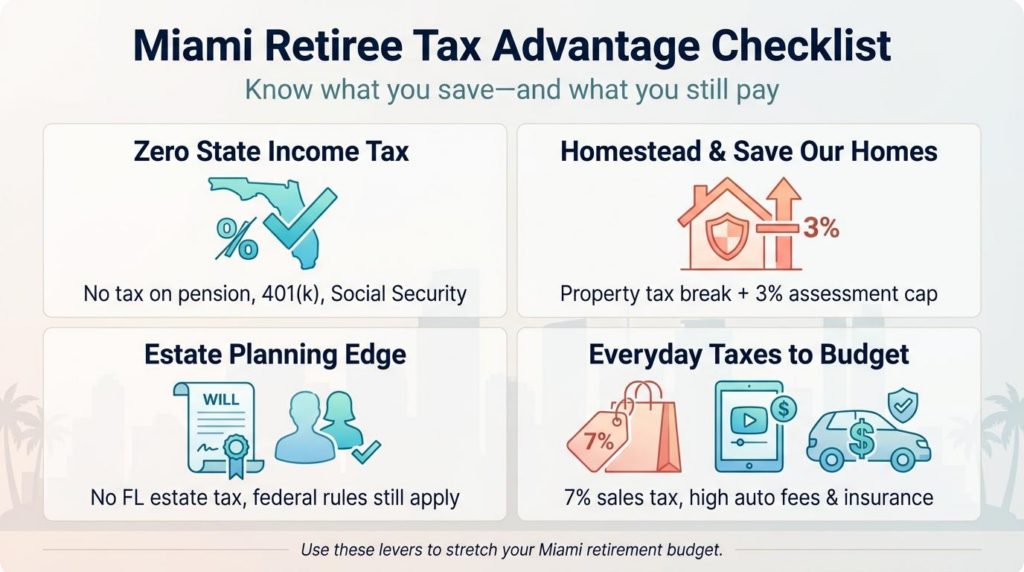
1. Claim Florida’s zero income tax: day one.
Florida taxes neither your pension, 401(k) withdrawals, nor Social Security. Update your driver’s license, voter registration, and spend at least six months plus one day in Florida each calendar year to prove residency. Tell every payor—pension custodian, annuity provider, brokerage—to stop state withholding; a quick call prevents refund delays. Channel that freed-up cash into homeowners’ insurance premiums or a hurricane reserve so the benefit shows up in your day-to-day budget.
Lock in the homestead exemption and Save Our Homes.
File one form with the Miami-Dade property appraiser and the first $50,000 of assessed value disappears from your tax bill. Meet the January 1 ownership date and March 1 filing deadline to activate the break for that year. From year two on, the Save Our Homes cap limits annual assessment hikes to 3 percent or less, a shield worth thousands over time. Keep a copy of the approval letter with your estate documents; the protection stays as long as the home is your primary residence.
Florida imposes no estate or inheritance tax, so more of your legacy reaches loved ones. Federal estate tax still applies, and the exemption is scheduled to shrink in 2026; review gifting or trust strategies if your estate approaches the federal limit. Refresh your will, power of attorney, and health-care surrogate using Florida forms. Be cautious with out-of-state trusts or LLCs—improper titling can strip away homestead creditor protection.
One local example is fee-only fiduciary firm Signature Financial Solutions, whose Coconut Grove office serves Miami-Dade retirees. The team begins every new-client estate-planning meeting with a beneficiary-and-deed review to be sure homestead protections stay intact, then steps back to map your financial journey through the four life stages—working years, pre-retirement, retirement, and later years—so each tax move and document lines up with long-term goals.
Tally the everyday taxes you still pay.
Sales tax fills the state coffers. In Miami-Dade, the combined rate is 7 percent on furniture, e-bikes, and streaming subscriptions. Groceries and prescription drugs are exempt, easing the food bill. Car ownership costs more here: registration fees run high, and auto-insurance premiums rank among the nation’s steepest. Log discretionary spending for 90 days, apply the 7 percent markup, and you will see the real price of your coastal lifestyle.
Count the real cost of housing
Buying a home in Miami sounds tempting, yet the metro’s median sale price sits near $510,000 according to Redfin’s August 2025 data. Mortgage payments, insurance, property taxes, and HOA dues can lift the monthly outflow above $2,000.
Renting tells a different story. The typical two-bedroom lease averages $1,500, which is about 28 percent cheaper each month than owning a similar space. Money saved on interest, maintenance, and roof assessments can fund travel, family visits, or a stronger emergency reserve.
Cost goes beyond price tags. Homeowners face property-insurance bills often topping $3,000 a year, plus rising condo fees tied to new reserve-fund rules. Renters pay a modest renter’s policy and let the landlord manage hurricane deductibles.
Ownership still offers stability and the Save Our Homes tax cap covered earlier. List every expense you will carry for the next five years—mortgage, HOA, flood policy, special assessments—and compare the sum with a realistic rent projection. The smaller total wins, and the answer can shift as interest rates or your lifestyle change.
Run the numbers before falling for a water-view listing. Careful math prevents sticker shock and keeps retirement funds aimed at the memories that matter.
Budget the everyday essentials
Electricity powers the air-conditioning that makes summer livable. Florida Power & Light pegs the typical Miami combined bill—electric, water, and sewer—near $130 a month for a midsize condo. Expect more if you like the thermostat set to “arctic.” Installing ceiling fans and a smart thermostat can trim costs without compromising comfort.
Groceries sit about 10 percent above the national average, according to the U.S. Bureau of Labor Statistics. Shop farmers’ markets, choose store brands, and use senior discount days. Small habits can free up hundreds of dollars for beachside brunches or travel.
Road costs add another layer. Miami is car-centric, and auto-insurance premiums rank among the country’s highest. Before renewing, gather three quotes, ask about mature-driver and defensive-driving discounts, and raise deductibles if your emergency fund can handle it. Pair those savings with Miami-Dade’s Gold Passport; residents aged sixty-five and older ride buses and trains for free, easing both traffic stress and gas spending.
Add your monthly utilities, groceries, transportation, and dining. Comparing that sum with today’s budget often surprises newcomers and shows whether a smaller condo or one car keeps your retirement lifestyle comfortable.
Protect your health and your wallet
Pick the right Medicare plan in Miami.
World-class hospitals surround Biscayne Bay, but the card in your wallet decides which doors open. South Florida offers dozens of Medicare Advantage contracts plus Original Medicare with Medigap. Start with two checks:
Confirm that your preferred doctors and flagship centers—Baptist Health, Mount Sinai Medical Center, Cleveland Clinic Florida—sit in network. Call each office to verify; directories can lag.
Match coverage to your travel style. Part-year residents often choose Original Medicare and a Medigap Plan G because it works nationwide without referrals, while full-time locals may favor Advantage HMOs for their bundled dental and vision perks.
Mark October 15–December 7 on your calendar; that open-enrollment window lets you switch plans if networks or drug formularies change.
Cover the out-of-pocket gap.
Even solid Medicare coverage leaves bills behind. KFF estimates the typical Florida retiree spends seven-hundred to nine-hundred dollars a month on premiums, copays, drugs, and dental services. List last year’s medical expenses, add today’s Part B and supplement premiums, then increase the total by five percent for future price creep. Keep a separate “medical shock” fund of at least two to three thousand dollars for hearing aids, crowns, or post-pickleball physical therapy, and refill it yearly with any savings you capture during open enrollment.
Insure your home against paradise risks.
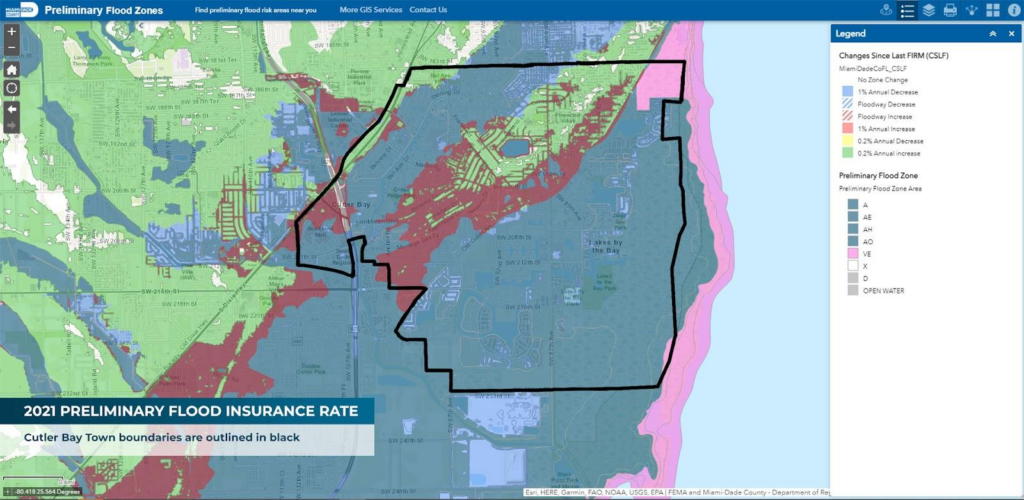
Miami homeowners policies now commonly exceed three thousand dollars a year, and some insurers leave the market after major storms. Shop coverage as soon as you spot a property. An independent broker can price the impact of a new roof, impact-rated windows, or hurricane shutters—all upgrades that cut premiums while protecting your investment. Add a National Flood Insurance Program policy even if your lender does not require it; more than one-third of flood claims come from areas labeled “low risk.” Round out the plan with a healthy emergency fund or home-equity line so a hurricane deductible never forces you to raid retirement accounts.
Official Miami-Dade FEMA Flood Zone Map for Hurricane and Flood Risk
Solid health and property coverage let you watch the Weather Channel with respect rather than worry, keeping more sunshine in your Miami retirement.
Conclusion: Live well, stay safe, thrive in the 305
Miami rewards residents who learn its rhythms. Summers steam, traffic pulses, and hurricane season keeps everyone alert. Master the details now and the city returns golden winters, year-round outdoor fun, and a welcoming, diverse community.
Start with climate. Spend at least one August in town before planting roots. Feel the midday humidity, nightly storms, and how a ten-minute downpour can flood low streets. The experience helps you decide whether to budget for a backup generator or an annual mountain escape.
Hurricanes call for respect, not fear. Each June, refresh water, batteries, and prescriptions, check shutter hardware, and confirm your evacuation zone. Write down who gathers vital papers and who secures patio furniture; a clear plan turns forecasts into orderly tasks instead of midnight scrambles.
Mobility shapes daily life. Rush hour often stretches past sunset, so many retirees keep one car. Miami-Dade Transit’s Gold Passport gives residents aged sixty-five and older free bus and rail rides. Pair that perk with ride-share apps and you may skip a second vehicle, saving insurance and maintenance dollars.
Community shrinks a big city. The county’s Active Older Adults program offers yoga, pickleball, and volunteer outings. Join a beach clean-up or bilingual book club to meet neighbors faster than waving from a balcony.
Protect your wallet as carefully as your health. Scammers target high-growth retiree markets; Florida law-enforcement bulletins confirm Miami is no exception. Treat unsolicited calls as background noise, verify every contractor—especially after a storm—and require written fiduciary commitments from any financial adviser.
Master these habits and Miami’s magic comes into focus: warm mornings on Biscayne Bay, sunset concerts at Bayfront Park, and the peace of knowing you planned well enough to enjoy them all.
KOLKATA, India — On the brink of their ICC Men’s T20 World Cup campaign, West Indies head coach Daren Sammy made one thing unmistakably clear: belief, not bravado, has carried his team to India, and belief is what fuels their ambition.
Speaking on Friday at Eden Gardens ahead of their opening match against Scotland, Sammy rejected any suggestion that the two-time champions were merely participants in a wide-open tournament. For him, West Indies’ presence alone implied purpose.
“We wouldn’t be here if we didn’t believe we could win. It feels like the same scenario 10 years ago where everything that was against us, nobody gave us a chance and I’m looking at the guys and the calibre of talent that we have in that dressing room,” Sammy said.
Echoes of 2016, eyes on 2026
Sammy, who captained West Indies to their second T20 World Cup title in 2016, spoke with the authority of someone who has walked this road before. The parallels, he suggested, are difficult to ignore, skepticism from the outside, uneven recent results, and a squad quietly confident in its own potential.
Execution, however, remains the non-negotiable currency of success.
“If we go out and execute with both ball and bat, and also in the field, we are in it to win it…We’re here at the World Cup and we believe that we can have an impact and that impact will take us to win it. It will take a massive effort from everyone, but one that is not impossible.”
The coach acknowledged that preparation alone does not guarantee outcomes, but insisted the collective mindset inside the camp has been unmistakable.
“…It’s going to be a fun tournament, but we really have to be on the ball…I watch these guys played that series in South Africa, I watched them here, and yes, the results haven’t been good, but there is something in those guys’ eyes that makes me believe that we can go all the way.”
Eden Gardens: History as motivation
Saturday’s opener carries added emotional weight. Eden Gardens, one of cricket’s most storied venues, serves as both stage and symbol for a West Indies side hoping to ignite momentum early.
“We’re here, starting at Eden Gardens, a place with so many memories and history and I’m pretty sure that will inspire the guys so I’m looking forward to tomorrow and taking it one game at a time,” Sammy said.
No favorites, no complacency
Despite West Indies entering the tournament ranked seventh in the ICC’s T20 standings, Sammy was careful to dismiss any notion of favoritism against Scotland, ranked 14th. The warning was deliberate, and rooted in recent history.
Scotland famously upset West Indies at the 2022 T20 World Cup in Australia, but Sammy stressed that dwelling on that result would serve no purpose now.
“Scotland has always been a tricky opponent, but when you go in a tournament you trust in the preparations that you’ve put in and when you prepare well you give yourself the best chance of performing.”
He emphasized that mental clarity, not memory, would determine the outcome.
“If you’re going to go in and doubt and think of the past, ‘Oh they’ve beaten us before in the tournament’ then you’re already behind the eight ball. I think the way these guys have prepared, the way we’ve managed to have guys who are in form, and the belief that you have in yourself and the team is that you deserve to win and you go out and play like you deserve to win.”
Yet realism remains central to the West Indies’ approach.
“But like we’ve seen in T20 cricket, the shorter the games the closer it brings the teams. So I will not sit down and say that we are favorites. We have to execute a good game of cricket every single time for us to win and that’s what we’ve come to do.”
The road still runs through India
Looking further ahead, Sammy offered a blunt assessment of the tournament’s ultimate challenge. For West Indies, or anyone else, lifting the trophy will almost certainly require overcoming the hosts.
“Nobody is winning this World Cup if they don’t go through India, whether you have to beat them in a knockout stage, whether it be a semi-final or a final, they are the favourites. Every team has to play really well to beat India at home. It’s their cup to lose.”
For now, though, the focus narrows to the next 40 overs, the next execution, and the quiet confidence of a team that believes history can repeat itself, one game at a time.
KOLKATA, India — Relief swept through the West Indies camp on the eve of their ICC Men’s T20 World Cup opener as Shimron Hetmyer finally arrived in India, rejoining his teammates just hours before their first match against Scotland.
The dynamic left-hander’s presence comes after several anxious days during which he was stranded in South Africa, delayed by visa complications following the conclusion of West Indies’ three-match T20 International series late last month.
Visa delay, missed moments
Hetmyer’s travel setback forced him to miss the team’s lone official warm-up fixture against Afghanistan on Wednesday, a match West Indies lost by 23 runs, as well as the tournament’s official photo shoot.
At the time the issue surfaced publicly, Cricket West Indies (CWI) offered only brief reassurance, noting that “the matter will be dealt with soon.” Until his arrival was confirmed, uncertainty lingered over the availability of one of the side’s most destructive batters.
Arrival confirmed, form intact
That uncertainty eased when Cricket West Indies posted images of Hetmyer on its official Instagram account on Thursday, showing him in the team’s new tournament kit, visual confirmation that he had arrived safely and was fully integrated with the squad in Kolkata.
The timing could scarcely be better. Hetmyer enters the World Cup in outstanding form, having played a central role in West Indies’ recent series in South Africa.
Sammy sees growing influence
West Indies head coach Daren Sammy underscored Hetmyer’s importance to the side, highlighting both his recent performances and his evolving role within the batting unit.
“He’s been a massive part for us in that South African series,” Sammy said.
Beyond raw runs, Sammy pointed to the internal competition and responsibility Hetmyer has embraced, particularly his transition higher up the order.
“I think it was a beautiful conversation to see his teammates challenging to take that number three spot. Because we all know over the last three or four years, he’s been finishing the innings.”
Strengthening the middle order
Sammy believes that Hetmyer’s adaptation and consistency could prove decisive as the tournament unfolds.
“Kudos to him. I mean, the responsibility he’s been given over the last three games. If he continues like that, he makes our batting stronger, and I hope that form can continue throughout the tournament.”
With Hetmyer now in place, West Indies head into their World Cup opener with renewed balance, and one less uncertainty, as preparations shift fully from arrival to execution.
Jamaica’s Davis Cup World Group II Playoff against Uruguay gets underway this weekend at the Liguanea Club, with both teams arriving confident, prepared, and fully aware of what is at stake.
The two-day tie, scheduled for Saturday and Sunday, forms part of the International Tennis Federation’s Davis Cup, the world’s premier men’s team competition, with 13 of the 26 competing nations advancing to World Group II of the 2026 Davis Cup and the remaining teams dropping into Group III.
For Jamaica, the clash represents both an immediate competitive test and a broader statement of intent, now strengthened by the backing of the Jamaica Olympic Association (JOA).
Home courts, high stakes
Jamaica will field a balanced squad led by national number one Blaise Bicknell (world ranking 463), supported by veteran Rowland ‘Randy’ Phillips, alongside Nicholas Gore and Daniel Azar.
Bicknell said the team’s preparation has been thorough and the mood in camp positive heading into the opener.
“The preparation has been very good. The team is very prepared and we’re all in good spirits and it’s going to be a great weekend of tennis and I’m confident that we’re going to get the win,” Bicknell said.
While acknowledging Uruguay’s experience, Bicknell believes surface conditions may favor the hosts.
“[Uruguay] is tough. I see them on the circuit and they’re on the clay courts more often, so I think the hard courts will give us an advantage so I’m looking forward to it.”
Match schedule
The tie will be contested in a best-of-five format, with two singles matches on Saturday, followed by a doubles encounter and two reverse singles on Sunday.
Saturday’s opening singles match is set for 11:00 a.m., featuring Phillips against Franco Roncadelli, with Bicknell facing Joaquin Aguilar 15 minutes after the conclusion of the first match.
Phillips, who has represented Jamaica in the Davis Cup since 2015, said the honor remains as strong as ever.
“Just the opportunity to play for my country over and over, it still feels like an honour and it never gets old,” Phillips said.
“You learn a lot through the situations, some tough matches, tough situations, tough conditions and you can take that going upward into new matches, so it helps me a lot.”
Uruguay confident, monitoring conditions
Uruguay also enter the tie believing they are well prepared, though team captain Ariel Behar admitted local weather conditions have posed challenges, particularly the wind.
“We have been preparing during the whole week with every combination possible. Our players are fit and they’re playing very well,” Behar said.
He added that calmer conditions would enhance the quality of play.
JOA boosts Jamaica’s push
Adding further momentum to Jamaica’s campaign, the Jamaica Olympic Association has committed $2 million in sponsorship to Tennis Jamaica ahead of the tie.
The announcement was made by JOA President Christopher Samuda during a media briefing at the Liguanea Club.
“We feel that, as an apex body, that we are obligated and it is our responsibility to invest in our talent,” Samuda said.
“It is on that principle, as well as the principle that we want to transition to the Olympic stage, that we are making this investment.”
Samuda said hosting and competing in Davis Cup ties also enhances Jamaica’s global sporting profile.
“When we are able to host tournaments at this level, it demonstrates that we have the expertise, the talent to do so.”
He added that the investment aligns with the JOA’s wider vision.
“The Jamaica Olympic Association will continue to invest in tennis, as well as other sports… so that we will not only be known as the world’s sprint capital, but for all-round sporting prowess.”
Execution and crowd support key
Non-playing captain Dominic Pagon believes preparation and discipline will be critical against higher-ranked opponents.
“I think we have a good chance because the preparations have been excellent so far,” Pagon said.
“We just have to play smart and make sure that we go out there and stick to the game plan.”
Pagon also emphasized the importance of home support.
“The home crowd is going to play a massive role in helping us to achieve our goal,” he said.
While acknowledging the challenge Uruguay present, Pagon remains confident.
“They are higher ranked than us, for sure, on paper… but I know our guys are ready.”
MANAGUA, Nicaragua — St. Lucian football continues to break new ground on the international stage. Lyndon Cooper, president of the St Lucia Football Association (SLFA), has been elected vice-president of Concacaf for the Caribbean region, solidifying his rising influence in regional and global football governance.
Cooper’s election comes on the heels of another historic milestone last year, when he became the first St. Lucian to lead the Caribbean Football Union (CFU). His unopposed election at Concacaf’s 41st Congress in Managua underscores both his stature in the region and the trust placed in his leadership.
Concacaf Congress highlights unity and milestones
The Congress brought together delegates from all 41 member associations, along with Concacaf senior leadership, to address statutory matters, approve the confederation’s 2026 budget, and review updates aligned with its strategic priorities.
The event also marked a decade of leadership under Concacaf President and FIFA Vice-President Victor Montagliani, who praised the member associations for strengthening the confederation’s foundations and charting a clear path toward long-term growth.
“Over the past decade, we rebuilt Concacaf on stable foundations, so today we have earned the right to think long term, invest with confidence, and aim higher than ever,” Montagliani said.
“As we step toward 2026, this is a moment to be proud, a moment to enjoy, and a moment to break through ceilings. Our continued success will come from staying united, leading through service, and protecting the integrity that makes progress possible.”
Cooper’s role in Caribbean and regional football
As Concacaf vice-president for the Caribbean, Cooper will play a pivotal role in shaping the direction of football in the region, bridging the ambitions of smaller associations with the broader vision of Concacaf.
His dual roles as CFU president and now Concacaf vice-president give him a unique platform to advocate for Caribbean football at the highest level, influence developmental programs, and ensure that smaller nations have a voice as the region gears up for major events, including the 2026 FIFA World Cup hosted by Canada, Mexico, and the United States.
Looking ahead to the 2026 FIFA World Cup
Montagliani also took the opportunity to recognize member nations already qualified for the 2026 FIFA World Cup, while wishing Jamaica and Suriname well as they prepare for the FIFA Play-Off tournament in March.
“Our continued success will come from staying united, leading through service, and protecting the integrity that makes progress possible,” he added, signaling that Concacaf intends to build on the solid foundations laid over the past decade.
A historic moment for St. Lucia
For Cooper, this election is not just a personal milestone, but a landmark achievement for St. Lucian football. His leadership at both the CFU and Concacaf levels reflects the growing influence of Caribbean football within regional governance and highlights the opportunities available for smaller nations to shape the sport on the global stage.
With the 2026 FIFA World Cup on the horizon and strategic development programs underway, Cooper’s role is expected to be instrumental in driving progress and enhancing the competitiveness of Caribbean football.
ADELAIDE, Australia — Jamaica’s Sunshine Girls endured a punishing 72-41 defeat against world number one Australia in the opening Test of their three-match series in Adelaide on Wednesday, but head coach Sasher-Gaye Henry sees reasons for optimism as the team prepares to rebound in Perth.
Despite the lopsided scoreline, Henry stressed that growth and learning remain the focus, with the next two Tests offering opportunities to refine strategy, sharpen execution, and build resilience.
Early struggles, moments of promise
The match began competitively, with Jamaica trailing 16-10 at the first-quarter whistle. By half-time, the deficit had widened to 34-22, and a disastrous third quarter saw the Sunshine Girls outscored 20-8, effectively putting the contest beyond reach. The final quarter ended 18-11 in favor of the hosts, cementing Australia’s commanding 31-goal victory.
“We are very hopeful going into game two because for us it is about building and so we definitely want to make a big impact on our performance in our next game based on our efforts in game one,” Henry said.
“We know that there are some areas that we really want to fix and we are hoping that we will get it right for game two.”
Game two is set for Sunday in Perth, followed by the series finale next Wednesday in Melbourne.
Scoring leaders and missing stars
Jamaica’s offense was led by Shanice Beckford, who converted 17 of 18 attempts, followed by Simone Gordon (12/15) and Giselle Allison (12/18). Australia’s attack, however, proved overwhelming, with Cara Coenen scoring 25/27, Kiera Austin 21/23, and Sophie Garbin 17/18.
The Sunshine Girls were once again without key players, including captain and star goal shooter Jhaniele Fowler-Nembhard, as well as top defender Shamera Sterling-Humphrey, which contributed to defensive lapses and turnovers.
Signs of improvement
Henry highlighted that, despite the scoreline, the team had improved compared to their December series against England, which Jamaica lost 2-0.
“I think that we have definitely improved in certain areas of our game against Australia compared to our last series in December against England,” she said.
“However, we didn’t start out well against the Australians and we made some poor errors, not Australia intercepting but our team giving away the ball easily.”
The coach noted that flashes of sharp, precise play indicate areas to build on.
“We set some targets but we didn’t achieve some of them in terms of the scoreline but we did see some nice, sharp passages of play,” Henry said.
“But again consistency to limit the turnovers played a big part for us.”
Focus areas ahead of Perth
Henry stressed ball control, tactical decision-making, and patient attacking as priorities moving forward.
“We definitely know that we have to work on our sharpness and our control, especially with our passes and not trying to force the ball very long, but working hard to get the ball in the circle before shooting,” she said.
She also praised the contribution of younger squad members stepping into more prominent roles.
“I must give credit to some of our younger players, like Roxonna McLean playing in the defending circle with Latanya Wilson for the first time, it was just super impressive,” Henry said.
“She is one of the young under-21s who are just coming into the squad for the first time.”
Looking ahead
While the Adelaide defeat was heavy, the Sunshine Girls are determined to use the lessons learned to fuel stronger performances in Perth and Melbourne. With adjustments in defense, ball control, and attacking coordination, Henry believes the series is far from over and that the squad can still make its mark.
“For us, it is about building. We want to make a big impact in game two,” Henry reiterated, setting the tone for a determined return Down Under.
KINGSTON, Jamaica — Jamaica Women’s captain Rashada Williams is calling on Cricket West Indies (CWI) to increase playing opportunities for female cricketers across the region, citing the need for more competitive cricket to develop talent and sustain momentum.
Williams led her side to their sixth CG United Women’s Super50 Cup title last weekend, but the truncated format, only three rounds of matches, left the captain yearning for more on-field action.
Triumph in a short tournament
Jamaica Women emerged champions with 21 points, edging out Windward Islands Women in second place and Guyana Women in third. While the victory added another title to Jamaica’s collection, Williams expressed concerns about the limited nature of the tournament.
“So, I think that it’s only fair that they add more games to the Super50 tournament. It doesn’t make sense holding a tournament where we are only playing three games and then you want to determine a winner. It’s just not enough cricket,” Williams told the Mason and Guest radio programme.
The shortened competition was officially attributed by CWI to financial constraints, but Williams warned that the lack of match play affects player development.
“As I said before we play in the regional tournaments in January, February every year and then there is a long break until next year January, February again, and if you’re not selected in the West Indies team or signed a league to play outside of the Caribbean like the WPL or the Big Bash, then you won’t have any cricket to play,” she added.
Tweaks to scoring and competition format
Williams also highlighted the Super50 bonus points system as an area that could benefit from adjustment. She argued that bonus points should not outweigh points for outright wins.
“For a win you get four points and I think you can probably get eight or more bonus points, so I think you could probably adjust it. I don’t think the bonus points should be more than the actual points you get for winning,” she said.
The captain’s suggestions underscore her commitment to strengthening competitive balance and ensuring players gain meaningful experience throughout the season.
A vision for women’s cricket
Williams’ call is part of a larger conversation about the growth of women’s cricket in the Caribbean. By increasing tournament rounds and providing more consistent playing opportunities, she believes the region can better nurture talent and prepare players for international competition, including leagues like the Women’s Premier League (WPL) and the Big Bash.
Her perspective reflects a proactive approach to leadership, with an emphasis not just on winning titles but on fostering sustainable pathways for female cricketers in the Caribbean.
“We want to keep improving. More games, more experience, that’s how we’ll continue to compete at the highest level,” Williams said.
Most people move at least once every five years, and each time feels brand new. You gather estimates, read reviews, and still end up wondering which company actually keeps its promises.
Picking a moving service shouldn’t feel like gambling, but the gap between a good company and a bad one is wider than most people realize. Good movers stay transparent from day one, while shady ones hide fees, change prices, and sometimes even hold your stuff hostage until you pay extra. That gap usually shows up the moment you know what to ask.
Check Licenses and Federal Authorization
Interstate movers must register with the Federal Motor Carrier Safety Administration. This registration isn’t optional. Federal law requires it. Companies without proper authorization face penalties. You face bigger risks.
Look Up the USDOT Number
Before you sign anything, check the FMCSA database using the company’s USDOT number. Legit movers display this number on both their website and their trucks, so if a company hesitates to share it, that alone deserves your suspicion.
Know How Brokers Work
Moving brokers operate differently than moving companies. Brokers like Coastal Moving Services connect you with authorized motor carriers. The broker handles your estimate and planning. Licensed carriers do the actual moving. This setup often means better pricing and more options. The broker still needs FMCSA authorization though.
Verify State Permits
State licensing counts too. Florida requires movers to register with the Department of Agriculture. Other states have similar rules. A company crossing state lines needs permits for both locations. Check origin and destination requirements.
Get Clear Pricing and Written Estimates
Moving companies charge based on several factors, with weight and distance carrying the most influence, followed by whatever services you request on top. Some companies quote by cubic feet instead of weight, and others offer flat rates on certain routes, so the pricing structure alone can vary a lot from one estimate to the next.
Different estimate types protect you in different ways:
Binding estimateslock in your final price. The cost stays fixed unless you add items or services.
Non-binding estimatesgive you a ballpark figure. Your final bill can rise if your shipment weighs more.
Binding not-to-exceed estimatescap your maximum cost. You might pay less if things weigh under the estimate.
Request an in-home visit rather than relying on a phone quote, because estimates based on room counts alone miss the details that actually matter. A rep who walks through your space will spot items needing special care and catch things that won’t fit a standard truck; both of which affect your final cost.
Put everything in writing. Spoken promises vanish when problems pop up. Your estimate should list every charge. Look for packing materials, labor, fuel fees, and extras. Read the section about coverage and claims carefully.
Pick Services That Fit Your Situation
Moving companies offer different service levels. Each one suits different needs and budgets. The key is matching what you need withwhat you can spend.
Full Service Packing
Professional packers handle everything from wrapping to boxing, and most teams finish in a single day. You skip the physical work entirely and avoid the kind of packing mistakes that lead to damage down the line. It’s the most expensive option, but the time and stress it saves often justify the cost.
Partial Packing Options
This middle ground works for busy people. The company packs your fragile stuff. They handle artwork, dishes, and electronics. You pack simpler items like clothes and books. Costs drop while protection stays high for vulnerable pieces.
Self-Packing Approach
Handling all the packing yourself saves the most money upfront, but the tradeoff shows up in coverage. Professional movers often limit liability for items you packed, which means damage claims can get tricky fast. Read the coverage terms carefully before choosing this route, because the savings can disappear if something breaks.
Storage Availability
Some moves need temporary storage. Your new place might not be ready yet. Good companies offer climate-controlled warehouses. Others work with third-party facilities. Find out who controls your belongings during storage. Ask what happens if delays stretch beyond the plan. Many South Florida families use flexible storage when selling one home and buying another.
Ask the Right Questions Upfront
Company history tells you plenty. New businesses can perform well. Established ones have records you can check. Ask about their experience with your move type. Cross-country residential moves differ from corporate relocations.
Coverage options vary widely between companies. Federal rules require basic coverage at 60 cents per pound. That rarely covers actual replacement value. Full protection costs more but pays to fix or replace damaged items.The FMCSA offers detailed guidance on understanding your coverage options.
Find out who moves your stuff. Brokers coordinate with carriers who do the physical work. Get the carrier’s USDOT number and name. Research them separately from the broker. The carrier actually touches your furniture.
Claims procedures matter more than people think. Every company promises careful handling. Things break anyway sometimes. Learn their filing process before problems happen. Ask what paperwork you need. Find out how long settlements typically take. Companies with simple claims processes usually cause fewer headaches.
Recent references beat old reviews. Talk to people who used the service within six months. Previous ownership or outdated practices make old feedback useless. Ask specific questions about timing and professionalism. Find out if final costs matched the estimates.
Spot the Red Flags Early
Large deposits before moving day signal trouble. Legit companies collect payment on delivery. Sometimes they bill shortly after. Requests for cash raise alarms. So do wire transfers to personal accounts. End those conversations fast.
Vague contracts guarantee future problems. Your paperwork should spell out pickup dates. Delivery windows need clarity too. Payment schedules, liability limits, and dispute steps must appear in writing. Companies pushing incomplete contracts hope you won’t notice gaps.
No physical address means no real business. Search their street address on Google Maps. A residential home or empty lot means you found a scam.The Better Business Bureau maintains records of complaint patterns and business legitimacy that help verify moving companies.
Super low estimates often hide bait-and-switch schemes. The company quotes an impossible price. Then they demand more before unloading your truck. Compare several estimates side by side. Trust your gut on deals that seem unreal.
Photo by Ketut Subiyanto
Choose Value Over Just Price
The cheapest quote might skip important steps. The priciest might include stuff you don’t need. Look for clear pricing first. Communication quality matters second. Check their credentials third.
Start planning eight weeks before moving day. This timeline lets you research properly. You can compare multiple estimates thoroughly. You can book your top choice before peak season fills up. Last-minute scrambling forces you to accept whatever’s available.
Pay attention during the estimate meeting. Companies that rush you don’t respect your needs. Same goes for ones that dismiss your concerns. Pressure tactics mean they want a signature more than a satisfied customer. Good movers prefer informed clients who understand the service.
Reverend Dr. Sheila McKeithen will be the Guest Speaker at the 2026 Jamaican Women Pinnacle Awards Gala, set for Saturday, March 14, 2026, at the Jamaica Pegasus Hotel. Held during International Women’s History Month, the annual event honours Jamaican women whose contributions have shaped the nation’s cultural, social, and economic landscape.
Rev. Dr. McKeithen’s selection as keynote speaker highlights the Awards’ focus not just on achievement, but on purpose-driven leadership that uplifts communities and inspires meaningful change. Her presence is expected to bring a message of hope, practical guidance, and empowerment to attendees.
Widely respected as a faith leader, educator, and social advocate, Rev. Dr. McKeithen has spent over three decades fostering spiritual growth and promoting social change in Jamaica and internationally. As Senior Minister of the Universal Centre for Truth for Better Living in Kingston, she emphasizes empowerment, dignity, and ethical leadership in her ministry.
A published author, Rev. McKeithen has made a lasting impact through works such as Twelve Steps to Your Healing and the children’s book Johnnie Toots His Horn. Her contributions are also recognized in major publications, including Peter Ferguson’s Change Makers: 101 Portraits of Women in Jamaica, Ian Boyne’s Profile of Excellence: Strategies for Extraordinary Achievement, and Bishop Vashti McKenzie’s Those Sisters Can Preach.
Beyond her writing and ministry, Rev. McKeithen actively engages in community service. She has participated in efforts to restore families in Western Jamaica following Hurricane Melissa and leads an annual self-care retreat in Negril for caregivers seeking spiritual renewal.
The Jamaican Women Pinnacle Awards, produced by Lyndon Taylor & Associates, recognize approximately 15 exceptional women each year across sectors including arts, education, business, healthcare, and community service. The gala celebrates leadership that extends beyond titles, showcasing women whose work transforms lives and communities.
This year’s honorees include prominent figures such as The Most Honourable Portia Simpson Miller, Fae Ellington, J.C. Lodge, Dr. Reem June Daley, Professor Minerva Thame, Althea Laing, Cedella Marley, Ionie Ramsay-Nelson, Jhaniele Fowler-Nembhard, Rhonda Walker-Walters, Dr. Terri-Karelle Johnson, Hope Markes, Carla Moore, and Nancy McLean.
Set against the elegant backdrop of the Jamaica Pegasus Hotel, the gala will bring together policymakers, corporate leaders, creatives, and changemakers for an evening of recognition, celebration, and national pride. Rev. Dr. McKeithen’s keynote will set the tone for the event, emphasizing leadership grounded in empathy, ethics, and service—qualities increasingly essential in today’s world.
With her decades of experience in ministry, community advocacy, and authorship, Rev. Dr. McKeithen embodies the very spirit of the Pinnacle Awards: leadership that matters not only in professional achievements but in lives changed and communities strengthened.
Sonia Fulford and Garvey Missick are opening up about a deeply personal chapter of their lives in their memoir, Hope in the Ashes: When the World Pressed In, We Pulled Closer. The book chronicles a marriage tested by infidelity and rebuilt through honesty, counseling, and faith.
The couple will celebrate the release with a fireside chat and book signing at Books & Books in Coral Gables (265 Aragon Ave., Coral Gables, FL 33134) on Sunday, February 22, at 7 p.m. The conversation will be moderated by veteran journalist and Visit Lauderdale vice president Neki Mohan, who brings a seasoned media lens and community-focused perspective to the discussion.
Rather than a typical book launch, the event promises an intimate and honest dialogue about betrayal, accountability, and the possibility of redemption. “When our marriage broke, we had a choice,” the authors write. “We could hide in shame or fight for something extraordinary.”
Through forgiveness and transparency, the Missicks confront the silence surrounding infidelity and offer a roadmap for others facing broken trust. “This book isn’t only for couples recovering from infidelity,” Fulford says. “It’s for anyone navigating trauma—loss, disappointment, broken trust, or unresolved wounds. Pain takes many forms, but healing always begins the same way: with truth.”
The memoir first sparked an emotional response across the Caribbean and has since resonated throughout the diaspora. Readers—including couples, individuals, faith leaders, and mental health professionals—describe it as both confronting and hopeful. Missick’s perspective speaks directly to men grappling with accountability and personal growth. “Counseling is not weakness; it’s wisdom,” he writes. “Accountability isn’t control; it’s protection. Real healing began when I stopped hiding, told the whole truth, and faced myself.”
Sonia Fulford is president of the Turks & Caicos Islands Football Association and a leading advocate for leadership and women’s empowerment. Garvey Missick is a construction professional and owner of Missick’s Contracting Ltd., with more than 25 years of experience. Together, they share their journey to help others heal, rebuild trust, and rediscover hope through faith and therapy.
Valentine’s Day reflections: A Q&A with Sonia Fulford
With Valentine’s Day approaching, Fulford shared her insights on love, healing, and second chances with Caribbean National Weekly:
CNW: Valentine’s Day often romanticizes love as perfect and painless. After betrayal, how did your definition of love change—and what did learning how to love again require from you emotionally?
Sonia: Love used to mean security, safety, comfort, and the display of care and affection. After betrayal, I learned that love is not the absence of pain; it is the presence of commitment, honesty, and growth even in the face of pain. Learning to love again required courage. It required me to sit with fear instead of pretending it wasn’t there. It required emotional boundaries, honest conversations, and a willingness to rebuild slowly. Love became less about fairy tales and more about daily choices: to communicate, to forgive wisely, and to stay emotionally present.
CNW: Rebuilding a relationship after trust is broken can feel risky. How did you decide that fighting for love was worth it, and what boundaries were essential to protecting yourself in that process?
Sonia: I didn’t decide overnight. I watched actions, not words. I needed to see accountability, transparency, and consistent change. Love without safety is not love; it’s anxiety. The boundaries were clear: honesty without defensiveness, access rather than secrecy, counseling rather than avoidance, and space for my emotions without being rushed to “move on.” Boundaries did not push him away; they created the conditions where trust could grow again.
CNW: For women reflecting on their relationships this Valentine’s Day, what message do you hope Hope in the Ashes offers about love, healing, and second chances?
Sonia: Second chances are not about pretending the past didn’t happen. They are about deciding whether the future can be different.
Healing love is not soft; it is intentional. It requires accountability, emotional maturity, and spiritual growth. My message is this: do not settle for apologies without change, but do not assume that broken means beyond repair. With the right foundation, love can return stronger, wiser, and more honest than before.
CNW: Love after betrayal often requires letting go of the relationship you thought you had. What grieving had to happen before you could even consider loving again?
Sonia: I had to grieve the illusion. I had to grieve the version of my marriage I thought existed. I had to grieve the innocence, the blind trust, and the story I told myself about “us.” That grief was real. It felt like a pain that would never end. But once I allowed myself to mourn what was lost, I could finally see what was still possible. You cannot build something new while clinging to what no longer exists.
CNW: Many women struggle with balancing forgiveness and self-respect. This Valentine’s Day, what would you say to women who fear that choosing love again means losing themselves?
Sonia: Choosing love should never mean abandoning yourself.
Forgiveness is not permission for repeated harm. It is a release of bitterness while still honoring your worth. You can love deeply and still have boundaries. You can forgive and still require change. You can stay and still choose yourself. Real love will meet you at your standards, not ask you to lower them.
The music world is today mourning the death of rising Belizean artist Anfernee “Big Bang Manifest” Pollard, who was murdered in Las Vegas, Nevada, on Wednesday, January 28, 2026, during an alleged domestic dispute. Big Bang Manifest is the brother of former Belize City Deputy Mayor Allan Pollard.
Pollard, who was just 31, and a woman (Briana) both lost their lives in the tragic incident. A 10-year-old child inside the house alerted the police about the shooting. Police in Las Vegas reportedly are now in pursuit of a fugitive named Jacob Charles, who is thought to be Briana’s ex-partner and the alleged triggerman.
His manager, Jamaica-born, Chicago-based Neville Muir, who confirmed Pollard’s death, told the Caribbean National Weekly that Pollard’s musical aspirations went far beyond just achieving fame in Belize.
“I signed him last September,” Muir exclaimed. “He had worked with dancehall producer Rvssian for a project with Interscope Records, and we were working on new material for a new album. He had gone to Los Angeles to wrap up a collaboration before heading to Las Vegas. He was on the brink of something great. The music he was working on was deeply personal and dealt with topics about street life and survival,” Muir added.
“I lost one of the biggest talents… I don’t even know, to be honest. I don’t even know. It is rough,” Muir confessed.
He recounted numerous conversations he had with recently deceased reggae legend Sly Dunbar about releasing new songs for Big Bang.
“The advice he gave me was not to rush the artist. Put out the songs at the right time because he has a unique sound and a groove,” Sly told me. “When he walked in a room, everybody had to look up, as he has the biggest voice. I called it a preacher’s voice,” Muir said.
News of Pollard’s death spread like wildfire among music fans on social media, where he had been building a name for himself. Based in Chicago, Big Bang represented a fresh wave of Belizean talent eager to share their sound with the world. He has collaborated with fellow Belizean artist King Kosa.
For Belize, the untimely death of Big Bang means losing a young ambassador of its evolving music. As investigations unfold in Las Vegas, hopefully Big Bang Manifest’s unfinished work will serve as a reminder of a dream cut short.
The grocery line moves slowly, and the total still climbs higher than you expected. You look at the bags and wonder how the basics got so pricey again. It feels sharper when your week is already packed and your money has to stretch.
In some regions, wellness costs sneak in through small choices, like quick lunches or last-minute pharmacy runs. When you are trying to keep routines steady, those extras can stack up fast. The budget works best when it stays calm, realistic, and easy to repeat.
A Budget Works Better When It Matches Real Life
Wellness spending gets messy when it lives in your head. One week can feel fine, then a bank alert says otherwise. That is usually when guilt shows up, and it never helps. What helps is seeing the pattern. A coffee here, delivery there, and a couple of “just in case” purchases. Then the month ends, and there is nothing left for what you meant to prioritize.
Track spending for one week. That is usually enough to spot repeat costs and surprise ones. Once you see them, you can choose what matters without feeling punished. A simple way to sort the list is three buckets:
Essentials: groceries, prescriptions, basic personal care
Planned extras: the things you choose on purpose, like supplements, a monthly massage, or choices like buy popcorn buds online so you can stock up once and stop making extra trips
The point is not what you pick. It is whether you can name it, price it, and keep it from quietly taking over the month.
Food Spending Feels Lighter With A Few Reliable Defaults
Weeknight food choices usually decide whether your wellness budget stays steady. You get home tired, the fridge looks random, and the easiest answer wins. Then the next morning starts with regret.
A few repeatable meals make life calmer because they remove daily decision stress. Think rice bowls, soups, and quick tray bakes. The shopping list gets shorter, and waste drops without much effort.
Keep two backup dinners on hand for the nights when cooking will not happen. That one move can save money and stress. It also helps when food planning stays flexible, especially in some homes where meals are social and not always scheduled. A pot of stew or peas and rice can cover multiple days, and it reheats well. When leftovers taste good, takeout stops feeling like the only break.
If you like a loose structure, the MyPlate guide is a practical reference for balanced meals. It keeps things simple without pricey ingredients. Two more budget habits that work:
Think in price per serving, not price per item
Build overlapinto your cart so one ingredient works across several meals
Preventive Care Feels Cheaper When It Stops Being A Surprise
Health costs hit harder when they arrive all at once, especially around rent and school expenses. A check-up, a refill, and a dental issue can land in the same month, and suddenly, the budget feels broken.
Planning helps when care becomes a monthly line item. Even a small set amount creates breathing room for refills, co-pays, and urgent visits. It also reduces the scrambling feeling when something pops up.
Insurance details are annoying, but knowing what is covered can save real money. A quick call can clarify whether labs need pre-approval or whether a clinic offers cash pricing. When you know the numbers, decisions feel calmer.
The CDC’s adult immunization schedule is also a helpful planning reference when you want to stay ahead. When money is tight, look for what your community already offers. Health fairs, screenings, and local programs show up more often than people expect. Sometimes a free screening catches something early, which is the best kind of savings.
Stress And Sleep Often Give The Biggest Return For The Least Cost
Wellness marketing loves to sell quick fixes. Meanwhile, the basics keep doing most of the work.
Sleep and stress support are often the highest value parts of a wellness budget. Better sleep makes food choices easier and steadies mood. When stress drops a notch, you stop spending money trying to soothe it.
The changes that last are usually simple: a darker room, the phone away from the bed, steady noise from a small fan. Spending can stay modest and still matter, like a decent pillow, a basic eye mask, or a second set of sheets.
Stress support can also come from routines you already have. Music in the kitchen, a walk after dinner, or a Sunday visit can reset your mood. When community is part of wellness, the budget often improves too.
A few low-cost options that hold up in busy weeks:
A twenty-minute walk three times weekly
A simple bedtime routine on work nights
A backup dinner plan for low-energy nights
One standing social touchpoint, like a family dinner or a church community
Community Options Can Make Wellness Feel Less Expensive
Wellness can feel private, but it often works better with support. When life gets busy, shared routines can keep you steady.
South Florida has low-cost resources that are easy to miss. Parks departments run classes, libraries host wellness events, and community groups organize walks. When you find one that fits, it can become a stable part of your week.
Treat support systems as part of the budget, not an extra. A meal swap with a relative can cut grocery waste and reduce weeknight stress. Child care trades can free up time for a walk, a nap, or an appointment. Many households already do this without naming it.
When the budget feels tight, fewer habits done consistently usually beat many habits done briefly. A short list you can keep through busy seasons will support you more than a perfect plan.
Small Shifts That Keep You Feeling Steady
A wellness budget holds up when it stays focused on repeatable basics. Food plans work best when they match your real evenings and your real energy. When preventive care and sleep get a place in the budget, surprises feel less overwhelming.
One leak cut can fund one habit that lasts. That habit could be backup dinners, a small health reserve, or a sleep upgrade that improves every week. When those pieces settle in, the rest of wellness starts feeling lighter.
February 6 marks the birthday of Bob Marley, the Jamaican reggae legend whose songs have left an indelible mark on music and culture worldwide — today, he would have turned 81 years old.
More than four decades after his passing, Marley’s music continues to resonate with fans old and new. In honor of his birthday, here are five of his most iconic songs, starting with the track that has become a universal anthem.
1. “One Love / People Get Ready” (1977)
Originally recorded in 1965 and reimagined for the 1977 album Exodus, “One Love” is perhaps Marley’s most enduring anthem of unity. The song blends reggae rhythms with a message of peace and togetherness, famously calling on people to “get together and feel all right.” Marley’s version incorporated elements of Curtis Mayfield’s People Get Ready, creating a timeless call for social harmony. The song was central to the historic 1978 One Love Peace Concert in Kingston, where Marley symbolically brought rival political leaders together on stage.
2. “No Woman, No Cry” (1974)
From the live album Live! recorded at the Lyceum Theatre in London, “No Woman, No Cry” is a soulful reflection on life in Kingston’s Trenchtown. With its tender lyrics and emotional delivery, Marley comforts listeners with the refrain, “Everything’s gonna be alright,” celebrating resilience in the face of hardship. It remains one of his most recognizable and beloved tracks worldwide.
3. “Redemption Song” (1980)
A stripped-down acoustic masterpiece from Uprising, “Redemption Song” is Marley’s meditation on freedom, slavery, and self-liberation. Inspired by the teachings of Marcus Garvey, the track’s poetic lyrics encourage listeners to “emancipate yourself from mental slavery,” offering a spiritual and political message that continues to inspire generations.
4. “Three Little Birds” (1977)
From the album Exodus, this lighthearted song has become an anthem of hope and positivity. With its unforgettable chorus of “Don’t worry about a thing, ‘cause every little thing gonna be alright,” Marley offers a simple, uplifting message that contrasts with the heavier social themes of some of his other work. Its universal appeal has made it a favorite in films, commercials, and personal playlists worldwide.
5. “Buffalo Soldier” (1983)
Released posthumously on the album Confrontation, “Buffalo Soldier” combines reggae grooves with historical storytelling. The song highlights the struggles and resilience of Black soldiers in the U.S. Army who fought during the Indian Wars, while also reflecting on themes of displacement and survival. Its catchy rhythm and powerful lyrics made it an international hit and an enduring anthem of resistance.
Bob Marley’s music was more than entertainment; it was a vehicle for social change, personal reflection, and cultural pride. On his birthday, fans across the globe continue to celebrate his legacy, proving that his songs — and their messages of love, unity, and resilience — remain as relevant today as ever.
The Miami Museum of Contemporary Art of the African Diaspora (Miami MoCAAD) is turning the North Dade Regional Library into a vibrant hub of Black Miami history with its “Telling Overtown Stories, Saying Their Names” Mobile Interactive Mural Exhibition.
The exhibition runs through the end of March 2026 at the library’s lobby, located at 2455 Northwest 183rd Street, Miami Gardens, FL 33056.
The exhibition features three mobile, interactive murals—replicas of permanent works in Historic Overtown—that combine augmented reality, oral histories, and storytelling to offer an immersive cultural experience. Visitors can use embedded QR codes to hear firsthand accounts from community members, historians, artists, and cultural leaders, connecting the past and present in engaging, interactive ways.
“Our Interactive Mural Initiative ensures that Overtown’s cultural heartbeat is not only remembered but also experienced in impactful new ways,” said Marilyn Holifield, Co-founder of Miami MoCAAD. “By bringing oral histories and contemporary art directly into public spaces such as libraries, we’re creating living environments where history speaks and future generations will see themselves reflected.”
Overtown, often referred to as the “Harlem of the South,” was historically a thriving center for Black arts, jazz, business, and community life. The construction of I-95 and other urban developments disrupted the neighborhood, but its cultural legacy endures. Miami MoCAAD’s murals honor that heritage while using technology to make it accessible to new audiences who may not visit Overtown.
The exhibition includes:
“OVERtown: Our Family Tree” by Anthony “Mojo” Reed II, highlighting Miami’s first Black judge, Lawson E. Thomas, and early civil rights activism.
“International Longshoremen Local 1416” by Reginald O’Neal, spotlighting Black waterfront workers who helped build Miami’s economy.
“Overtown Pitch: Game Changers” by Stefan Smith, celebrating soccer, inclusion, and youth empowerment.
By bringing the murals to a public library, Miami MoCAAD transforms the space into a living archive, where art educates, communities engage, and Black Miami’s stories are preserved for future generations.
Jamaica’s declining birth rate is being shaped by modern societal pressures and social media, Health and Wellness Minister Dr Christopher Tufton said Thursday, urging citizens to consider having more children.
Speaking at Percy Junor Hospital’s baby-friendly accreditation ceremony in Spalding, Tufton noted that while technology and exposure bring positives, they also create pressures that influence family planning decisions.
“One of the challenges with families or parenting today is the pressures that have emerged from a society that has become more modern and exposed,” Tufton said. “Positives out of modernisation, positives in exposure, positives in technology, but it adds significant pressure on many of us who feel that unless we reach a particular height and achievement and wealth we can’t have children. It is a serious thing.”
He highlighted social media as a “double-edged sword,” where unrealistic portrayals of life, combined with misinformation, can discourage people from making the commitment required for parenthood.
Tufton also urged healthcare workers to engage directly with communities to promote responsible parenting. “We must leverage the credibility that we represent by spending more time in the community talking to people to encourage families to encourage responsible parenting,” he said.
The Minister drew attention to a stark decline in births at Percy Junor Hospital, which dropped from 201 deliveries in 2024 to 71 in 2025, a 64 per cent reduction. He acknowledged the trend reflects a wider global phenomenon affecting Jamaica.
Last year, the United Nations Population Fund’s State of World Population report listed Jamaica among countries with some of the lowest fertility rates, with the total fertility rate falling to 1.3 children per woman — far below the replacement rate of 2.1.
“The decision is actively so for people to have fewer children. Every time I walk, because I talk about it so much, people say, ‘Bwoy, yu a promote children, you can afford them?’ and that is not the conversation I want to have,” Tufton said. “Our job is to promote responsible parenting, not just to have children for children’s sake…It doesn’t necessarily have to cost too much either, depending on where you put your priorities and your emphasis.”
The Minister stressed that fostering informed and supported families is key to reversing the declining birth rate while ensuring children are raised responsibly and communities strengthened.
The Ministry of Foreign Affairs has announced the opening of a Jamaican consulate in Lagos, Nigeria, aimed at expanding the country’s presence in one of Africa’s leading commercial, financial, and technology hubs.
In a post shared on X, the ministry said the consulate, led by Aima Lijadu, will strengthen connections with the Jamaican diaspora in Lagos while supporting the country’s broader commercial and technological interests.
The consulate will operate under the guidance of the Jamaican High Commission in Abuja and will provide services including processing applications for Jamaican passports and citizenship, as well as facilitating visa applications for foreign nationals.
“We warmly welcome members of the Jamaican Diaspora in Lagos to take advantage of our services, including applications for Jamaican passports and citizenship. Nigerian and other foreign nationals residing in Lagos are also invited to submit visa applications,” the ministry stated.
Services are available to the public on Tuesdays and Wednesdays from 10:00 a.m. to 3:00 p.m.
Enquiries can be directed to the consulate via telephone at +234 916 0323 314 or by email at jamconsulatelagos@gmail.com.
Air passenger traffic through Jamaica’s two main international gateways declined in January as the tourism sector continued to grapple with the aftereffects of Hurricane Melissa.
Data released late Thursday by concession operator Grupo Aeroportuario del Pacífico, S.A.B. de C.V. showed that Sangster International Airport (SIA) handled 284,200 passengers in January — a 37.7 per cent drop from the 456,200 passengers recorded in January 2025. The figure, however, represented an improvement over December 2025, when the island’s busiest airport processed 262,200 passengers.
At Norman Manley International Airport (NMIA), passenger traffic fell by 6.9 per cent year-on-year, with 155,500 travellers passing through the Kingston-based facility compared with 167,000 in January 2025.
The steep decline at Sangster International largely reflects the ongoing recovery of several hotels that were impacted by the hurricane. Efforts to restore utility services and clear roadways leading to key town centres have also contributed to slower-than-usual visitor flows.
According to the Jamaica Tourist Board’s Visit Jamaica platform, 23 hotels remain closed with reopening dates stretching into late 2026. Two Grand Decameron properties are expected to reopen by March 1, while three Sandals resorts are scheduled to resume operations by May 30. Two Royalton hotels are set to reopen by August 25, with another two properties reopening by September 15 and eight Hyatt hotels by November 1. The Bahia Principe Grand Jamaica is slated to reopen on December 1.
Tourism Minister Edmund Bartlett recently told nearly 100 travel advisors and industry stakeholders that Jamaica remains on track for a strong winter tourist season. He was speaking at a welcome dinner held last Saturday at the RIU Montego Bay Resort in St James.
Princess Resorts reopening, boosting available rooms
Princess Senses the Mangrove resumed operations on February 1 and is offering up to 60 per cent off bookings for travel between February 2026 and October 2027. That promotional booking window closes on February 8. Meanwhile, the Princess Grand Jamaica is expected to reopen by March 1.
“The reopening of 415 rooms and the return of 800 workers at Princess Resorts represent a major step forward in Jamaica’s tourism recovery,” Bartlett said. “This is about restoring livelihoods, strengthening communities, and ensuring that our tourism growth remains inclusive and sustainable.”
Other major hotel chains, including Sandals Resorts and RIU Hotels, have already reopened their room stock. Princess Resorts is expected to complete its full reopening next month with 590 rooms and a staff complement of 1,005.
Director of Tourism Donovan White said the reopening comes at a critical time as travel demand across Jamaica’s major source markets continues to strengthen. “We are seeing strong and sustained interest in Jamaica across our major markets, and the return of this room inventory is both timely and strategic,” White noted. “This underscores the confidence global hotel partners have in Jamaica as a resilient and high-performing destination.”
Additional room capacity is expected to support increased visitor arrivals, while the return of workers will strengthen service delivery across the tourism sector, one of Jamaica’s largest employers.
Speaking at the February 1 reopening, Enrico Pezzoli, Managing Director of Princess Hotels and Resorts Jamaica, said the period following the hurricane had prompted reflection and growth.
“The past period invited reflection and growth. It challenged us to look closely at who we are and how we serve, and it encouraged us to return stronger, more focused, and more intentional in everything we do. I am deeply proud of our team for their professionalism, adaptability, and continued belief in this vision,” he said.
Tourism officials say the reopening of hotels across the island signals growing momentum in the accommodation sector as properties resume full operations in line with improving airlift, booking trends and traveller confidence.
“We are seeing stronger efforts by all our hotel partners who are working to get back on stream ahead of their original timelines. This is a testament to our commitment to a full reopening to build resilience and ensure the sector’s growth delivers long-term economic benefits for the Jamaican people,” Bartlett added.
As part of efforts to tap into the vast expertise and resources within the Guyanese diaspora, the government has facilitated the successful remigration of more than 2,000 overseas-based Guyanese citizens over the last five years.
This was revealed by Foreign Affairs and International Cooperation Minister Hugh Todd on Wednesday evening as he delivered his presentation to the ongoing debates on Budget 2026 in the National Assembly.
The Dr Irfaan Ali-led People’s Progressive Party/Civic (PPP/C) Administration has positioned diaspora engagement as a critical part of its development agenda and the Foreign Affairs Ministry is tasked with connecting members of the Guyanese diaspora with what is happening across various sectors in the country.
“So far, between 2020 and 2025, we’ve assisted approximately 2,162 Guyanese who have successfully re-migrated to Guyana, and that is a part of our development agenda because, as you’re aware…His Excellency, the President would also like to tap into the human capital that can actually return to Guyana and to be a good fit in areas where we may have a need for their level of competency,” Minister Todd explained.
In addition to expertise, the Guyana Government is also looking to tap into the resources of Guyanese living overseas. According to the Foreign Affairs Minister, several overseas-based Guyanese business owners are returning, moving capital and/or expanding their businesses here or even partnering with companies in Guyana.
“So, it’s doing a lot for us in terms of creating employment and helping to build out our economy. So, we’re very focused, Mr. Speaker, on ensuring that we remain connected to the diaspora, remain engaging with the diaspora and to ensure that that connection can lead to a return, reintegration and allowing those diaspora to enjoy building out Guyana,” Todd posited.
In fact, during the 2020 to 2025 period, the Guyana Government, through the various embassies and consulate offices, had engaged approximately 3,000 residents from the diaspora in Suriname, the United States, Canada, and Trinidad and Tobago.
To further facilitate similar diaspora engagements this year, the Ministry has allocated some $35 million in Budget 2026. According to Todd, they are working on a roadmap that will see not just overseas visits to meet with the diaspora, but also increased webinars and conferences to gauge the level and areas of interest by those persons living overseas as well as to help them seamlessly re-migrate to Guyana.
Moreover, the Foreign Affairs and International Cooperation Ministry has also made it easier for members of the Guyanese diaspora to return home through enhanced efficiency at the overseas consulate offices especially with regards to passport services.
As a matter of fact, over the last five years, approximately 17,000 Guyanese passports have been processed for persons living in the diaspora and according to Minister Todd, they plan to ramp up this process in order to allow more persons to travel back to Guyana.
“We are attracting a lot of our returning Guyanese and if we’re going to be able to support our returning Guyanese through the diaspora engagement, then being able to facilitate travel documents and other instruments are very important for us. So, we’re taking that role also very seriously…and we have been very effective even more so now because we have a new technology in issuing of the passports.”
“And for those persons who may not have had or renewed their passports for many decades, in some cases decades, we want to ensure that they can have their passports because for them, that is, bringing their identity back and giving them an opportunity to return home even for visit because as you’re aware…His Excellency, the President is very focused in having more traffic, not only from outside the diaspora but also from within the diaspora,” he asserted.
Citing figures from the Bureau of Statistics, Guyana President Dr Irfaan Ali revealed that the unemployment rate in the country has dropped by a stark 50% while workers’ earnings have grown between 50% to 100% from 2020 to 2024.
In a live broadcast today, the Head of State said unemployment fell from 12.8% in 2020 to 6.8% in 2024. However, he contended that the 6.8% rate could be further analyzed since there are “a lot of people” in the unemployment bracket “who would not accept a job outside of what they are seeking”, for instance, in construction where there are significant labour shortages.
Importantly too, the President pointed out that female unemployment rate dropped from 14.4% to 9% over the same period. The unemployment rate is also fairly balanced across the country’s regions, he added.
In providing a further breakdown, the Guyanese leader said that between 2020 to 2024, more than 104,000 persons became employed. “So, persons employed moved from 264,000 to almost 370,000 in the last quarter of 2024,” the President noted. “That is more persons in the labor force because there are more jobs available, because the economy is growing.”
Furthermore, President Ali noted that the average earnings across the major sector also grew exponentially between 2020 and 2024.
Beyond oil and gas, he said there was an 84% increase in earnings in agriculture, forestry and fishing; followed by mining and quarrying at 59%; manufacturing at 57%; electricity, gas and steam at 61%; construction at 71%; wholesale and retail trade at 69%; transportation and storage at 62%; information and communication at 88%; professional, scientific and technical services, over 100%; health and social work, 63%; art, entertainment and recreation, over 114%; and other services, 112%.
“There is no other economy that is more diversified. There is no other structural growth in employment and earning like we have in Guyana. These are the facts,” President Ali asserted.
“Most sectors saw growth in average earnings ranging between 50% and 100%, reflecting rising wages amidst Guyana’s economic expansion. And the rising wages was not followed by the type of inflation that we see around the world,” he added.
This is as a result of the prudent management of the economy by the Peoples Progressive Party Civic (PPP/C) administration, he noted. The President explained that diversification of the economy is key, noting that it is reflected in the emergence of new jobs.
“You will see that there are a number of areas where the new jobs are distributed: agriculture, forestry and fishing, mining and quarrying, manufacturing, electricity, gas, steam, and air conditioning, water supply, construction, wholesale retail trade, transportation and storage, accommodation and food service activities, information and communication, financial and insurance activities, real estate activities, professional scientific and technical activities, administrative and support service activities, public administration and defense, education, human health and social work activities, arts, entertainment and recreation, other services activities,” he listed.
“These are the areas in which we see that structural change, that structural change in our employment profile and earning profile,” the President outlined.
Notwithstanding, as a consequence of the government’s aggressive developmental agenda, there is a serious labour shortage challenge in key sectors and studies show that the country will need thousands of workers in the years ahead to keep up with its economic growth.
President Ali cited a labour assessment conducted by the Center for Local Business Development in Guyana which shows that the country is short of 52,396 workers.
He also referenced an assessment done by the International Organization on Migration (IOM) which states that even if Guyana were to harness all of its unemployed and discouraged workers, the potential labour requirement would still be 63,000 in the medium term but would still need some 160,000 workers in the longer term to realise the growth agenda being pursued by the government.
“The report, the IOM studies, also pointed to indirect and induced demand which will create job opportunities in construction, hospitality and tourism, commerce and specialised services, agricultural food systems, health and social services and green technology and climate resilience. That is what the international study is telling us, that the areas in which the government is promoting investment and the private sector is growing in, that these are the areas of growth and development,” President Ali emphasised.
“This is not a story about oil and gas, this is a story about a country on the rise with a diversified economic system that is building jobs, creating wealth, enhancing prosperity and delivering for the Guyanese people,” he posited.
Guyana opposition leader and US-indicted businessman Azruddin Mohamed was on Thursday denied a further adjournment of his extradition committal hearing in the Georgetown Magistrates’ Courts, despite arguments that his constitutional responsibilities as Leader of the Opposition required his full attention.
The application was made by Attorney-at-Law Siand Dhurjon before Principal Magistrate Judy Latchman, who told the court that Azruddin’s duties in the National Assembly, particularly during the ongoing budget debates and the upcoming line-by-line consideration of estimates, made it necessary for him to dedicate his time and focus to parliamentary proceedings.
He argued that granting the adjournment would be in the public interest.
Dhurjon further explained that Mohamed’s role in Parliament extended beyond delivering a speech, as he was required to listen to hours of debate, identify key issues, and respond to points raised by the government.
As such, he described it as “unfair” to continue the committal proceedings during this period and added that Mohamed was suffering from a migraine and was taking medication.
But Magistrate Latchman rejected the request.
Speaking after the court session, special prosecutor Terrence Williams argued that the court proceedings needed to move ahead without delays.
The matter continues today, February 6.
The extradition of the Mohameds is being sought under the Guyana–United Kingdom extradition treaty, which continues to operate in Guyana pursuant to Section 4(1)(a) of the Fugitive Offenders Act, Cap. 10:04, as amended by Act No. 10 of 2024. The extradition request was formally submitted by the US Government on October 30, 2025.
On June 11, 2024, the Mohameds, along with their businesses, were sanctioned by the US Treasury’s Office of Foreign Assets Control (OFAC) for large-scale corruption, including gold smuggling, money laundering, and bribery, which involved avoiding over $50 million in taxes for the Guyanese Government.
The father-son duo has also been indicted by a grand jury in the US District Court for the Southern District of Florida on 11 criminal charges ranging from wire fraud and mail fraud to money laundering, primarily connected to the export of gold to the US by their company, Mohamed’s Enterprises.
If convicted, most charges carry a maximum sentence of 20 years in prison and fines of up to US$250,000, while the money laundering charge carries a fine of US$500,000 or the value of the laundered property.
The Caribbean Community (CARICOM) has deepened its relations with Sweden, Norway and Austria following the accreditation of new ambassadors from the three European countries this week.
Secretary-General Dr Carla Barnett accepted the Letters of Credence of Her Excellency Maria Velasco, the new Ambassador of Sweden to CARICOM, on Tuesday, February 3. She accredited His Excellency John Petter Opdahl of the Kingdom of Norway and His Excellency Gerold Vollmer of Austria on Wednesday, February 4.
In her remarks, Dr Barnett highlighted the long-standing relationship between CARICOM and Sweden, citing cooperation at bilateral, regional and multilateral levels. She noted continued engagement between foreign ministers and collaboration on ocean governance, water management and climate resilience, describing Sweden as a consistent partner in global climate efforts. She also acknowledged Sweden’s technical support for resilient energy systems across the region.
Turning to Norway, the Secretary-General underscored the shared identity of CARICOM and Norway as maritime nations and their mutual commitment to multilateralism. She recalled Norway’s early support in 2001 and 2003 that helped establish the CARICOM Secretariat’s Office in Haiti, which facilitated Haiti’s integration into the Community. Dr Barnett also welcomed Norway’s support for the Gang Suppression Force under United Nations Security Council Resolution 2793.
Addressing the Austrian Ambassador, Dr Barnett said CARICOM and Austria share a commitment to multilateralism and the rule of law. She acknowledged Austria’s seed capital for the Caribbean Centre for Renewable Energy and Energy Efficiency (CCREEE) and its capacity-building support for young diplomats from the region.
Dr Barnett urged all three ambassadors to keep Haiti on their agendas as the country continues its delicate transition toward general elections.
Ambassador Velasco said CARICOM and the European Union together represent 41 states that share similar positions on many global issues and can use their combined influence to defend foundational principles and address shared challenges, including climate change and organised crime.
Ambassador Opdahl pointed to shared challenges facing small-island and coastal states and reaffirmed Norway’s commitment to long-term collaboration, particularly through its partnership with the Caribbean Disaster Emergency Management Agency (CDEMA).
Ambassador Vollmer outlined three areas of ongoing cooperation: Austria’s support for CCREEE, training programmes for CARICOM diplomats in Vienna, and Austria’s offer to support the establishment of a CARICOM office in Vienna to enhance representation at United Nations agencies.
When it comes to choosing insurance, whether it’s car, home, life, or health coverage, many people instinctively focus on the monthly premium. While cost is important, it is far from the only factor to consider. The cheapest policy may not provide the protection you need or the service you expect when it matters most.
With a growing number of insurers and policy options in Ireland, knowinghow to compare insurance policies effectively has never been more important. This guide will help you navigate the process, highlighting what to look for beyond price to ensure you get the right coverage for your needs.
1. Understand What’s Being Covered
The first step in comparing insurance policies is understanding exactly what is included. Coverage isn’t always straightforward, two policies with the same premium can offer very different levels of protection.
When reviewing policies, consider:
Scope of coverage: What events or damages are included? For example, in home insurance, does it cover accidental damage, natural disasters, or personal belongings outside the home?
Exclusions and limitations: Check the fine print. Some policies exclude certain events, like floods, storms, or wear-and-tear, which could leave you underprotected.
Optional extras: Some insurers allow add-ons such as breakdown cover, legal assistance, or gadget insurance. Compare these carefully, as they can significantly affect value.
By understanding what is covered, you can make sure that your chosen policy truly meets your needs, rather than being lured by a lower price.
2. Consider Customer Service and Support
Insurance is a long-term relationship, and customer service quality matters, particularly when you need to make a claim. A policy that is cheap but frustrating to deal with can quickly turn into a costly headache.
Look for:
Responsiveness: How quickly does the company answer calls, emails, or social media queries?
Claim handling: Are claims processed efficiently and fairly? Some insurers provide online claim tracking, which makes the process more transparent.
Customer reviews and ratings: Sites like Trustpilot, Google Reviews, or industry-specific surveys can provide insight into customer experiences.
Remember: the cheapest option may not be the most reliable if you face delays or poor service when making a claim.
3. Examine Claim Success Rates
An insurer’s claim success rate is a strong indicator of reliability. A company that rejects a high percentage of claims may save money on premiums but could leave you exposed when you need them most.
Things to check:
Average payout times: How long does it typically take to settle a claim?
Accepted vs. denied claims: Industry reports sometimes provide this data. Look for insurers with high approval rates.
Customer feedback: Online reviews often reveal recurring complaints about denied claims or difficult processes.
Choosing an insurer with a strong claims record reduces the risk of being left out of pocket during a stressful situation.
4. Evaluate Digital Tools and Mobile Apps
In today’s digital world, ease of access and digital management are increasingly important. Many insurers now offer apps and online dashboards to help manage policies conveniently.
Consider.
Policy management: Can you update your address, add drivers, or adjust coverage online?
Claims submission: Is there a mobile or online option to submit claims quickly?
Notifications and reminders: Some apps alert you to renewal dates or changes in coverage.
A well-designed app or online portal can save time, reduce stress, and give you more control over your insurance.
5. Understand Flexibility in Making Changes
Life changes, and so do your insurance needs. A policy that is easy to adjust as circumstances change is far more valuable than one that locks you in.
Ask:
Can you add or remove coverageeasily?
How simple is it to update information like vehicles, homes, or dependents?
Are there penalties or fees for mid-term adjustments?
Flexibility ensures your policy remains relevant and cost-effective over time.
6. Compare Deductibles and Excesses
A lower premium often comes with a higher excess, the amount you must pay out-of-pocket when making a claim. Understanding this balance is crucial.
High excess: Lower monthly premiums but more to pay if something happens
Low excess: Higher monthly payments but less financial shock when claiming
Consider your personal finances and risk tolerance when evaluating this aspect.
7. Look Beyond Price: Total Value Matters
Price is important, but value is more than cost. When comparing policies, think about the overall package:
Coverage level and exclusions
Customer service quality
Claim success rate and efficiency
Digital access and ease of management
Flexibility for future changes
Sometimes paying a slightly higher premium provides peace of mind, better protection, and a smoother claims experience, which is often worth the extra cost.
8. Tips for Comparing Policies Effectively
To make the process more manageable, follow these steps:
List your needs: Know what coverage is essential for your situation.
Gather quotes: Use comparison tools or direct insurer websites.
Check the fine print: Don’t rely solely on summary tables; exclusions matter.
Evaluate non-price factors: Customer service, apps, flexibility, and claims history.
Consult a financial adviser if unsure: Professionals can highlight differences you might miss.
By systematically comparing policies, you ensure that your decision is informed, not just based on the lowest price.
Final Thoughts
Insurance is about protection, not just cost. While it is tempting to shop for the cheapest premium, true value lies in comprehensive coverage, responsive service, and ease of use.
When comparing insurance policies in Ireland, take the time to consider what’s being covered, how the insurer handles claims, digital tools, flexibility, and overall service quality. Combining these factors with price ensures that you get a policy that protects you when you need it most, without unpleasant surprises.
Remember: a well-chosen policy isn’t just an expense, it’s peace of mind for you and your family.
Improving your golf game does not always require a trip to the local course or a bucket of balls at the driving range. Creating a dedicated practice area in your own home allows you to refine your swing whenever you have a free moment. This convenience can lead to significant improvements in consistency and confidence. With the right approach and careful planning, any golfer can transform an unused corner, garage, or backyard strip into a highly effective training zone.
Assessing Your Available Space
The first and most critical step is identifying exactly where your practice station will live. You need a safe area that accommodates the full, dynamic motion of a golf swing without restriction.
Ceiling Height and Clearance
If you plan to practice indoors, vertical space is your primary constraint. Most golfers need a ceiling height of at least nine to ten feet to swing a driver comfortably without fear of striking the roof. It is important to test this carefully. Take a club and simulate a slow motion swing to check for obstructions like light fixtures, garage door openers, or ceiling fans. You also need ample width and depth to ensure you do not strike walls or furniture during your backswing or follow-through.
Indoor Versus Outdoor Options
Garages and basements are popular choices because they offer protection from the weather. This allows you to train year-round regardless of rain, wind, or cold temperatures. If indoor space is tight, a backyard setup works well. However, you will need weather-resistant equipment or a designated storage solution to put your gear away quickly when conditions change.
Selecting Essential Hitting Equipment
Once you have secured your location, you need the right tools to make practice productive. The core of any home setup involves what you hit off and what you hit into.
The Hitting Mat
Invest in a high-quality hitting mat. This is not the place to cut corners. A thin or cheap mat can cause joint pain in your wrists and elbows over time because it does not absorb the shock of impact properly. Look for mats that simulate real turf and possess enough density to accept a real tee. A premium mat provides realistic feedback on fat shots and protects your flooring from damage. Ensure the mat is large enough so that you can stand on the same level as the ball to maintain proper posture.
The Impact Net
Unless you are hitting limited-flight foam balls, a sturdy net is non-negotiable. It must be durable enough to withstand thousands of shots at high ball speeds. Side barriers are also a smart addition to catch shanks or errant shots that miss the main netting. Safety is paramount, so ensure the net is positioned far enough from walls to prevent the ball from bouncing back at you. Some nets even feature ball-return systems that roll the ball back to your feet, which saves time and keeps your practice rhythm steady.
Incorporating Short Game Practice
While smashing drives is fun, the short game is where scores are lowered. A complete home practice space should address putting and chipping.
Putting Solutions
A putting mat is one of the easiest additions to any room. Modern putting surfaces roll true and often come with alignment guides to help you start the ball on line. If you have more space, consider installing a permanent turf area. This allows you to practice chips and pitches, giving you touch and feel that translates directly to the course.
Integrating Technology for Feedback
Hitting balls into a net feels good, but without visual confirmation, you might groove bad habits. Technology helps you understand what the ball is actually doing since you cannot see its flight.
While mirrors help you check your body position, electronic aids take training to a higher level. For players who want detailed metrics, adding a launch monitor golf device to your setup provides critical data on ball speed, launch angle, and carry distance. This information confirms if you are striking the ball purely or if you need to adjust your mechanics. Even a basic setup benefits from this type of objective measurement, as it prevents you from guessing about the quality of your shots.
Finalizing the Environment
The physical environment plays a huge role in how effectively you practice. You want a space that mimics the focus you feel on the course while remaining comfortable.
Lighting and Visibility
Good lighting is essential, especially in windowless basements or garages. You need to see the ball clearly at address. Shadows can be distracting and make it hard to check your grip or alignment. Install bright, cool-toned LED lights to illuminate the hitting area without creating glare. If you plan to record your swing with a phone or camera, extra lighting is crucial to prevent blurry video footage.
Safety and Comfort
Consider what happens when a ball misses the net. Padding the floor between the mat and the net prevents balls from bouncing wildly around the room. Gym tiles or carpet remnants are affordable ways to deaden the sound and control stray golf balls. Additionally, if you are in a garage, a small space heater or fan can make the area usable during extreme weather seasons.
Conclusion
Building a home golf practice space is an investment in your game that pays dividends in lower scores. By selecting the right location, investing in quality turf and nets, and utilizing modern technology, you create an environment where improvement is inevitable. Start with the basics and upgrade your setup over time. The most important factor is simply having a place where you can pick up a club and swing with purpose every single day.