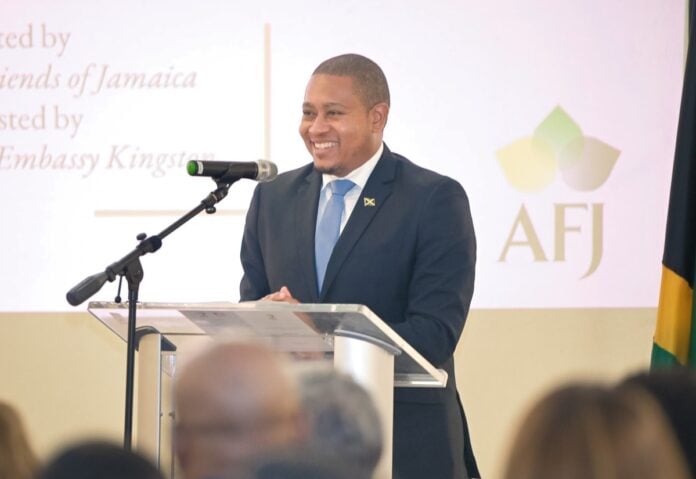
Minister of Agriculture, Fisheries and Mining, Hon. Floyd Green, addresses the American Friends of Jamaica (AFJ) grant awards ceremony held on Tuesday (April 14), at the United States (US) Embassy in Kingston
Sixty-five organizations working to improve the lives of Jamaicans have received grants totaling J$208 million (US$1.3 million) from the American Friends of Jamaica (AFJ).
The beneficiaries — including registered charities, non-profit organizations, community groups, hospitals, and schools — will use the funding to support initiatives in education, healthcare, disaster recovery, economic development, and community resilience across Jamaica.
Floyd Green welcomed the support, noting that it comes just weeks after the organization distributed cash vouchers to small farmers affected by Hurricane Melissa. He added that AFJ is also assisting with roofing and shelter reconstruction efforts in impacted parishes.
“Just the other day, we were gathered to distribute $80 million… benefiting 1,600 farmers in our hardest-hit parishes and we would have heard from some of our poultry farmers how much it means to them and how much your support is helping them build back stronger,” Green said.
The minister, who spoke at the grant awards ceremony on April 14 at the United States Embassy in Kingston, emphasized the importance of the organizations receiving funding.
“[They] are at the heart of what makes Jamaica work,” he said, describing AFJ as “an excellent partner.”
“The fact is, you have been a partner that has stood up in the good times and in the bad times, and it could have been very easy for you to say that with the hurricane and the recovery efforts, that that is the focus [and not the grant efforts] but I think you understand how important this grant programme is,” Green added.
Scott Renner also praised the organization’s continued commitment to community development.
“I am particularly impressed by the more than US$10 million raised in response to the devastation caused by Hurricane Melissa, supporting homeowners, schools, clinics and farmers,” Renner said, noting that AFJ “has stood tall among the many American partners who stepped forward to help communities recover.”
Caron Chung said the organization remains committed to supporting Jamaicans through its annual grant program.
“Today, we are celebrating a long-standing commitment towards a strategic annual granting programme. Importantly, the funding behind these grants is made possible in large parts through the generosity of our donors and the success of our annual galas in New York and Miami. Those are our cornerstones that fuel our grants year after year,” Chung said.
She noted that this year’s grantees represent a broad cross-section of organizations working in education, healthcare, and economic development.
Wendy Hart also commended the recipients for their role in strengthening communities across the island.
“[That] is why we are here in this room. We have been here for over 40 years. Every day is focused on building the role of philanthropy, of supporting the work of our partners and improving the lives of Jamaicans and the communities they live in,” Hart said.
Founded more than four decades ago, the American Friends of Jamaica continues to play a significant role in supporting community-based organizations and strengthening development initiatives across Jamaica.
At the Antigua Recreation Ground, the Guyana Harpy Eagles transformed steady progress into outright control, batting through the entire second day to build a commanding first-innings advantage over the Windward Islands Volcanoes.
Resuming on 130 for two, the innings briefly wavered when captain Tevin Imlach and overnight partner Tagenarine Chanderpaul departed in quick succession, reducing the score to 143 for four.
What followed, however, was a reassertion of control built on patience and partnerships.
Middle-order steel defines the day
Kemol Savory and Keemo Paul combined to steady the innings with a 96-run stand that restored balance and began to stretch the lead. Paul’s 56 off 87 balls provided momentum before Ryan John intervened.
Savory, however, pressed on. Anchoring the innings with discipline, he crafted 72 from 157 deliveries before falling to Kavem Hodge.
Even as wickets fell around him, including that of Gudakesh Motie, the Harpy Eagles refused to relinquish their advantage.
Richie Looknauth added a valuable 41, while Veerasammy Permaul (25 not out) and Shamar Joseph (10 not out) ensured the lower order extended the innings deep into the day.
By stumps, the Harpy Eagles had advanced to 361 for eight, establishing a formidable lead of 210 runs, a position that places them firmly in command.
For the Volcanoes, Kenneth Dember (3-82) and Shadrack Descarte (2-59) offered resistance, but the broader narrative belonged to Guyana’s resilience.
Seales ignites Red Force revival
Across the island at the Sir Vivian Richards Stadium, the Trinidad and Tobago Red Force engineered a dramatic reversal against the Leeward Islands Hurricanes, a contest defined by momentum swings and decisive spells.
The turning point began with resistance rather than dominance. Resuming at 85 for six, the Red Force appeared vulnerable, but Jyd Goolie delivered a composed, unbeaten 51, guiding the lower order through pressure.
His partnership with Jayden Seales proved critical. Together, they added 44 runs for the final wicket, pushing the Red Force to a first-innings lead of 44, a margin that would soon grow in significance.
Seales then took control of the match with the ball.
In a devastating burst, he dismantled the Hurricanes’ second innings, removing key batters in rapid succession. Early strikes against Kadeem Henry and Karima Gore set the tone, before he dismissed Keacy Carty to deepen the collapse.
The slide continued as Jewel Andrew and Justin Greaves followed, leaving the Hurricanes reeling at 43 for five.
Seales’ figures, six wickets for 33 runs from 16 overs, underscored a spell of sustained precision and pace that transformed the match.
Resistance prevents total collapse
Just as the contest threatened to unravel completely, Mikyle Louis and Jahmar Hamilton combined to restore some stability.
Louis struck a composed 73, while Hamilton remained unbeaten on 41, their 82-run partnership pulling the Hurricanes back from the brink.
Seales eventually returned to dismiss Louis, completing his six-wicket haul, but the Hurricanes reached 136 for six at the close, holding a slender overall lead of 92, though with the Red Force firmly in the ascendancy.
At Sabina Park, the contest between the Jamaica Scorpions and the Barbados Pride was shaped as much by weather as by play. Persistent showers limited action to just 54 overs, leaving the match finely poised.
The Scorpions, resuming on 358 for four, extended their first innings to 457, thanks largely to a counterattacking 54 from Odean Smith, who dominated a 68-run, ninth-wicket stand with Ojay Shields.
Earlier, the Pride had struck effectively through Shamar Springer, who claimed three wickets, while Jomel Warrican and Roston Chase provided support.
In reply, Barbados began with purpose. Kraigg Brathwaite and Shayne Moseley shared a brisk 105-run opening stand before Moseley fell for 53 to Peat Salmon.
At 125 for one, with Brathwaite unbeaten on 51 and Jonathan Drakes on 17, the match remained delicately balanced when rain brought an early end to proceedings.
Advantage claimed, outcomes pending
Across venues, the second day of action reinforced a central theme: control earned through resilience.
The Harpy Eagles have built a position of strength through sustained batting discipline. The Red Force, through grit and explosive bowling, have seized momentum from a precarious situation. Meanwhile, in Jamaica, weather has delayed clarity in a contest still open to either side.
With matches approaching decisive phases, the balance of power has begun to tilt, but the final outcome remains to be claimed.
In a move that extends his influence beyond the boundary, Chris Gayle has stepped into cricket ownership, joining the leadership group of a Glasgow-based franchise set to compete in the inaugural European T20 Premier League (ETPL).
The franchise, operating under the name Glasgow Mugafians, represents both a new venture for Gayle and a broader push to establish elite T20 cricket within emerging European markets.
Gayle’s involvement comes through a collaboration with the Mugafi Group, an India-based entertainment enterprise that has secured rights to the Glasgow franchise.
The ownership landscape, however, has shifted along the way. A group led by Rahul Dravid and Ravichandran Ashwin had initially been linked to the Glasgow team but is now expected to redirect its focus toward the Dublin-based outfit instead.
From dominance to development
For Gayle, whose career spanned more than two decades and redefined the possibilities of T20 batting, the transition into ownership signals a new phase, one centered on growth and legacy.
“Stepping into the role of co-owner of Glasgow Mugafians marks an exciting new chapter for me,” Gayle said.
His vision extends beyond competition to cultivation.
“Europe represents cricket’s final frontier, and the ETPL has the potential to unravel promising local talent and nurture future heroes who will strengthen the sport in that region. I can’t wait to get started on this new journey.”
The ETPL is designed as a multi-nation collaboration, organized in partnership with the cricket boards of Ireland, Scotland, and Netherlands.
Franchises will be based in key cities including Amsterdam, Rotterdam, Belfast, Dublin, Glasgow, and Edinburgh, reflecting an ambitious geographic footprint aimed at expanding cricket’s reach across the continent.
Financially, the league has already demonstrated significant backing, with franchise rights reportedly sold for £11.1 million over a 10-year cycle, a signal of long-term intent.
Countdown to a new competition
The tournament is scheduled to run from August 26 to September 20, marking the first full staging of a competition that seeks to blend established cricketing talent with emerging European prospects.
For Gayle, the timing aligns with a broader shift from player to stakeholder, from dominating games to shaping the environments in which they are played.
Having amassed 103 Tests, 301 One-Day Internationals, and 79 T20 Internationals between 1999 and 2021, Gayle’s reputation as one of cricket’s most recognizable figures is firmly established.
Now, through the Glasgow Mugafians, he enters a new contest, not for runs, but for influence, development, and the future direction of the game in untapped regions.
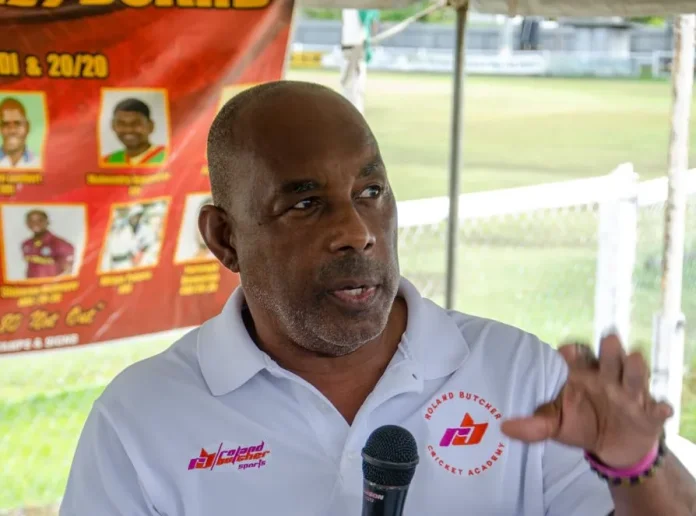
In a moment that fused history with recognition, Roland Butcher, the first Black man to represent England in Test cricket, was celebrated for a lifetime of influence both on and beyond the field.
The honor came at the prestigious Sporting Equals Awards, staged at the Royal Lancaster Hotel, where leading figures from across the sporting world gathered to recognize contributions that have reshaped access, inclusion, and opportunity.
Butcher shared the spotlight with Maggie Alphonsi, as both were presented with Special Lifetime Achievement Awards, a distinction reserved for individuals whose impact transcends performance and extends into lasting societal change.
The awards ceremony, now in its ninth edition, continues to highlight those driving meaningful progress for ethnically diverse communities within sport and physical activity.
From Barbados roots to historic debut
Born in Barbados, Butcher’s journey took him to England at a young age, where his cricketing talent flourished. He carved out a distinguished career with Middlesex County Cricket Club, performing at the iconic Lord’s Cricket Ground.
His place in history was secured in 1981 when he made his Test debut for England against the West Indies at the Kensington Oval, a symbolic full-circle moment in his birthplace.
For Butcher, the recognition carries deep personal meaning, while connecting him to a lineage of sporting excellence.
“I’m delighted and truly honoured to be nominated for a Special Lifetime Achievement Award and alongside Maggie Alphonsi. It is also great to be joining Lynford Christie, Denise Lewis, Sol Campbell and Jason Robinson, such a prestigious group who have received this special award,” he said.
His words reflected both gratitude and awareness of the broader legacy he now represents.
More than a career, a catalyst for change
Butcher’s significance extends beyond statistics and milestones. His breakthrough into England’s Test side marked a turning point, opening doors and challenging long-standing barriers within the sport.
Decades later, that impact continues to resonate, not only in cricket, but across the wider sporting landscape.
The Sporting Equals Awards, in recognizing his journey, reaffirm a central truth: progress in sport is often driven by those willing to step into uncharted space and redefine what is possible.
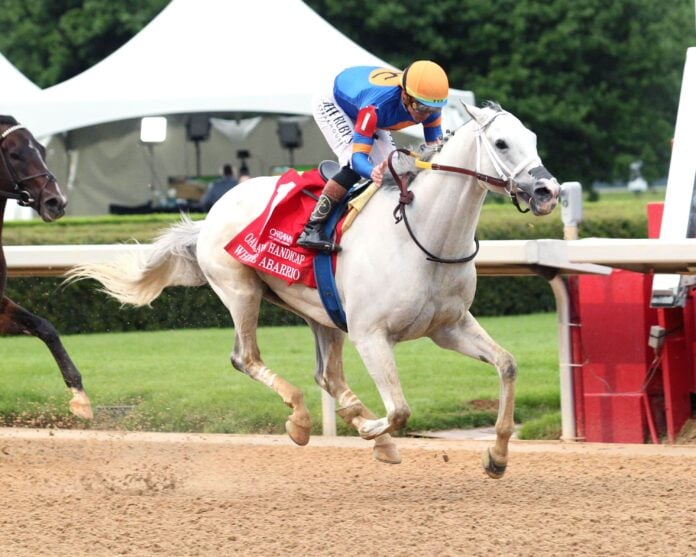
At Oaklawn Park, experience met execution as Saffie Joseph Jr guided his accomplished runner White Abarrio to a commanding victory in the US$1.25 million Oaklawn Handicap.
With Irad Ortiz Jr aboard, the seven-year-old delivered a polished performance, defeating a high-caliber field by two lengths and reinforcing his status as one of racing’s most dependable elite competitors.
Turning a showcase into a statement
The race entered the weekend framed as a clash between emerging stars, Sovereignty, the reigning Horse of the Year, and Journalism, both of whom had shaped last season’s Triple Crown narrative.
But as the gates opened, White Abarrio inserted himself into the conversation immediately. Breaking sharply, he dictated the early tempo before yielding the lead to Sovereignty heading into the first turn of the 1 1/8-mile contest.
Sovereignty set a demanding pace, 23.13 seconds for the opening quarter, 47.03 at the half, and 1:11.27 through six furlongs, with Journalism tracking closely. The anticipated duel began to unfold.
A calculated move, a decisive finish
Positioning proved pivotal. Approaching the final turn, Ortiz Jr angled White Abarrio off the rail, moving three-wide to launch a sustained challenge.
In the stretch, the veteran surged past the frontrunners, gradually separating himself as the finish approached. Sovereignty and Journalism continued to press, but White Abarrio found another gear in the closing stages, asserting control in the final sixteenth.
He crossed the line in 1:47.49 minutes on a fast track, the quickest winning time in the race since 1996, underscoring both the quality of the performance and the pace of the contest. Journalism finished strongly in third, eight lengths clear of the rest of the field.
A career that continues to deliver
The victory adds another milestone to an already distinguished résumé for White Abarrio, whose earnings now stand at $8.4 million, with 11 wins from 26 starts.
His career highlights include victories in the Florida Derby (2022), the Breeders’ Cup Classic (2023), and the Pegasus World Cup (2025), achievements that have cemented his reputation as a durable and elite competitor across multiple seasons.
For Barbadian Joseph, the triumph carried emotional weight beyond the purse and prestige. Speaking after the race, he reflected on the bond between the horse and its supporters.
“He has such a following. The horse, he’s been going so long. It’s nice to see how much appreciation people have for him.
“You don’t want to disappoint the fans when you have a horse like this now. You don’t want to disappoint the fans or the horse. It’s not even about us anymore.”
Enduring excellence
In a race billed as a showdown between the sport’s rising stars, it was the seasoned campaigner who delivered the defining performance.
With precision, patience, and power, White Abarrio once again proved that greatness in racing is not only about emergence, but about endurance.
As a teenager growing up in Jamaica, Monique Broughton remembers following the nightly news with ease — until the finance segment appeared.
“I would see market trends and stock prices going up and down, and I used to wonder what it was all about,” she recalls. “I could understand everything else on the news except that, and I always wished one day I would be able to.”
Today, that curiosity has come full circle. Now 36, Broughton serves as Chief Representative Officer for JN Bank in Canada, helping thousands of diaspora members navigate financial decisions while strengthening ties between Jamaicans abroad and their homeland.
Based in Toronto, Broughton oversees more than 20,000 member accounts and leads business development efforts across the country. Her work includes promoting savings and mortgage products, ensuring regulatory compliance, and representing the broader JN Group brand.
“JN is an exceptionally strong brand in the diaspora,” she said. “As an immigrant in Canada, while you are trying to assimilate, there’s something powerful about having an affinity to home, and JN provides that. People here say that when they walk into JN, they feel as if they’ve walked into Half-Way-Tree.”
For the Ardenne High School alumna, who studied sociology with a minor in human resource development at University of the West Indies Mona, relationships remain central to her success. Broughton and her team regularly attend community events across Canada — from alumni galas and jerk festivals to Jamaica Day celebrations — connecting directly with diaspora communities.
“We try to be at every diaspora-related event. We attend about 80 per cent of them in person to connect, network and represent the brand,” she said.
Broughton migrated to Canada in 2014 to pursue a postgraduate certificate in finance at Humber College. After completing her studies, she interned with JN’s Toronto branch and steadily rose through the ranks, serving as project coordinator and later assistant manager for operations and promotions.
In 2021, she joined Alterna Savings Credit Union as branch compliance manager before returning to JN in 2024 to take on her current leadership role.
Her early career interest in finance was sparked during a summer job while attending university. That experience introduced her to banking operations, including customer service, account management, and financial transactions — helping her connect the dots to the financial concepts she once struggled to understand.
“I was connecting the dots and fully understanding: ‘Oh, this is what I used to see on the news,’” she said.
However, the move to Canada was not without challenges. At 23, Broughton faced a steep learning curve — from harsh winters and long commutes to adapting to a different academic system.
She recalls commuting up to five hours daily between Brampton and Toronto, navigating freezing temperatures, and adjusting to a more fast-paced learning environment.
“It was very hard to transition from Jamaica to Canada,” she said. “Moving here meant navigating a new country and, for the first time, being fully independent.”
Now, more than a decade later, Broughton sees the diaspora playing an increasingly influential role in Jamaica’s future. She believes professionals abroad should contribute their expertise through short-term sabbaticals to help strengthen sectors such as finance, healthcare, and public administration.
“The diaspora is growing and strong beyond Toronto,” she said. “We are exposed to another way of doing things, and we are seeing what works.”
Outside of her professional role, Broughton remains deeply involved in community service. She chairs the Metropolitan Action Committee on Violence Against Women, serves on the Jamaica Independence Church Service Committee, and volunteers at the First Mennonite Church.
She also mentors students through the Global Diaspora Council’s Diaspora Mentorship Academy, guiding a sixth-form student at St Elizabeth Technical High School.
“I was once in sixth form myself, really wanting to hear from someone who had gone through the same experiences,” she said. “When this opportunity came, I jumped at it, because it was exactly what I had wished for at her age.”
For Broughton, the mission extends beyond banking. It is about connection — linking Jamaicans abroad with opportunity, community, and home.
International reggae icon Buju Banton has been announced as the official headliner for the 2026 Yard on The Lawn Festival, a major celebration of Caribbean American Heritage Month hosted by the City of Tamarac.
The highly anticipated event, founded by Vice Mayor Marlon D. Bolton, will take place on Saturday, June 6, 2026, beginning at 6:00 p.m. at the Tamarac Sports Complex. Organizers expect thousands of attendees from across Florida and beyond for what has quickly become one of South Florida’s most celebrated Caribbean cultural events.
“Bringing Buju Banton to Tamarac is more than securing a performer — it is creating a historic cultural experience for our city and for Caribbean people across the region,” Bolton said in a statement. “Buju Banton’s music has uplifted generations with messages of perseverance, empowerment, and truth. We are honored to welcome a living legend to Tamarac.”
Although the festival is free, attendees will be required to obtain tickets due to expected demand and venue capacity. The City will release free general admission tickets, 250 VIP tickets, and media registration access on April 30, 2026, at noon.
Bolton said demand is expected to be immediate.
“We fully expect tickets to be claimed within the first hour of release. If you want to be part of this unforgettable night, be ready when tickets go live,” he added.
VIP tickets, typically priced at $200, will be offered at a special launch-day rate of $50 on April 30 while supplies last. VIP guests will receive premium seating near the stage, exclusive swag bags, reserved accommodations, and an elevated festival experience. General admission attendees will enjoy standing-room access in the main celebration area.
Organizers also announced limited vendor opportunities for businesses, artisans, food vendors, and community exhibitors. Applications must be submitted by April 30, 2026, with early submissions strongly encouraged due to anticipated demand.
In addition, Fairfield by Marriott Tamarac has been named the official hotel partner for the festival. Special room rates for attendees will also be released April 30.
Born Mark Anthony Myrie in Kingston, Jamaica, Buju Banton is widely regarded as one of the most influential reggae and dancehall artists of his generation. Over a career spanning more than three decades, he has delivered hits including Hills and Valleys, Not An Easy Road, Who Say, and Bogle. His acclaimed albums include Til Shiloh, Before the Dawn, and Born For Greatness.
The reggae star recently made headlines after becoming the first reggae/dancehall artist to sell out UBS Arena, underscoring his continued global appeal.
For ticket releases, vendor applications, and additional event updates, organizers are encouraging the public to follow Vice Mayor Marlon D. Bolton and the City of Tamarac’s official social media channels.
The numbers tell one story: four matches, four wins, 12 points, and complete control of Group B. The performance, however, tells another.
Jamaica’s Reggae Girlz closed their Concacaf Women’s Qualifiers campaign with a 2-0 victory over Guyana at the National Stadium on Saturday night, a result that confirmed their place atop the standings and secured passage to the Concacaf W Championship. Yet for Head Coach Hubert Busby Jr., the night was less about celebration and more about reflection.
His team overwhelmed the opposition from the opening whistle, but the margin of victory failed to reflect the scale of dominance.
“[I’m] only really frustrated from the aspect that the players obviously deserved more,” Busby said afterward. “I think we could have put the game away earlier… but I’m obviously pleased with the performance in terms of how we managed the game.”
Headers that framed the night
The match unfolded like a controlled script with two decisive punctuation marks.
Captain Khadija Shaw set the tone early, rising to head home in the eighth minute and ignite the crowd. Nearly 80 minutes later, substitute Shania Hayles mirrored that moment with a late header of her own, sealing the result in a match Jamaica never relinquished.
Between those goals, the Reggae Girlz dictated everything, tempo, territory, and possession. They pressed high, recycled the ball with purpose, and generated a relentless stream of chances that should have transformed control into a rout.
Instead, the scoreline remained stubbornly narrow.
Chance creation without conversion
Jamaica’s attacking output was overwhelming in volume but underwhelming in return. The team unleashed 36 shots, 17 of them on target, yet found the net only twice.
It was not an isolated concern. After an explosive 18-goal opening against Dominica, the Girlz have managed just nine goals from 103 attempts across their last three matches, a conversion rate dipping below nine percent.
For Busby, the issue is not a lack of quality, but a matter of execution, and perhaps mindset.
“I think it’s a situation where now we’ve to get over a little bit [of a] mental [block],” he explained. “We’re creating opportunities; the players and the quality is absolutely there… sometimes you can overthink, and I think that’s kind of happening now.”
Even so, he sees reason for optimism rather than alarm.
“We’d be more concerned if we are not creating opportunities, but we are.”
Control, composure, and context
If finishing was the flaw, control was the foundation. Jamaica suffocated Guyana with sustained pressure and commanding possession, rarely allowing the visitors a foothold.
Busby pointed to that control as evidence of the team’s growth.
“Goals change games and allow us to get on the ball a bit more and move it and manage it,” he noted. “But at the end of the day, we found a way to get over the line, and that’s a good sign of a team.”
There were also mitigating factors. The playing surface at the National Stadium proved unpredictable, particularly in critical attacking areas.
“The ground has come up… right in front of goal. You either take a bobble or lose your footing, so those things were a little bit in factor as well,” Busby said.
Add in a resilient Guyanese goalkeeper who produced key saves, and the explanation becomes more layered, though not excused.
Progress over perfection
For Busby, the broader philosophy remains unchanged. Results matter, but development matters more.
“It is not about perfection; it is about making progress,” he emphasized. “You can see how we’re looking to play, and we get better each and every game.”
That progress is reflected not only in results but in identity, a team that presses with intent, controls possession, and consistently manufactures scoring opportunities.
The next step is converting those patterns into decisive outcomes.
Eyes on the bigger prize
With qualification secured, Jamaica now turns its attention to the Concacaf W Championship in November, the gateway to the 2027 FIFA Women’s World Cup and the 2028 Olympic Games in Los Angeles.
Busby’s message to his players is clear: improvement does not pause between camps.
“It’s really important… when they go back into their environments that they are playing, they’re doing well, and continuing to push the level,” he said.
The immediate focus shifts to the June international window, where two matches will serve as critical preparation. Beyond that lies a longer runway toward October and the high-stakes tournament ahead.
“We’re turning to what happens within the June window and looking to maximise those two games in terms of preparation,” Busby added.
The verdict: Encouragement with an edge
Jamaica’s campaign ends where it began, in control, unbeaten, and undeniably among the region’s elite. But beneath the perfect record lies a challenge that cannot be ignored.
The Reggae Girlz are creating chances at will. The next evolution is finishing them with authority.
For now, Busby walks the line between satisfaction and demand, encouraged by what his team is becoming, but insistent on what it must still fix.
At Sabina Park, the Jamaica Scorpions authored a day of authority that blended technical discipline with attacking flair, finishing the opening day of their West Indies Championship second-round clash against the Barbados Pride on Sunday at a commanding 358 for four.
Central to the effort was Kirk McKenzie Jr, whose second consecutive century on home soil reinforced both his form and his growing stature within the side. Yet, even amid the dominance, the day carried a moment of regret, a near-perfect innings from captain John Campbell that ended four runs shy of a deserved hundred.
A partnership of precision and patience
After electing to bat on a surface offering a hint of grass without significant threat, Jamaica’s openers settled quickly into a rhythm that never allowed Barbados to dictate terms.
Campbell and McKenzie navigated the morning session with composure, moving steadily to 54 without loss before shifting gears. Their partnership reached three figures in just over 20 overs, with both batters balancing restraint and aggression.
Campbell’s half-century arrived first, a crisp effort off 54 deliveries, while McKenzie followed, bringing up his own in 70 balls. By lunch, the Scorpions were firmly in control at 128 without loss, the foundation laid with precision.
The stand swelled beyond 200, echoing their previous match heroics and underlining a growing synergy at the top of the order.
The cruel turn in the nineties
Campbell appeared destined to convert control into a landmark innings. Having punished the attack with authority, he moved to 96 with a towering six off Johann Layne.
But in a fleeting lapse, ambition overtook judgment. Attempting another maximum to seal his century in emphatic fashion, he miscued, offering a chance that was brilliantly taken by Shamar Springer in the deep.
The dismissal, 96 from 111 balls, punctuated by 12 fours and two sixes, halted momentum and briefly shifted the tone.
That momentary disruption deepened when Carlos Brown, after striking an elegant boundary, edged loosely to slip, where Kyle Mayers completed the catch.
At 242 for two, rain intervened, pausing play and threatening to break Jamaica’s rhythm.
McKenzie’s measured mastery
If the interruption invited uncertainty, McKenzie dismissed it with calm assurance. Resuming with focus intact, he continued to anchor the innings, blending patience with calculated strokeplay.
His century, crafted from 131 deliveries and adorned with 14 fours and a six, was both a personal milestone and a stabilizing force for the innings.
“I think it was a very good innings,” McKenzie reflected. “I started slowly again, like the last innings. It allows me to continue my form and continue my processes. It is really good to score back-to-back centuries, scoring them at home as well. So I really enjoyed that.”
His eventual dismissal for 114, taken in the deep by Jomel Warrican off Jair McAllister, did little to diminish the imprint he left on the day.
Acceleration through the middle
With the platform secure, the Scorpions shifted into a higher gear. Javelle Glenn injected urgency, taking a particular liking to the spin duo of Roston Chase and Warrican.
His 65 came in a blur of controlled aggression, featuring six boundaries and three sixes, and ensured Jamaica maintained pressure deep into the evening session.
Alongside him, Brad Barnes provided steady support, the pair adding 73 runs for the fourth wicket to stretch the advantage further. Glenn eventually fell to Warrican, but the damage had been done.
As the light faded, Barnes remained unbeaten on 34, with Romaine Morris on nine, guiding the Scorpions safely to stumps at 358 for four.
Layne emerged as the pick of the bowlers with two wickets, but Barbados spent much of the day on the defensive, unable to consistently disrupt Jamaica’s flow.
Momentum with meaning
Day one belonged emphatically to the Scorpions, a blend of discipline at the top, resilience in the middle, and acceleration when it mattered.
Yet the narrative was defined as much by what was achieved as by what narrowly slipped away: a captain’s century denied, and a rising star confirming his place with another commanding performance.
With the foundation firmly laid, Jamaica now carries both momentum and expectation into the days ahead.
At the Antigua Recreation Ground, the defending champions, the Guyana Harpy Eagles, wasted little time asserting their authority, turning the opening day of their West Indies Championship second-round clash into a showcase of disciplined, incisive bowling.
The foundation of their dominance was laid by Nial Smith, whose relentless accuracy dismantled the Windward Islands Volcanoes top order. His return of 5-36 carved through the innings and ensured the Volcanoes never found stability.
Inserted to bat, the Volcanoes quickly slipped into disarray. Early strikes from Keemo Paul removed Ackeem Auguste, before Smith orchestrated a collapse that saw key wickets tumble in rapid succession.
By the time Alick Athanaze departed, the scoreboard read a precarious 17 for four. When Paul returned to dismiss Shadrack Descarte, the innings teetered at 21 for five, a position from which recovery seemed unlikely.
Resistance restores respectability
Salvation arrived through a measured partnership between Sunil Ambris and Noelle Leo, who combined for 68 runs to steady the innings and inject some resistance.
Ambris compiled 35, while Leo added 36, absorbing pressure and briefly halting the slide.
Even after their stand was broken, Smith returning to remove Leo, the lower order contributed valuable runs. Ryan John top-scored with 37, and Kenneth Dember chipped in with 18, as the final wickets added 57 runs to push the total to 151.
Paul finished with 2-46, while Shamar Joseph provided further support with 2-52, ensuring the Harpy Eagles maintained pressure throughout.
Steady reply keeps champions in command
In response, the Harpy Eagles approached their chase with composure befitting champions.
Matthew Nandu and Tagenarine Chanderpaul laid a solid platform with an opening stand of 64, neutralizing any early threat from the Volcanoes’ attack.
Nandu’s fluent 54, striking eight boundaries and a six, set the tempo before Dember intervened to break the partnership.
From there, Kevlon Anderson joined Chanderpaul to maintain control, the pair adding 61 runs to further tilt the balance. Anderson’s 41 was eventually ended lbw by Dember, but the damage had already been done.
By stumps, the Harpy Eagles had advanced to 130 for two, trailing by just 21 runs and firmly positioned to seize a first-innings lead early on the second day. Chanderpaul, resolute as ever, remained unbeaten on 29 from 129 deliveries.
Hurricanes rocked, then rally
Across the island at the Sir Vivian Richards Stadium, the narrative took a different turn, one defined by collapse, resistance, and a dramatic reversal.
The Leeward Islands Hurricanes endured another difficult outing with the bat, dismissed for 131 in 39.3 overs against the Trinidad and Tobago Red Force.
Karima Gore stood alone in defiance, crafting a determined 57 from 90 balls while wickets fell steadily around him.
The chief architect of the Hurricanes’ struggles was Anderson Phillip, whose devastating six-wicket haul dismantled the innings and appeared to place the Red Force firmly in control.
Collapse flips the script
With a modest target to surpass, the Red Force began confidently, progressing to 43 for one despite the early loss of Cephas Cooper.
At that stage, a routine march toward a first-innings lead seemed inevitable.
Instead, the match turned sharply. The retirement of Jyd Goolie triggered a sudden and dramatic collapse, as the Red Force lost five wickets for just 26 runs.
Kelvin Pitman led the charge, removing Jason Mohammed, Terrance Hinds, and Khary Pierre in a decisive spell.
At the other end, Oshane Thomas struck key blows, dismissing Evin Lewis and Amir Jangoo, as the innings unraveled.
From control to crisis, the Red Force stumbled to 69 for six before closing at 85 for six, their advantage suddenly under threat.
Day one defined by the ball
As stumps were drawn, two matches revealed a common thread, bowlers dictating terms and reshaping contests within sessions.
The Harpy Eagles hold firm control, driven by Smith’s incisive spell and a composed batting reply. Meanwhile, the Hurricanes, despite early struggles, clawed their way back into contention through disciplined, aggressive fast bowling.
With momentum split across venues, the second day promises a continuation of contests shaped not by predictability, but by sharp, decisive bursts of brilliance.
Amid the charged atmosphere of the UWI Sport and Physical Education Centre, Trinidad and Tobago’s junior “Calypso Girls” transformed expectation into execution, successfully defending their crown at the Jean Pierre Caribbean Youth Netball Tournament.
Their 42-21 triumph over Barbados on Friday not only sealed consecutive titles, but did so with authority, a performance that reflected preparation, composure, and depth.
A competitive opening gives way to control
The final began at a frenetic pace, with Barbados immediately asserting themselves by scoring from the opening pass. Their early sharpness translated into a narrow 9-8 edge at the end of the first quarter, signaling a contest worthy of the occasion.
But the balance shifted steadily. Trinidad and Tobago tightened their structure, sharpened their passing, and began to dictate tempo. By halftime, the hosts had established a 19-14 lead, gradually squeezing the life out of Barbados’ momentum.
The decisive surge came in the third quarter. Defensive pressure intensified, transitions became cleaner, and the Calypso Girls pulled clear at 33-16, a margin that effectively settled the contest before the final whistle.
Precision in attack, pressure in defense
At the heart of the victory was a clinical attacking display led by Curleen Lara, whose 33 goals from 40 attempts anchored the offense with both volume and accuracy.
Supporting her was Zewditu Alexander, who delivered an efficient nine goals from 11 attempts, ensuring the attacking unit remained balanced and relentless.
Barbados found resistance through Cherish Gibson, who produced 15 goals from 21 attempts, but consistent scoring proved elusive under sustained defensive pressure.
That defensive effort proved decisive. Trinidad and Tobago disrupted passing lanes, forced turnovers, and dictated the rhythm of play, a suffocating approach that left Barbados chasing the game for long stretches.
Momentum built long before the final
The championship performance was not an isolated peak, but the culmination of a tournament defined by dominance.
A day earlier, Trinidad and Tobago delivered a resounding statement, dismantling Antigua and Barbuda 51-9 in a display of overwhelming superiority. Lara again led the charge with 37 goals, while Alexander’s near-flawless 14-of-15 shooting highlighted the team’s attacking efficiency.
Defensively, that contest underscored their intensity, with Antigua & Barbuda held scoreless for extended periods, a reflection of a unit operating in complete cohesion.
Barbados, for their part, had earned their place in the final with a 36-27 victory over Saint Lucia, but ultimately encountered a side operating at a different level.
A coach’s pride, a program’s foundation
For head coach Sojourner “Suzie” Hyles-Lewis, the triumph carried deeper meaning beyond the scoreboard.
“It was a privilege and an honour to actually repeat this victory, especially at home, in front of friends, supporters, and well-wishers,” she said. “I think dedication and commitment from the staff was key, because all of us had the same mission: to complete the task at the end. I dedicate this victory to our well-rounded technical staff and the solid foundation we have with these girls.”
Her words reflected a program built on collective effort, one supported by assistant coach Simone Morgan, manager Jody Sprott, physiotherapist Runako Gittens, and massage therapist David Mack.
While Barbados secured second place and Grenada finished third, the tournament ultimately belonged to Trinidad and Tobago, a team that combined discipline, firepower, and unity to stand above the rest.
On home soil, with a crowd roaring in rhythm, the Calypso Girls did more than defend a title. They defined a standard.
At the Percy Beard Track, a race expected to showcase elite collegiate speed instead became a defining moment for a rising star.
Adaejah Hodge, a freshman representing the University of Georgia Lady Bulldogs, delivered a performance that instantly altered the landscape of women’s sprinting. Her electrifying 10.77 seconds in the 100 meters at the Tom Jones Memorial was not merely a victory, it was a declaration.
Numbers that resonate beyond the finish line
The time carries weight on every level. It stands as the fastest mark in the world this season, a new national record for the British Virgin Islands, and the second-fastest performance in NCAA history.
Only Sha’Carri Richardson has run quicker at the collegiate level, her 10.75 from 2019 now looming just two hundredths ahead.
For a 19-year-old in her first year of NCAA competition, the proximity to that benchmark underscores the magnitude of Hodge’s breakthrough.
Execution at full throttle
From the moment the gun fired, Hodge imposed herself on the race. Her start was explosive, her transition seamless, and her top-end speed decisive.
There was no late surge required, she had already broken the field. Each stride widened the gap, turning a competitive final into a showcase of individual brilliance.
Behind her, elite performances unfolded in her shadow. Shenese Walker of Florida State University clocked an outstanding 10.80 seconds for second place, a time that would typically dominate any meet.
Alexis Brown of University of South Carolina secured third in 11.04 seconds, completing a podium that reflected the race’s exceptional quality.
A statement that echoes
Hodge’s performance was not simply fast, it was disruptive. It challenged expectations, redefined her trajectory, and signaled the arrival of a contender capable of shaping the future of the event.
In a discipline where margins are measured in hundredths, her 10.77 seconds stands as both a milestone and a warning.
The sprint world now has a new focal point, and Adaejah Hodge has made it clear she is not just participating in the conversation. She is leading it.
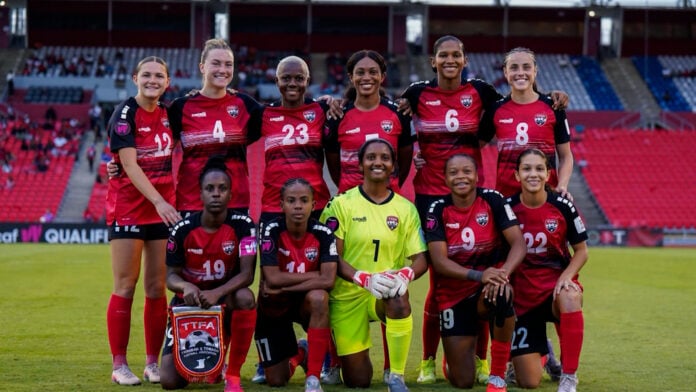
At the Hasely Crawford Stadium on Friday night, the Trinidad and Tobago senior women’s national team saw their ambitions for the 2027 FIFA Women’s World Cup come to an abrupt end, falling 2-0 to El Salvador women’s national football team in a result that confirmed their exit from qualification contention.
The defeat was not an isolated disappointment. It arrived as part of a broader and increasingly troubling trend across national football programs, one that has seen multiple age groups, including senior men, Under-20 men, Under-17 boys, and Under-17 girls, all fail to advance in their respective World Cup qualifying campaigns in recent months.
For former national player, coach, and sports administrator Kenneth Butcher, the pattern has moved beyond frustration. In his view, it represents systemic breakdown.
A system under fire
Speaking on the Friday edition of iSports on i95.5 FM, Butcher delivered a forceful critique of the current direction of the Trinidad and Tobago Football Association (TTFA), arguing that the repeated failures point to deeper structural issues rather than isolated setbacks.
His central message was stark: leadership change is no longer optional.
“I know they won’t resign,” Butcher stated. “But if I were the government, I would say, no more funding for them. I am not interfering with you. But if I am spending $4 to $5 million a year, I am telling you that if you don’t do X, Y and Z, no more funding.”
For Butcher, accountability must now be enforced externally if it cannot be established internally. He called for government intervention through financial leverage, arguing that continued investment without reform only prolongs stagnation.
“You want to save Trinidad and Tobago football?” he asked. “Then you have to force their hand. Decisive action. Not more press conferences. Not more promises. Action.”
Beyond results: A question of direction
While acknowledging the defeats themselves, Butcher insisted the issue runs deeper than match outcomes. In his assessment, Trinidad and Tobago’s struggles stem from technical mismanagement, particularly in coaching and selection decisions.
“Yes, of course. It’s the coaching,” he said when asked whether the teams could have performed better. “When you look at some of the teams that we had together, the selection of the team was poor. The combinations.”
He pointed to what he described as inconsistent decision-making in player utilization, suggesting that talent has not always been properly integrated into matchday plans.
“Look at this boy, Nathaniel James,” Butcher said. “He’s one case. You could use that as an example. A youngster who was doing extremely well and couldn’t start. That is not technical. That is coaching.”
A pattern that demands answers
Butcher refrained from naming specific coaches or administrators, but his broader criticism was unmistakable. He argued that failures are not confined to one team or one tournament, but instead reflect a recurring inability to build coherent systems from youth to senior level, across both men’s and women’s football.
In his view, the absence of consistent technical direction has left national programs fragmented, with talent underutilized and potential repeatedly unrealized on the international stage.
The latest women’s team elimination has now added another layer to a growing narrative of disappointment across the national setup. Each failed qualification campaign, Butcher contends, reinforces the urgency for structural change rather than incremental adjustment.
For him, the conclusion is unavoidable: Trinidad and Tobago football is no longer in need of minor correction, but fundamental reset.
As the dust settles on yet another missed World Cup opportunity, the question now extends beyond the pitch, and directly toward governance, accountability, and the future direction of the sport itself.
Prime Minister Kamla Persad-Bissessar says there is no need for a curfew following the killing of a municipal police officer and the theft of dozens of firearms from a police facility in Trinidad and Tobago.
In a statement issued Sunday, Persad-Bissessar said she had been advised that the incident at the San Fernando City Corporation Municipal Police Station on King’s Wharf was not an external attack on the Trinidad and Tobago Police Service (TTPS) or other national security agencies.
Instead, she described the incident as an “internal betrayal” within the Trinidad and Tobago Municipal Police Service (TTMPS).
The Prime Minister emphasized that the TTPS is separate from the municipal police service and confirmed that TTPS officers were not involved in the incident.
She said the Ministry of Homeland Security and the TTPS will provide full support to the municipal police, Robert Parris, and the San Fernando City Corporation as authorities investigate the matter, recover the stolen weapons, and bring the situation to closure.
The body of Acting Corporal Anushka Eversley, 42, was discovered at the Municipal Police Headquarters on Lady Hailes Avenue in San Fernando around 4:40 a.m. Sunday.
Authorities reported that 62 firearms and approximately 4,000 rounds of ammunition were stolen from the station’s armoury. Eversley, a mother of three children aged 18, 15 and seven, had more than 19 years of service. Officials said she was fatally shot in the upper body.
In her statement, Persad-Bissessar also addressed a separate incident involving bodies discovered at the Cumuto Cemetery, noting that authorities had determined the remains were unclaimed bodies that had been improperly disposed of, and not homicide victims.
She said both matters are being actively investigated and are expected to be resolved in the coming days.
“There is no need for any curfew,” Persad-Bissessar stated, adding that law enforcement continues to make progress in addressing crime. She encouraged law-abiding citizens to continue their normal activities.
The Prime Minister also thanked Commissioner of Police Guevarro and TTPS officers for their swift response to both incidents.
Jamaican dancehall star Sean Paul continues to expand his global achievements, with his 2009 collaboration “Brown Skin Girl” alongside Chris Brown earning Gold certification in New Zealand.
The certification, awarded by Recorded Music NZ, represents 15,000 units sold as of April 9, further underscoring Sean Paul’s sustained popularity in the region.
The latest milestone follows another recent achievement in New Zealand. On March 26, Sean Paul’s hit “(When You Gonna) Give It Up To Me” featuring Keyshia Cole also secured Gold status, adding to his growing list of accolades in the country.
Among his biggest successes in New Zealand, “No Lie” featuring Dua Lipa has reached triple Platinum, while crossover dancehall hits “Temperature” and “Get Busy” have both been certified double Platinum. Meanwhile, “Baby Boy” with Beyoncé holds Platinum status.
Sean Paul’s Jamaican crossover anthem “Go Down Deh,” featuring Spice and Shaggy, has also earned Gold certification, along with his classic hit “I’m Still in Love With You.”
“Brown Skin Girl” originally appeared on Chris Brown’s third studio album, Graffiti, released on December 8, 2009, via Jive Records. The album debuted at No. 7 on the Billboard 200, selling more than 102,000 copies in its first week.
Known for global hits such as “Temperature,” “Get Busy,” and “Gimme the Light,” Sean Paul first broke onto the Billboard charts in the early 2000s and has maintained a strong international presence ever since, helping bridge dancehall with mainstream audiences worldwide.
His critically acclaimed album Dutty Rock won the Grammy Award for Best Reggae Album, while several of his other albums have also earned nominations.
Sean Paul has also contributed to numerous global chart-topping collaborations, including “Baby Boy” by Beyoncé, “Breathe” by Blu Cantrell, “What About Us” by The Saturdays, “Rockabye” by Clean Bandit, “Cheap Thrills” by Sia, and “Fuego” by DJ Snake.
Several of these hits — including “Cheap Thrills,” “Rockabye,” and “No Lie” — have each surpassed one billion views on YouTube, with “Rockabye” exceeding 2.7 billion views, further cementing Sean Paul’s status as one of dancehall’s most successful global ambassadors.
The Government of Antigua and Barbuda has rejected as “false and misleading” claims by Opposition Leader Jamale Pringle that recent United States visa restrictions are the result of government actions or could be reversed by local political intervention.
In a statement issued Saturday, the government said decisions regarding U.S. visas are made solely by United States Department of State and are based on American national interests, not policies implemented by Antigua and Barbuda.
The statement referenced comments from U.S. Secretary of State Marco Rubio, who recently announced an expansion of visa restrictions targeting individuals believed to be working on behalf of U.S. adversaries in ways that could undermine regional security and democratic governance.
Rubio also emphasized that obtaining a U.S. visa is “a privilege,” not a right, and that such decisions rest entirely with the United States government.
Officials in St. John’s stressed that Antigua and Barbuda is not the only country affected, noting that similar visa denials occur across the Caribbean and the wider Western Hemisphere under existing U.S. immigration policies.
The government also defended its diplomatic approach, stating that it has been actively engaging U.S. officials on the issue. According to the statement, Prime Minister Gaston Browne recently discussed visa-related concerns directly with U.S. lawyer and diplomat Christopher Landau as part of ongoing diplomatic efforts.
Officials said such engagement reflects responsible governance and contrasted that approach with what they described as political rhetoric from the opposition.
The statement argued that Pringle’s comments either reflect a misunderstanding of international relations or an attempt to mislead the public for political gain, adding that visa policy decisions are made in Washington, not St. John’s.
Government officials concluded that while diplomacy can help improve arrangements, no local political leader has the authority to alter U.S. visa policies unilaterally.
Authorities in Trinidad and Tobago are investigating what is being described as one of the most serious security breaches at a police facility in recent years, after a municipal police officer was found dead and a large quantity of firearms went missing from a station strong room.
The officer has been identified as Acting Corporal Anusha Eversley of the Trinidad and Tobago Municipal Police Service.
The incident occurred at the San Fernando Municipal Police Station on Lady Hailes Avenue in San Fernando.
Police reported that Eversley was last seen around 11 p.m. on Saturday. At approximately 4:40 a.m. on Sunday, a fellow officer returned to the station and found the building in darkness. After turning on the lights, the officer noticed blood coming from the corporal’s quarters. The strong room, where weapons are stored, was also discovered open.
Further checks revealed that dozens of firearms and thousands of rounds of ammunition were missing. Officials confirmed that among the items unaccounted for were Glock pistols, shotguns, and other weapons.
Responding officers found Eversley unresponsive inside her quarters. She was later pronounced dead. Investigators reported that she had visible injuries, but the exact cause of death has not yet been determined.
Homicide investigators and senior police officials have since secured the scene and launched a full investigation. The police station remains under lockdown as forensic teams continue processing evidence.
Authorities are also examining whether Eversley may have been assaulted prior to her death, as investigators work to determine how the breach occurred and to locate the missing firearms.
Officials have not yet announced any suspects, and the investigation remains ongoing.
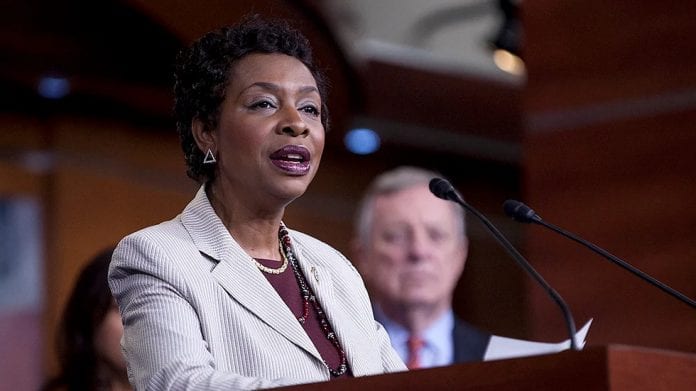
Caribbean-American Democratic U.S. Rep. Yvette D. Clarke has officially launched her re-election campaign, drawing a large crowd of supporters, community leaders, and residents to her Central Brooklyn headquarters on Saturday, April 11.
The kickoff event, held along Nostrand Avenue near Maple Street, marked the start of Clarke’s bid to retain her seat representing New York’s 9th Congressional District — an area known for its strong Caribbean-American population. The district includes Brownsville, Crown Heights, East Flatbush, Flatbush, Kensington, Midwood, Sheepshead Bay, Marine Park, Gerritsen Beach, and Prospect Lefferts Gardens.
The Democratic primary is scheduled for June 23, with early voting running from June 13 to June 21.
Addressing supporters, Clarke — the daughter of Jamaican immigrants — reflected on her upbringing in Brooklyn and her deep ties to the community.
“I’m so grateful to be here in the community that raised me,” she said, noting that her parents built their lives in Flatbush, where she still lives today.
Clarke was born in Flatbush, Brooklyn, on November 21, 1964, to Lesley Clarke and former city councilwoman Una Clarke, both immigrants from Jamaica.
Clarke emphasized that despite hard work and resilience, many families in the district continue to face economic challenges.
She pointed to rising costs for housing, food, and fuel, while also criticizing what she described as policies that benefit wealthier Americans at the expense of working families.
“Tax breaks for the wealthy while cutting healthcare, food assistance, and housing support are straining families,” Clarke said. She also expressed concern about increased federal spending on defense and international conflicts, arguing that such priorities divert resources away from domestic needs.
Clarke, who currently serves as chair of the Congressional Black Caucus, said the political climate underscores the importance of experienced leadership.
“We need proven fighters in Congress,” she said. “The stakes could not be higher, and our determination must be stronger than ever.”
During the campaign launch, Clarke also highlighted her legislative record, including efforts to address misinformation and emerging technologies. She has introduced measures such as the DEEPFAKES Accountability Act and the REAL Political Ads Act, aimed at increasing transparency and regulating artificial intelligence-generated content in political advertising.
Separately, Clarke recently joined fellow lawmakers in calling for revisions to the 21st Century ROAD to Housing Act (H.R. 6644), citing the need to address the nation’s housing affordability crisis. She aligned with senior legislators, including Maxine Waters, urging Congress to strengthen provisions that expand homeownership opportunities, protect tenants, and increase the supply of affordable housing.
Clarke said bipartisan cooperation will be critical to advancing meaningful housing reform.
“It is our responsibility to ensure that families across America receive the support they need,” she said, calling on lawmakers to reconcile differences between House and Senate versions of the legislation.
With decades of public service, including her tenure on the New York City Council, Clarke framed her campaign as a continuation of her longstanding commitment to Central Brooklyn.
As the June primary approaches, she urged supporters to remain engaged and mobilized.
“When we fight, we win,” Clarke told the crowd, encouraging voters to head to the polls in the weeks ahead.
Clarke has been serving as the U.S. representative for New York’s 9th congressional district since 2013. A member of the Democratic Party, she first entered Congress in 2007, representing New York’s 11th congressional district until redistricting. Clarke represented the 40th district in Brooklyn on the New York City Council from 2002 to 2006.
Florida may soon see the beginning of the end for the penny in everyday cash transactions, after state lawmakers approved legislation allowing businesses to round cash payments to the nearest five cents.
The measure, known as Senate Bill 1074, would permit retailers to round totals up or down when customers pay with cash. If signed into law, the change could quietly reshape how millions of Floridians pay for everyday purchases, while the penny technically remains legal tender.
Under the proposal, totals ending in one or two cents would be rounded down, while those ending in three or four cents would be rounded up. The same pattern would apply to amounts ending in six through nine cents.
For example:
$10.02 would round to $10.00
$10.04 would round to $10.05
$10.07 would round to $10.05
$10.09 would round to $10.10
The rounding would apply only to cash transactions. Payments made with credit cards, debit cards, or digital methods would still be charged the exact amount. Taxes would also continue to be calculated based on the precise price before rounding.
Each retailer would be allowed to decide how rounding is applied, although advocates say the goal is to keep the impact minimal and balanced over time.
While the change may go largely unnoticed by many consumers, it could have a greater effect in places where cash payments remain common, such as convenience stores, small retailers, and supermarkets.
Florida would not be alone in adopting such a system. Countries including Canada and Australia have already phased out their lowest-value coins and implemented similar rounding practices without significant economic disruption.
The bill is now awaiting the signature of Gov. Ron DeSantis. If approved, Florida would become one of the first states to formalize cash-rounding practices in response to penny shortages — a move that could signal a broader shift away from exact cash pricing in the United States.
If the measure takes effect, consumers may soon find fewer coins in their pockets — and a new approach to paying with cash.
Dr. Howard Hepburn, Superintendent of Broward County Schools
Some 300 employees in Broward County Public Schools have been notified that their jobs may be eliminated after the current school year, as district officials move to address a growing budget deficit and years of declining student enrollment.
District leaders say the layoffs are part of a broader restructuring plan that could ultimately impact about 1,000 positions annually over the next three years. While roughly 300 currently filled jobs are at risk, most of the approximately 856 to 1,000 positions identified for elimination are already vacant, officials said.
Superintendent Howard Hepburn described the decision as difficult but necessary.
“Yesterday was a difficult day for our BCPS family,” Hepburn said in a statement after employees were notified. “These decisions are driven by sustained declining enrollment and the resulting loss of funding. The proposed organizational chart reflects the need to responsibly align resources while protecting classrooms.”
The district faces an $80 million budget shortfall this year and anticipates an additional deficit of nearly $90 million next year. Officials say enrollment has declined significantly, with roughly 50,000 fewer students over the past decade — including more than 12,000 students lost in recent years — resulting in reduced state funding.
School board member Debra Hixon said fewer students inevitably lead to fewer positions.
“If you decrease your student enrollment by over 12,000 students, there are fewer students to serve, so you would need fewer positions,” Hixon said. “This really impacts people, and it hurts my heart to have to go through this, but unfortunately, it’s where we find ourselves.”
The proposed cuts primarily affect non-teaching positions, including:
11 elementary school counselors
17 exceptional student education counselors
16 social workers
21 clerical support assistants
40 district management positions
53 non-teaching roles tied to schools scheduled to close in the 2026-27 school year
Additional reductions impact transportation, maintenance, and other support services.
Union leaders warn the cuts could still significantly affect students.
Anna Fusco, president of the Broward Teachers Union, said she has received calls from “frantic workers” across departments.
“The cuts will greatly impact schools,” Fusco said, noting that even though teachers are not directly affected, vulnerable students could lose important support services. “You are not getting the services these kids need. The people at the top need to stop playing games.”
Fusco also criticized the scale of the reductions, arguing that leadership positions at the highest levels were not targeted.
District officials say not all affected employees will necessarily lose their jobs. Some may be reassigned to newly created lower-paid positions, while others may be eligible for recall if openings become available. Employees may also apply for other roles within the district.
The proposed restructuring is expected to generate about $45 million in savings from both filled and unfilled positions currently funded this school year.
School officials say the job cuts are part of a broader “right-sizing” effort ordered by the School Board as enrollment continues to decline. The board directed the superintendent to identify 1,000 positions to cut annually over the next three years.
The School Board is scheduled to discuss the proposed layoffs during a workshop on April 21, with a vote expected the following week.
Snapchat has changed a lot over the years. What used to be just a place for disappearing messages is now a space where people build audiences, promote brands, and even make money. Because of that, more users are starting to look for faster ways in — including the option to buy verified Snapchat account access instead of growing one from zero.
You’ll see people browsing listings where they canbuy snapchat account profiles that already have some history behind them. Maybe the account has been active for years, maybe it has a decent Snap Score, maybe it just looks more “legit” than a brand-new profile. That alone is often enough to catch attention.
It sounds simple: skip the slow part and move straight to the result. But in practice, it’s not that straightforward. There’s always a trade-off, even if it’s not obvious at first.
Why People Want to Buy Snapchat Accounts
Starting fresh on Snapchat can feel like shouting into the void. You post, you wait, you try different ideas — and nothing really moves for a while. That early stage is where most people lose patience.
So it’s not surprising that the idea of a Snapchat account buy has picked up interest. Instead of building everything step by step, you take over an account that already exists. It may not be huge, but at least it doesn’t look empty.
People usually come to this decision for practical reasons, not just impatience:
they need a working account quickly for a project or launch
they want to test content without spending months growing a profile first
they assume older accounts attract more trust
they’re simply tired of slow progress
There’s also a subtle perception factor. Even a modest account with some history feels different from a brand-new one. It doesn’t look like a throwaway. And in social platforms, that matters more than most people admit.
Still, buying an account doesn’t magically solve growth. It just changes the starting point.
What Does It Mean to Buy a Verified or Old Snapchat Account?
This is where confusion usually starts. The terms people use in this space don’t always match reality.
When someone offers a buy verified Snapchat account, it doesn’t necessarily mean official verification from Snapchat. Real verification is rare and usually tied to public figures or well-known creators. What’s being sold under that label is often something else — an account that appears credible, active, or established.
Then you have those who want to buy old Snapchat account profiles. Here the focus is different. It’s not about status, it’s about age. Older accounts tend to have a more natural activity pattern, and sometimes a higher Snap Score. That can make them look less suspicious compared to newly created ones.
And then there’s the general category — a basic Snapchat account buy where the account may have some usage, maybe a few contacts, but nothing particularly special.
A quick comparison makes it clearer:
Account Type
What It Usually Means
Why People Choose It
Risk Level
“Verified” listing
Looks established, not official
Faster credibility
High
Old account
Long usage history
Stability, trust signals
Medium
Regular account
Basic activity
Quick entry, low expectations
Medium
The problem is that labels can be misleading. Two accounts described the same way can be completely different once you look closer.
Why People Choose to Buy Instead of Build
For someone who has already worked with social media, the early growth phase often feels like the hardest part. Not because it’s complicated, but because it takes time and there’s no guarantee of results.
That’s why buying an account starts to look like a shortcut — or at least a way to avoid the slowest stage. A buy verified Snapchat account option can seem like a way to jump straight into a better position.
The reasoning usually goes like this:
the account already looks active
it may have some level of trust from the start
there’s no need to “warm it up” from zero
you can start posting and testing ideas immediately
But there’s something people don’t always think about.
When you take over an account, you’re stepping into something that already existed before you. You don’t know every detail of how it was used, who interacted with it, or what kind of content was there. Sometimes that doesn’t matter. Sometimes it does.
So instead of building your own foundation, you’re working with someone else’s. That can save time — or create new problems.
Risks and Legal Considerations You Should Know
This is the part many people tend to overlook.
Buying a Snapchat account might seem harmless, but it goes against the platform’s rules. Snapchat doesn’t allow accounts to be sold or transferred. That alone means there’s always a chance something could go wrong, even if everything looks fine at the beginning.
And issues don’t always show up immediately. Sometimes they appear later — after login changes, unusual activity, or even random checks.
There are also risks tied to the deal itself:
the original owner could try to get the account back
recovery details might still be connected to them
past violations on the account could surface later
access might not be as secure as it seems
Security is often underestimated here. Changing a password is only one step. If email access or recovery options aren’t fully transferred, control over the account is never really complete.
Brian Krebs, who has spent years writing about cybersecurity, once said: “Accounts are often the weakest link in the security chain, especially when ownership changes hands without proper controls.” That applies very directly in this situation.
So while buying an account isn’t typically a legal issue, it’s still risky in practical terms. The question isn’t just whether you can do it — it’s whether you’re ready to deal with what might come after.
Marketplace Overview: Where People Buy Snapchat Accounts
If you spend even a little time researching this topic, you’ll notice one thing right away — there’s no single “official” place where these deals happen. It’s a scattered landscape.
Some people look for listings on niche marketplaces, others rely on private sellers in forums or Telegram channels, and some prefer middlemen who act as a buffer between buyer and seller. Each option comes with its own level of comfort — and its own risks.
What matters more than the platform itself is how the deal is handled.
In most cases, the process looks something like this: a seller lists an account with basic details (age, Snap Score, sometimes niche), a buyer shows interest, and then both sides agree on a transfer method. More cautious buyers use escrow services, where payment is held until access is confirmed. Others skip that step — and that’s usually where problems begin.
Prices vary a lot, and not always for obvious reasons. Two accounts that look similar on paper can cost completely different amounts depending on how they’re presented or where they’re listed.
Here’s a general overview of what’s typically on the market:
Account Type
Price Range
Typical Buyer
Main Risk
Perceived Value
“Verified” listing
High
Brands, influencers
Misleading claims, recovery issues
High (but unstable)
Old account
Medium
Marketers, testers
Hidden history
Moderate
Regular account
Low
Beginners, experiments
Low security
Basic
One important detail: the way an account is described often matters more than what it actually is. Sellers know which words attract attention, so terms like “verified” or “aged” can be stretched quite a bit.
That’s why experienced buyers don’t rely on descriptions alone. They ask questions, request proof, and look for inconsistencies. Because once the deal is done, there’s usually no easy way back.
How to Buy Safely (If You Still Decide To)
Let’s assume you’ve weighed the pros and cons and still want to go ahead. At that point, the focus shifts from “should I do it?” to “how do I not get burned?”
There’s no completely safe way to buy an account — but there are definitely smarter ways to approach it.
A few practical steps can reduce the chances of running into trouble:
always check how the account behaves before buying (activity, login history, general consistency)
make sure email access is fully transferred, not just the password
change all credentials immediately after purchase
avoid deals that feel rushed or pressured
use escrow or a trusted middleman whenever possible
It’s not about being paranoid — it’s about being realistic. Most issues happen not because the idea itself is flawed, but because the process is handled carelessly.
Another thing worth mentioning: even if everything goes smoothly, the first days after the transfer are critical. Sudden changes in location, device, or behavior can trigger security flags. Moving slowly at the beginning can actually help keep the account stable.
In short, if you’re going to do it, treat it like a sensitive transfer — not a casual purchase.
Alternatives to Buying Snapchat Accounts
Buying isn’t the only way forward, even if it sometimes feels like the fastest one.
Many people who consider a buy old Snapchat account option are mainly looking for momentum. They don’t necessarily care about the account itself — they care about getting past the slow start.
The thing is, there are other ways to achieve that without taking on the same risks.
Organic growth, for example, is slower but far more predictable. You build your own audience, your own style, and you know exactly what’s behind the account because you created it.
Paid promotion is another route. Snapchat ads or shoutouts from established creators can bring attention much faster than people expect — and without the uncertainty of buying someone else’s account.
Then there’s collaboration. Working with influencers or niche creators can give you exposure without needing to own a pre-built account at all.
None of these options are instant. But they’re stable in a way that purchased accounts rarely are.
So it comes down to a simple trade-off: speed versus control.
Conclusion: Is It Worth It?
There’s no universal answer here, and that’s probably the most honest thing to say.
For some people, buying an account feels like a practical shortcut. It saves time, removes the frustration of starting from zero, and can create the impression of credibility right away.
But that convenience comes with uncertainty. You don’t fully control the past of the account, you rely on the honesty of the seller, and you’re operating outside the platform’s rules.
For beginners, this path is usually more trouble than it’s worth. Too many unknowns, too many ways for things to go wrong.
For experienced users, it can work — but only if they understand the risks and treat the process carefully.
In the end, it’s less about whether you can do it, and more about whether you’re comfortable with the trade-offs that come with it.
FAQ
Is it legal to buy a Snapchat account? In most countries, buying an account is not considered illegal by itself. However, it does violate Snapchat’s terms of service. That means the platform has the right to suspend or permanently ban the account if the transfer is detected, even after a successful purchase.
Can a purchased account get banned later? Yes, and this is one of the main risks. Even if the account works fine at first, unusual activity such as a new location, device, or behavior pattern can trigger automated checks. In some cases, bans happen weeks after the purchase.
What is the difference between verified and aged accounts? A verified account usually refers to perceived credibility, not official status. An aged account, on the other hand, simply means it has been active for a long time. Buyers often choose aged accounts for stability rather than visibility.
How much does a Snapchat account cost? Prices vary widely depending on how the account is presented. Basic accounts can be inexpensive, while those labeled as “verified” or highly active may cost significantly more. The price doesn’t always reflect real value, so careful evaluation is important.
Is buying better than growing organically? It depends on your goals. Buying can save time in the short term, but organic growth offers more control and fewer risks. Many users who try both eventually prefer building their own accounts because it’s more stable in the long run.
How can I avoid scams when buying an account? There’s no guaranteed protection, but you can reduce risk by using escrow services, verifying account details before payment, and avoiding rushed deals. If something feels off or too good to be true, it usually is.
The Jamaica Senate on Friday (April 17) approved the Casino Gaming (General) Regulations, 2025, marking a key step toward the formal rollout of the country’s casino gaming industry.
The regulations were developed by the Casino Gaming Commission under powers granted in Section 72 of the Casino Gaming Act, 2010. They establish the operational framework for the sector, including administrative procedures, licensing requirements, record-keeping and reporting obligations, regulatory fees, inspection powers, enforcement measures, and broader compliance standards.
Leader of Government Business and Minister of Foreign Affairs and Foreign Trade, Senator Kamina Johnson Smith, said the regulations are intended to ensure the industry operates in an orderly, transparent and internationally compliant manner.
She said the framework is designed to safeguard patrons, protect the integrity of operations, and uphold Jamaica’s reputation while also supporting efforts to prevent financial crime.
“At the heart of these regulations is the drive to provide a further boost to Jamaica’s economy by diversifying and enhancing our tourism industry which is a major contributor to Jamaica’s GDP,” Johnson Smith said.
She noted that casino gaming forms part of Jamaica’s broader strategy to expand tourism offerings, describing it as an area of untapped potential.
The Minister said the Government has been working to strengthen tourism competitiveness through Integrated Resort Developments (IRDs), which combine hotels, entertainment, shopping, and other amenities.
“IRDs including luxury hotel rooms, luxury shopping, entertainment facilities and casinos in particular…have great potential to diversify, enhance and further expand Jamaica’s attractiveness and sought-after tourism product,” she said.
Johnson Smith emphasised that the Casino Gaming Act is not intended to create standalone casinos, but rather to support IRDs where gaming is one component of a wider tourism offering.
She also outlined the regulatory role of the Commission in ensuring strict oversight of the sector, including protections for vulnerable groups and safeguards against criminal activity.
“The commission is also the designated competent authority in respect of casino gaming under the Proceeds of Crime Act, under the Terrorism Prevention Act, and under the UN Security Council Regulations Implementation Act,” she said.
The Minister added that operators will be required to maintain strong internal controls and meet minimum standards set by the Commission to ensure accountability and transparency.
She also highlighted collaboration with Rise Life, a non-governmental organisation that supports individuals affected by gambling addiction, noting that the organisation already works with the Betting, Gaming and Lotteries Commission and is now engaging with the Casino Gaming Commission.
Johnson Smith said additional support is being provided through the Responsible Gambling Council of Ontario to help strengthen the wider support system for responsible gambling.
She added that the regulatory framework has been carefully designed to ensure the Commission can effectively evaluate and grant licences.
The Casino Gaming Commission received its first application for a gaming licence last year. With the regulations now approved, the process can move forward toward issuing licences once applicants meet all requirements.
The Virgin Islands now has an additional airline option for travel between the Territory and the Dominican Republic, following the launch of direct flights by Sunrise Airways.
The carrier operated its inaugural service on Thursday, April 16, 2026, flying from Santo Domingo in the Dominican Republic to Beef Island in the Virgin Islands.
The new route will operate twice weekly, with flights scheduled on Thursdays and Sundays. Departures from Santo Domingo are set for 8:00 a.m. on Thursdays and 1:00 p.m. on Sundays, while return flights from Beef Island will depart at 9:45 a.m. on Thursdays and 1:45 p.m. on Sundays. The flight time is approximately one hour.
Premier and Minister of Finance Dr. Natalio D. Wheatley welcomed the launch, describing it as an important development for residents and the Territory’s regional connectivity.
“This new service is deeply appreciated by our community,” Wheatley said during the launch ceremony at the Platinum Executive Lounge at Terrence B. Lettsome International Airport. He noted the long-standing ties between the Virgin Islands and the Dominican Republic, adding that many families in the Territory have connections in the DR.
He said the direct service would make it easier for people to visit family, conduct business, and maintain regional relationships.
Wheatley also said the Virgin Islands is strengthening trade and commercial ties with the Dominican Republic, and that the new flights would create opportunities for entrepreneurs, investors, and professionals travelling between the two territories and beyond.
He encouraged Sunrise Airways to consider expanding its Caribbean network further, citing demand for more intra-regional travel options.
“As the Virgin Islands continues to deepen its engagement with CARICOM, the need for reliable intra-regional travel will only grow,” he said, particularly for business-related travel.
The service will be operated using an Embraer ERJ140 regional jet, configured in a single-class layout with seating for up to 30 passengers.
Wheatley said the aircraft’s capacity could improve travel flexibility and potentially support more competitive fares.
“More seats mean more convenience, more flexibility, more travellers – and hopefully lower fares, for travellers,” he added.
The International Monetary Fund (IMF) has projected mixed economic performance across the Caribbean Community (Caricom) over the next two years, with growth expected to range widely between tourism-dependent states and commodity exporters.
Speaking on Friday, Nigel Clarke, Director of the IMF’s Western Hemisphere Department, said Caricom economies will see uneven growth outcomes, with projections spanning from 3.1 per cent among tourism-dependent countries to 19.1 per cent among commodity exporters.
He said the ongoing conflict in the Middle East will have “unambiguously negative economic impacts for both economic activity and the population,” noting that tourism-driven economies are likely to be among the most affected due to high debt levels and heavy reliance on imported energy.
“The tourism-dependent Caribbean economies are likely to be the hardest hit,” Clarke said, adding that net energy imports in these states average around 6 per cent of GDP.
Regional outlook
According to IMF projections, the Caribbean region as a whole is expected to record average growth of 5.7 per cent in 2026 and 8.6 per cent in 2027.
Tourism-dependent Caribbean economies are forecast to grow by 0.9 per cent in 2026 and 2.5 per cent in 2027. Non-tourism-dependent economies are expected to perform more strongly, with growth projected at 7.9 per cent and 11.3 per cent over the same period.
Among tourism-dependent states:
Jamaica is projected to contract by 1.2 per cent this year, before growing 3.1 per cent in 2027
Grenada is also expected to follow a similar trajectory
Antigua and Barbuda: 2.6 per cent in 2026 and 2.4 per cent in 2027
The Bahamas: 2.1 per cent in 2026, falling to 1.9 per cent in 2027
Barbados: 2.5 per cent and 2.2 per cent
Belize: 2.2 per cent and 2.1 per cent
Dominica: 3.1 per cent and 2.8 per cent
St Kitts and Nevis: 2.0 per cent rising to 2.5 per cent
Saint Lucia: 2.0 per cent falling to 1.7 per cent
St Vincent and the Grenadines: 3.0 per cent declining to 2.7 per cent
Commodity-exporting economies are expected to outperform:
Guyana: 16.2 per cent in 2026, rising to 19.7 per cent in 2027
Suriname: 3.9 per cent increasing to 4.4 per cent
Trinidad and Tobago: 0.8 per cent rising to 3.0 per cent
Haiti: -1.7 per cent improving to 0.5 per cent
Global pressures and inflation risks
Clarke said the Western Hemisphere began 2026 on relatively stable footing, with growth near potential in many countries and inflation close to targets. However, he warned that the Middle East conflict has introduced fresh risks through energy price shocks, capital flow shifts and heightened investor uncertainty.
“Countries are being affected by shifts in global financial conditions and capital flows, by swings in investor risk aversion, and by volatile commodity prices,” he said.
He noted that oil-producing countries including Argentina, Brazil, Canada, Colombia, Ecuador, Guyana, Trinidad and Tobago, the United States and Venezuela may benefit from higher energy prices, which could strengthen trade balances and fiscal positions.
However, he cautioned that vulnerable populations even in those countries would still face rising food and fuel costs.
Inflation pressure expected across the region
The IMF warned that inflation pressures will be broad-based across the region, affecting fuel, transport, food and other essential goods.
“Inflation will be higher for all,” Clarke said, adding that the situation will increase hardship for lower-income households.
He described the current environment as a renewed and unpredictable challenge for a region still recovering from the effects of the COVID-19 pandemic.
Clarke also stressed the importance of strong macroeconomic frameworks, saying countries with credible fiscal policies, low debt and anchored inflation expectations are better positioned to manage shocks.
He encouraged governments with fiscal space to use it carefully, while advising energy exporters with limited reserves or high debt to save windfall gains.
Policy advice and IMF support
Clarke said central banks across the region will once again be required to prioritise price stability, noting that some institutions will face greater difficulty due to weaker monetary frameworks.
He also urged governments to resist political pressure to delay necessary adjustments to food and fuel prices, and to protect social safety nets where possible.
“Given high debt levels, the region has little scope to further increase fiscal deficits,” he said, adding that governments should focus on targeted support for vulnerable groups.
He concluded that the IMF stands ready to support member countries through policy advice, knowledge-sharing and lending where necessary.
Jamaica’s Police Commissioner Dr Kevin Blake has warned that unprofessional behaviour by officers risks undermining recent progress in reducing violent crime, including murders.
In his weekly column in Force Orders, Blake said that while the Jamaica Constabulary Force (JCF) is recording what he described as “very encouraging results” in crime reduction, recent incidents circulating on social media are raising serious concerns.
“I want to draw your attention to a troubling and related matter… some videos of unprofessional conduct of a few of our members are surfacing and are cause for grave concern,” he wrote.
The Commissioner said such incidents extend beyond individual officers, noting that public reaction to misconduct often reflects on the entire organisation rather than those directly involved.
He added that in social media commentary, “very few persons speak about the member as an individual, but instead as the JCF. That includes you and I.”
Dr Blake stressed that the Force’s broader goal of reducing Jamaica’s murder rate to align with global averages depends not only on operational performance but also on maintaining public trust and legitimacy.
“We have a mission that we are committed to realise… But we will not achieve that target if we lose our legitimacy among the people,” he stated.
The remarks come amid the JCF’s ongoing transformation programme, which focuses on strengthening professionalism, accountability, and service delivery. The Force has reported sustained reductions in major crimes in recent years, which leadership attributes to more intelligence-led policing.
However, Blake cautioned that these gains could be weakened if standards of conduct are not consistently upheld across the organisation.
“There is no conflict between professionalism and firmness. Only the weak in the mind believe that both cannot coexist,” he said.
He urged officers to take responsibility for maintaining internal discipline and to challenge inappropriate behaviour among colleagues.
“I want you to share the High Command’s intolerance of these behaviours whenever you are on duty with a colleague who believes that to be firm is to be unprofessional,” he added.
The Commissioner’s comments underline continued efforts within the JCF to reinforce discipline and strengthen public confidence as part of its wider modernisation agenda.