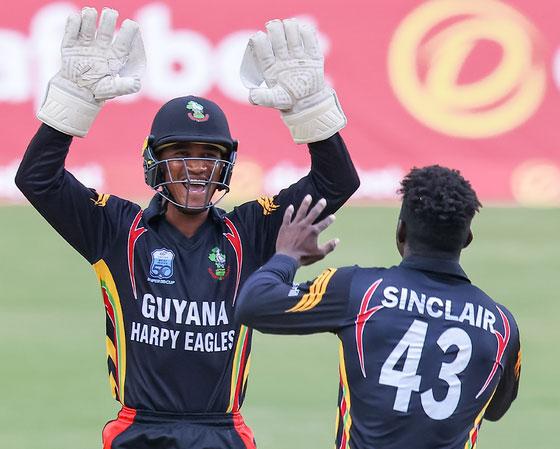
At the Antigua Recreation Ground, the defending champions, the Guyana Harpy Eagles, wasted little time asserting their authority, turning the opening day of their West Indies Championship second-round clash into a showcase of disciplined, incisive bowling.
The foundation of their dominance was laid by Nial Smith, whose relentless accuracy dismantled the Windward Islands Volcanoes top order. His return of 5-36 carved through the innings and ensured the Volcanoes never found stability.
Inserted to bat, the Volcanoes quickly slipped into disarray. Early strikes from Keemo Paul removed Ackeem Auguste, before Smith orchestrated a collapse that saw key wickets tumble in rapid succession.

By the time Alick Athanaze departed, the scoreboard read a precarious 17 for four. When Paul returned to dismiss Shadrack Descarte, the innings teetered at 21 for five, a position from which recovery seemed unlikely.
Resistance restores respectability
Salvation arrived through a measured partnership between Sunil Ambris and Noelle Leo, who combined for 68 runs to steady the innings and inject some resistance.
Ambris compiled 35, while Leo added 36, absorbing pressure and briefly halting the slide.
Even after their stand was broken, Smith returning to remove Leo, the lower order contributed valuable runs. Ryan John top-scored with 37, and Kenneth Dember chipped in with 18, as the final wickets added 57 runs to push the total to 151.
Paul finished with 2-46, while Shamar Joseph provided further support with 2-52, ensuring the Harpy Eagles maintained pressure throughout.
Steady reply keeps champions in command
In response, the Harpy Eagles approached their chase with composure befitting champions.

Matthew Nandu and Tagenarine Chanderpaul laid a solid platform with an opening stand of 64, neutralizing any early threat from the Volcanoes’ attack.
Nandu’s fluent 54, striking eight boundaries and a six, set the tempo before Dember intervened to break the partnership.
From there, Kevlon Anderson joined Chanderpaul to maintain control, the pair adding 61 runs to further tilt the balance. Anderson’s 41 was eventually ended lbw by Dember, but the damage had already been done.
By stumps, the Harpy Eagles had advanced to 130 for two, trailing by just 21 runs and firmly positioned to seize a first-innings lead early on the second day. Chanderpaul, resolute as ever, remained unbeaten on 29 from 129 deliveries.
Hurricanes rocked, then rally
Across the island at the Sir Vivian Richards Stadium, the narrative took a different turn, one defined by collapse, resistance, and a dramatic reversal.
The Leeward Islands Hurricanes endured another difficult outing with the bat, dismissed for 131 in 39.3 overs against the Trinidad and Tobago Red Force.
Karima Gore stood alone in defiance, crafting a determined 57 from 90 balls while wickets fell steadily around him.
The chief architect of the Hurricanes’ struggles was Anderson Phillip, whose devastating six-wicket haul dismantled the innings and appeared to place the Red Force firmly in control.
Collapse flips the script
With a modest target to surpass, the Red Force began confidently, progressing to 43 for one despite the early loss of Cephas Cooper.
At that stage, a routine march toward a first-innings lead seemed inevitable.
Instead, the match turned sharply. The retirement of Jyd Goolie triggered a sudden and dramatic collapse, as the Red Force lost five wickets for just 26 runs.
Kelvin Pitman led the charge, removing Jason Mohammed, Terrance Hinds, and Khary Pierre in a decisive spell.
At the other end, Oshane Thomas struck key blows, dismissing Evin Lewis and Amir Jangoo, as the innings unraveled.
From control to crisis, the Red Force stumbled to 69 for six before closing at 85 for six, their advantage suddenly under threat.
Day one defined by the ball
As stumps were drawn, two matches revealed a common thread, bowlers dictating terms and reshaping contests within sessions.
The Harpy Eagles hold firm control, driven by Smith’s incisive spell and a composed batting reply. Meanwhile, the Hurricanes, despite early struggles, clawed their way back into contention through disciplined, aggressive fast bowling.
With momentum split across venues, the second day promises a continuation of contests shaped not by predictability, but by sharp, decisive bursts of brilliance.