Since Jamaica gained its independence in 1962, crime has proven one of the hardest problems for the nation to solve.
During the first decade of independence crime could be considered routine, consisting mainly of robberies. Violent crime was rare. When incidents like murder occurred, they made news headlines for days.
But in the mid-70s crime took a violent turn as it co-mingled with politics. It wasn’t long before political and other murders became routine news. During this period an unfortunate stain blemished the Jamaican society, as some politicians became associated with criminals whose dirty work helped them to attain or maintain power.

During the Michael Manley administration of the 1970s as political-crime related violence escalated, the administration took the bold step of using the constitutional tool of a national state of emergency to curb the violence, claiming the State was under threat from political terrorists. In addition to the SOE, which was renewed several times, the administration created a Gun Court, painted red, to emphasize, as Manley then said, it was “dread.” Anyone caught with illegal guns was tried and subject to be charged and placed into a new detention center at Up Park Camp.
But despite the often-renewed SOE, “dread” Gun Court, and detention center, violent politically related crime continued. Several Jamaicans fearing for their lives migrated in droves in the latter 1970s.
Forward to 2022, and violent crime in Jamaica has escalated to a far worse problem than in the late 1970s. The nature of this violence is characterized by a peculiar evil and associated brutality. Hardly a day passes without news of violent, deadly shootings, rapes, and domestic disputes. Jamaicans are living in fear. Jamaicans living in the diaspora are afraid to visit Jamaica, and return home to live, as much as they want to.

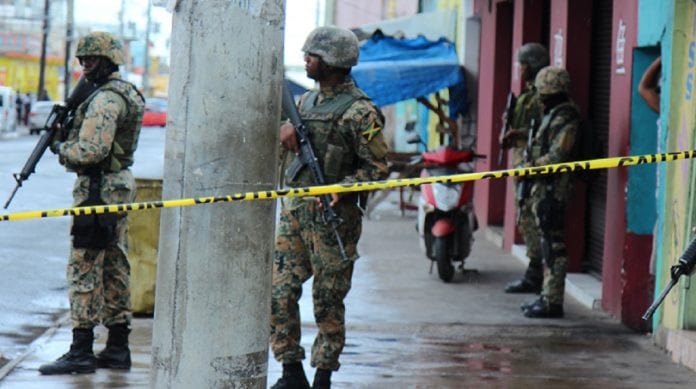
Jamaicans home and abroad want solutions. They want the government to find these solutions. So, when the government announces SOE’s in some communities, most people are thankful as security forces patrol the area to eradicate criminals and create a semblance of law and order.
The incumbent government, in power since February 2016, has used SOE’s several times as a tool to solve crime. But violent crime has escalated despite the SOE’s. The latest round of SOE’s was announced and implemented on November 14 for a 14-day period in five rural parishes with high incidents of crime, and parts of Kingston and St. Andrew.
According to the Jamaican Constitution the government must get the vote of two-thirds of the Legislature to extend SOE’s beyond the 14-day period. But while the government attained approval in the House of Representative, where it has a vast majority, it failed to obtain the one Opposition vote it needed in the Senate. This means, unless the government acts unilaterally, and perhaps unconstitutionally, the latest SOE’s couldn’t be expanded beyond November 28.

In opposing the extension of the SOE’s, the opposition claimed they are useless tools to fight crime, which instead of curbing crime are infringing on the human and constitutional rights of law-abiding citizens.
Likely buoyed by the apparent sense of security created by these SOE’s, some Jamaicans have criticized the Opposition for not caring that Jamaicans are being killed daily and are only opposing the SOE’s for political reasons.
At face value, it does seem the Opposition is acting hypocritically and using political motives to oppose the government’s SOE strategy. But at closer analysis it’s seen that these several and frequent SOE’s have been ineffective in curbing crime long term. Moreover, during the latest SOE’s, people were still being murdered in parishes with SOE’s.
As this editorial space suggested previously, there’s urgent need for the Jamaican government and Opposition to stop using crime as a football and collaborate to find realistic, meaningful strategies to curb this plague of violent crime.
Earlier this week, Opposition Leader Mark Golding offered a strategy which he seems to believe could help apprehend known criminals, based on “credible evidence.” Under Golding’s strategy such violent criminals would be initially detained for seven days, with provision for an additional 14-day extension up to 42-days. At each interval, law-enforcement agencies would need to satisfy the court that progress was being made in building a case supporting criminal charges.
Hopefully, the government will be open to meeting with Golding and his associates to take an objective look at this strategy which seems feasible on paper. At least, it’s something different from what has become the over-used, ineffective SOE’s. Jamaica desperately needs strategies to curb crime immediately and long term. Clearly, SOE’s are not the solution.