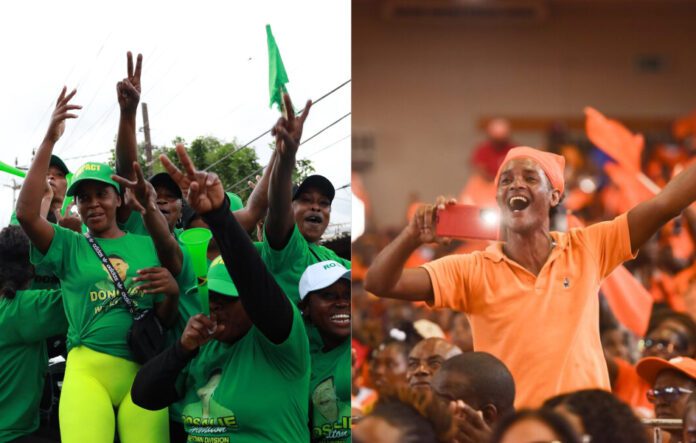
The two major political parties in Jamaica—the ruling Jamaica Labour Party (JLP) and the opposition People’s National Party (PNP)—are actively in campaign mode for the next general elections, though an election date has yet to be announced by JLP leader and Prime Minister Andrew Holness. As head of government, Holness holds the constitutional authority to set the election date.

According to some Jamaicans, “Holness is a stubborn gatekeeper. Him refuse to fly the gate and call the election.”
The last Jamaican general elections, which the JLP—led by Holness—won in a massive landslide (40 seats to the PNP’s 14), were held on September 3, 2020, and the new Parliament was seated on September 15 that year.

According to the Jamaican Constitution, Parliament must be dissolved no later than five years after its first sitting following the previous election. This means that Parliament must be dissolved by September 15, 2025. The Constitution further states that a general election must be held within three months after Parliament has been dissolved, meaning the latest possible date for the next general election is December 15, 2025.
In a court ruling last month, a Jamaican Supreme Court Justice confirmed that the current Parliament “must be dissolved on or before 14 September 2025.”
Since Jamaica became an independent nation in 1962, most general elections have been held before the anniversary of the previous one. Accordingly, political pundits and many Jamaicans are expecting Holness to call the election before September 14. However, the Prime Minister has given no indication of when he plans to do so—even though he recently declared that the JLP is in the final phase of campaign mode. The JLP’s chairman and general secretary both said as recently as last weekend that the party is fully prepared and ready for elections.

The PNP, led by Mark Golding—who will be contesting his first general election as party leader—has also declared that it is ready and has been actively pressuring Holness to announce the date.
According to some political observers, the delay could signal a lack of confidence on Holness’s part in leading the JLP to a third consecutive term. They believe he may be waiting until the last possible moment to dissolve Parliament in order to give his government more time to shore up support or introduce voter-friendly policies. The PNP has accused Holness of being afraid to call the election, claiming the political tide is now in its favor.
The PNP made a strong comeback from its 2020 general election defeat by winning the majority of divisions in a hotly contested local government election in February 2024. That victory gave the party national momentum, with subsequent political polls showing it leading the JLP by as much as 9 percentage points. However, in the months since, the JLP has made inroads into the PNP’s gains. A poll released last month showed the PNP’s lead had narrowed to 4 percent.

Another recent poll revealed that both Holness and Golding have low favorability ratings, though Holness maintains a slight edge over his opponent.
The bottom line? The race is tight. The polls suggest that the results could go either way, and neither party—or party leader—has a clear advantage going into the election.
One particularly telling figure emerging from the polls is that about 40 percent of registered voters say they are either undecided or uninterested in voting. This spells trouble not only for the JLP, which has held power since 2016, but also for the PNP, which has been campaigning aggressively over the past two years to reclaim government.
If either party had managed to inspire genuine enthusiasm, more voters would likely have already made up their minds. Perhaps by delaying the announcement, Holness is hoping to buy time to reenergize his base and boost turnout.
Whoever wins, it’s critical that the next government enters office with a strong mandate. It is politically risky—and a shaky foundation for governance—when a government is elected by a small share of the electorate.
In the meantime, Jamaicans—supporters of both the JLP and PNP—are busy speculating on when Holness will set the date. Hopefully, it will be sooner rather than later, and not one that drags the country into an unnecessarily long campaign.
For the sake of Jamaica’s social and economic stability, the election should be held promptly. The question of who will govern the country for the next term must be settled soon. There are urgent policies that need to be implemented, and political uncertainty should not be allowed to stall the nation’s progress.