Where did all the green go? Kingston’s vanishing public spaces
Key Points(5)
- <p data-start="273" data-end="337">Kingston is running out of places where people can simply exist.</p> <p data-start="339" data-end="669">Where grassy lots, shade trees, and open spaces once provided breathing room in Jamaica’s capital, concrete now dominates.
- Spaces that once absorbed runoff have been paved over in the name of development.
- Water now rushes across parking lots and roadways, overwhelming drains and flooding streets that were never designed to handle that volume.</p> <p data-start="1537" data-end="1669">The loss of green space has consequences beyond drainage and infrastructure.
- It is also quietly reshaping daily life in the capital.</p> <p data-start="1671" data-end="1870">In many cities, public parks function as democratic spaces — places where students study, children play, and families gather without spending money.
- “We drove around for almost half an hour trying to find somewhere safe to leave the car.”</p> <p data-start="2212" data-end="2327">Eventually, he found a spot.
Kingston is running out of places where people can simply exist.
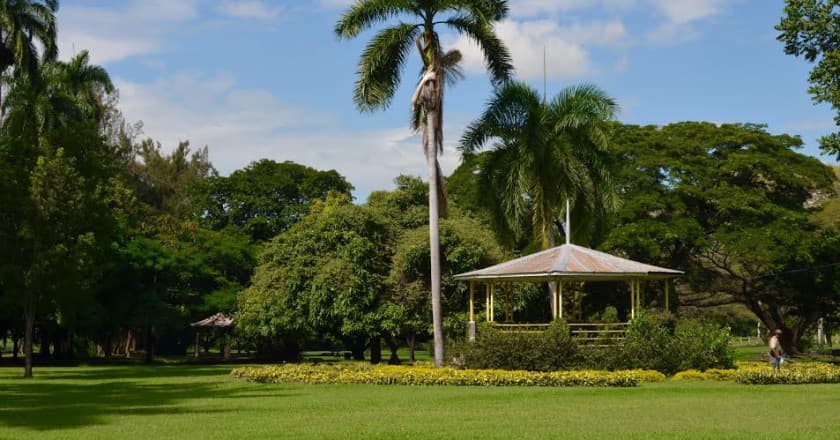
Where grassy lots, shade trees, and open spaces once provided breathing room in Jamaica’s capital, concrete now dominates. Parking lots, commercial complexes, and gated developments have steadily replaced the natural spaces that once absorbed rainwater, cooled the city, and offered residents somewhere to sit, gather, and unwind.
Today, Kingston faces a stark reality: there are fewer and fewer places where families, students, and young people can spend time outdoors without paying for it.
According to data from the World Bank, public open spaces occupy only 1.8 percent of Kingston’s total urban area — far below the 15 to 20 percent recommended for a functional and sustainable city. Even when including all undeveloped and accessible spaces, such as streets, the total rises to just 11.3 percent, compared with the 45 to 50 percent typically recommended.
In simple terms, Kingston has become a city of hard surfaces.
That shift is felt most clearly when it rains. Spaces that once absorbed runoff have been paved over in the name of development. Water now rushes across parking lots and roadways, overwhelming drains and flooding streets that were never designed to handle that volume.
The loss of green space has consequences beyond drainage and infrastructure. It is also quietly reshaping daily life in the capital.
In many cities, public parks function as democratic spaces — places where students study, children play, and families gather without spending money. In Kingston, those spaces are few and far between.
For many residents, the options are limited to a handful of parks, often with their own barriers.
Marcus Brown, a father of two young children, says even a simple trip to Emancipation Park can be stressful.
“First challenge was parking,” he said. “We drove around for almost half an hour trying to find somewhere safe to leave the car.”
Eventually, he found a spot. But once inside the park, he says the experience didn’t feel ideal for a young family.
“There were vendors everywhere and several people who clearly seemed mentally unwell moving through the space,” Brown said. “When you have two small children, you want somewhere calm and safe. A park should be the easiest place to take your family — definitely not somewhere you feel uneasy.”
The family stayed briefly before deciding to leave.
For others, even green spaces that appear open can come with restrictions.
University student Simone Richards recalls planning a small picnic with friends on the lawns at Devon House.
“We just wanted to sit outside, talk, and have a little picnic,” she said. “Nothing big. Just a blanket and some snacks.”
But as evening approached, security guards told the group they could no longer sit on the grass and would have to leave unless they were customers of businesses on the property.
“It felt like we were basically being chased out,” Richards said. “We were told that unless we were patrons of the shops, we couldn’t stay.”
The message, she said, was clear.
“Where are young people supposed to go if we just want to sit outside and talk without spending money?”
The Mental Health Factor
The disappearance of green space is not just an aesthetic problem — it poses a public health one.
Psychologist Dr. Alisha Grant says access to natural environments plays a critical role in emotional well-being.
“Green spaces provide a psychological reset,” she explained. “Exposure to trees, grass, and open landscapes has been shown to reduce stress, improve mood, and support overall mental health.”
Without those environments, urban residents can experience higher levels of fatigue, anxiety, and burnout.
“In cities dominated by concrete and noise, people have fewer opportunities to decompress,” Grant said. “Something as simple as sitting under a tree or walking through a park can have measurable benefits for mental wellbeing.”
Environmental Impact
The environmental consequences are also mounting.
Rapid development has replaced permeable landscapes with asphalt and concrete, increasing heat and worsening flood risks. Urban expansion has also contributed to the loss of vital ecosystems in Kingston Harbour, including approximately 318 hectares of mangrove forests and extensive seagrass beds.
Urban planners have warned that Kingston is beginning to resemble what some describe as a “scorched earth” style of development, where natural space is treated as expendable.
There have been attempts to address public well-being in the city.
The Ministry of Health, for example, has promoted the installation of “wellness benches” designed to encourage moments of rest and reflection.
However, a bench placed on a stretch of concrete does little to replace the restorative benefits of actual green space.
If wellness is the goal, the priority should be planting trees, protecting open land, and creating parks that people can access freely.
At its core, the issue raises a simple but profound question: who is the city for?
If every comfortable outdoor space requires a purchase, a membership, or an entrance fee, then public life becomes increasingly privatized.
Cities around the world increasingly recognize parks as essential infrastructure — just as important as roads, drains, and electricity.
Kingston, however, is running dangerously short on them.
A capital city cannot be built only for cars, concrete, and commerce. It must also make room for its people. And right now, Kingston is running out of room to breathe.