By Kathy Barrett
The night of August 25, 2017, will be forever etched in memory of Toney Campbell, one of thousands of Jamaicans who witnessed the onslaught of Hurricane Harvey as it made landfall and unleashed its fury on the Texan coast, battering coastal and inland communities.
Toney, a broadcaster and community activist who migrated to Houston, the fourth largest city in the United States, in 1971 recalls sitting at home, keeping abreast of the weather updates as Harvey pummeled the city of 6.6 million people.

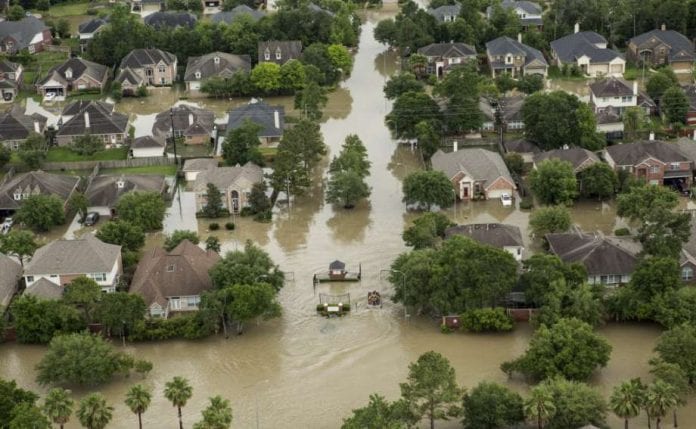
He hoped for the best, but quickly realized escape was the only option. “We were watching the water rise and decided we needed to get out of my sub-division.”
Grabbed whatever they could
Although water had not yet entered their house, Toney and his wife, a medical doctor, grabbed whatever they could and left.
“We got our water boots, and anything else we could, just to get out ….no one could come in, no one could get out the complex, and we didn’t want to get stuck. Gingerly, we walked out to the main road and a friend picked us up. We thought the water would eventually recede, but it kept rising. Before you knew it – the sub-division was a lake!”
While Toney has not returned home since fleeing on the weekend, he does have a good idea of the condition of his house.

Everything is under water
“I saw a video of my house. The water was close to the roof. Everything is lost, cars, everything under water!”
Toney and his wife are now staying with fellow Jamaican Errol Anglin, the president of the Jamaica Foundation of Houston.
However, Toney is undaunted. “As a Jamaican, one thing instilled in us is resilience. “Wi likkle, but wi Tallawah”….. we have life, we are breathing. I’ve always wanted to go on a cruise… we have the water, but I don’t have the boat,” he said with laughter.
Help from Jamaica Foundation of Houston
Errol Anglin, who lives in a slightly elevated subdivision, was largely spared the storm’s wrath. This enabled him to help Toney and two other Jamaican families.
“I came close to being affected, but I’m on a slightly higher elevation. When the heavy rainfall started, the flooding came four feet from my house but didn’t get in. It came really close, but I escaped.”
According to Anglin, he knows of 20 Jamaicans whose houses were destroyed.
“I would probably say that 90 percent of these people don’t have flood insurance. The ten percent that do are only covered to a certain threshold. Half a million cars are underwater, and over three thousand homes will remain underwater for at least a month. No one has hundreds of thousands of dollars in a bank to fix their homes,” said Anglin. He’s trying his best to help those who came into his home with just the clothes on their back.
Despite the circumstances, he said Jamaicans are putting their “best foot forward”.
“Inside they may be hurting, because it’s tough. You can’t take stuff with you. You work hard for what you have. It’s hard to move on. We, as a community, are trying to do what we can to help our fellow Jamaicans out. As president, I will assure the foundation spread out what it has to help people get on with their lives; maybe they can’t buy a brand-new house but maybe they can buy clothes.”
He told CNW his organization is mindful the Jamaican government may be unable to offer financial support.
“We know Jamaica doesn’t have money, we understand that. What has been great, however, is different Jamaican associations across the country have called and pledged support. Whatever comes, we will give it to those most in need.”
Messages of sympathy from CARICOM
Meanwhile, the wider Caribbean community has sent messages of condolence to the US.
The 15-member Caribbean Community (CARICOM) noted the destruction caused by the storm “highlights the unusual nature of weather patterns that continue to affect nations across the globe”.
The Prime Ministers of Dominica and St. Lucia – Roosevelt Skerrit and Allen Chastanet, respectively, have announced plans to visit hurricane ravaged Houston to meet with Caribbean nationals.
Hurricane Harvey has weakened into a tropical depression but the recovery process will continue for months and even years.
While 32,000 remain in shelters and approximately 40,000 thousand homes have been damaged, Toney echoed the sentiments of his fellow Jamaicans, saying, “While there is life there is hope. This too shall pass – I live one day at a time. We can’t take anything with us. We need to worry about living life, take one day at a time and enjoy it because you never know when your number will be called.”
Those wanting to make financial donations may visit Jamaicafoundationofhouston.org.