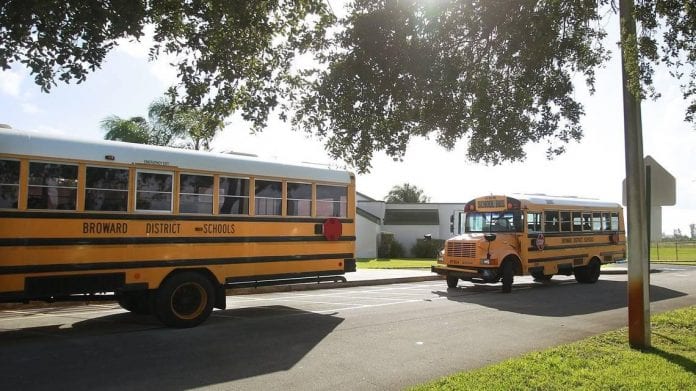
The Broward County School Board is reassessing its ban on electronic devices in schools, including cellphones, after a survey revealed mixed reactions from students and parents.

The policy, aimed at improving mental health and academic performance, was implemented following a statewide law that took effect in July 2023.
The state bill, CS/HB 379, signed into law by Florida Gov. Ron DeSantis, allows students to bring devices to school but restricts their use during instructional time. The goal, according to DeSantis, is to ensure that “students need to be focused on learning — not social media.” The Broward School Board adopted a similar ban in summer 2024, prohibiting devices not only in classrooms but also in hallways and during lunch.

“We are giving teachers the authority to establish classroom rules on cell phone use,” DeSantis posted on X after signing the bill, emphasizing the need for students to concentrate on their studies rather than social media.
The district’s policy permits teachers to set aside designated areas for devices during instructional time and to allow their use for educational purposes. However, exceptions can be made by individual teachers.
Full enforcement began at the end of August, following a two-week grace period at the start of the school year. Violations have led to disciplinary action, including parent meetings, verbal warnings, and device confiscation. In some cases, students faced suspensions for repeated violations.
Survey conducted on impact of cellphone ban
The survey conducted by the school board in November asked students and parents for feedback on the policy’s impact. Of the nearly 27,000 students surveyed, about half strongly disagreed with the restrictions. In contrast, a large majority of the approximately 40,000 parents who responded expressed support for the ban, though many disagreed with the restriction on cellphone use during lunch.
“Not surprisingly, based on what we’ve heard from our students, they were very dissatisfied with the implementation of the policy,” said Jodi Washington, executive director of Student Services Initiatives, during a workshop meeting of the school board.
Despite the dissatisfaction from students, a majority of parents supported the ban in the classroom, though their backing diminished when it came to lunchtime restrictions. Board members are taking the survey results into account as they deliberate the ban’s long-term effectiveness.

“We cannot necessarily say restricting use during lunchtime supports or not supports mental health,” said Dr. Jeff Holness, a school board member, highlighting the need for further analysis.
Superintendent Dr. Howard Hepburn echoed the sentiment, suggesting that more time and data would be required to fully assess the ban’s impact. “I think at the end of the school year, once we’ve gone through an entire school year and started embedding some things in culture, we can better answer that question,” Hepburn said.
In addition to concerns about the effectiveness of the ban, the survey also raised alarms about potential emergencies. Some parents and staff expressed worry that limiting device use could hinder students’ ability to quickly contact their parents during emergencies, such as school shootings or medical issues, as well as for everyday needs like coordinating after-school pickups.
Board member Dr. Allen Zeman cautioned against making immediate changes to the policy mid-year. “I’m happy to change this long term,” Zeman said. “But I want to try it this year, measure, measure, measure. I want to make sure what we’re doing really works and if it helps academics, as the students, teachers, and staff told us it should, or if it improves mental health in any kind of tangible way.”
The school board will continue to evaluate the policy throughout the year and is committed to collecting more data before making any decisions on future changes.