Guyana, Barbados unveil diaspora bond and plans for new regional fund
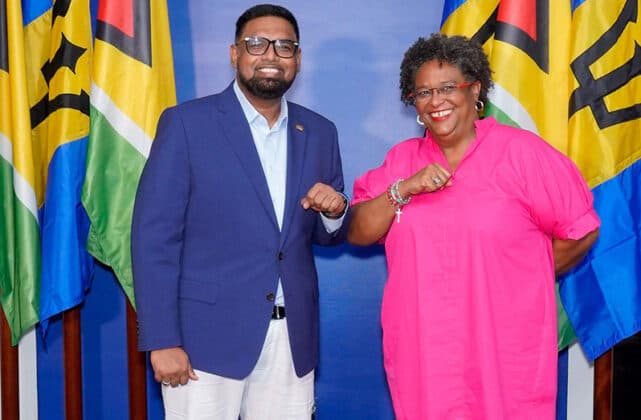
Guyana's President Irfaan Ali and Barbados Prime Minster Mia Mottley
Key Points(5)
- Guyana and Barbados are moving to deepen regional integration through a series of major financial and digital initiatives, including the launch of a diaspora bond, digital ID card travel, and plans for a new regional investment fund.
- - Advertisement - Speaking during a press conference on Tuesday evening at the Guyana National Stadium in Providence, held as part of Guyana’s Diamond Jubilee celebrations, President Mohamed Irfaan Ali announced that Guyana will launch a special diaspora bond within one week.
- The bond is aimed at raising funds from Guyanese living overseas to support public infrastructure projects across the country.
- “Members of the diaspora, here is your opportunity to make your contribution and be part of the massive transformation taking place in our country,” President Ali said.
- The initiative forms part of Guyana’s broader development push as the country continues expanding its infrastructure and modernisation programme.
Guyana and Barbados are moving to deepen regional integration through a series of major financial and digital initiatives, including the launch of a diaspora bond, digital ID card travel, and plans for a new regional investment fund.
Speaking during a press conference on Tuesday evening at the Guyana National Stadium in Providence, held as part of Guyana’s Diamond Jubilee celebrations, President Mohamed Irfaan Ali announced that Guyana will launch a special diaspora bond within one week.
The bond is aimed at raising funds from Guyanese living overseas to support public infrastructure projects across the country.
“Members of the diaspora, here is your opportunity to make your contribution and be part of the massive transformation taking place in our country,” President Ali said.
The initiative forms part of Guyana’s broader development push as the country continues expanding its infrastructure and modernisation program.
President Ali also announced that from July 1, 2026, citizens of Guyana and Barbados will be able to travel between the two countries using only their digital ID cards, eliminating the need for passports.
The announcement came during a joint appearance with Barbados Prime Minister Mia Mottley, who described the initiative as a historic step in Caribbean integration.
“We have said before in one of our first meetings that we will work hard to break every boundary, bring our countries closer and more integrated. And today you have seen the power of the digital ID card,” President Ali said.
While the system is already operational, airlines were given additional time to align their procedures ahead of the official rollout date.
“From July 1 you can forget your passport at home and travel with your digital ID card to Barbados and same from Barbados to Guyana,” he added.
According to President Ali, the digital ID system is expected to go beyond travel and eventually support integrated healthcare services between the two countries. He said the technology could allow medical professionals in either jurisdiction to securely access a traveller’s health records during emergencies.
Guyana and Barbados are also advancing discussions to digitally connect their financial systems to expand opportunities for trade, business and commerce.
“We are now advancing talks on how we would digitally connect our financial systems in a much stronger way, creating financial opportunities, business opportunities, commerce opportunities for both citizens of Barbados and Guyana,” President Ali said.
Prime Minister Mottley praised the rapid work undertaken by technical teams in both countries, noting that the digital travel arrangement was completed in under six weeks.
“It endures not to the benefit of the cabinet of Guyana or the cabinet of Barbados, not to the benefit of the private sector of Guyana or the private sector of Barbados, but it is now the benefit of each and every citizen,” Mottley said.
She also announced plans for the proposed Trident Arrow Investment Fund, which is intended to allow ordinary citizens from both countries to invest collectively in infrastructure, technology and agri-processing projects.
“We believe that this is the only way we can allow our citizens to become owners in the land of their birth rather than tenants for the period of their lifetime,” Mottley stated.
The two leaders said the initiatives reflect a shared commitment to strengthening CARICOM integration, modernising governance systems and expanding economic opportunities for Caribbean citizens through digital innovation.