From the beginning of this month until the end of November, the whole Caribbean stays under watch for extreme weather conditions.

Although the US National Oceanic and Atmospheric Administration (NOAA) predicts near-normal hurricane activity in the Atlantic this year, the risks for the population are still significant, including impacts to electricity generation and distribution. The forecast is 12 to 17 total named storms, with up to nine potentially becoming hurricanes (winds of 119 kmh/74 mph or higher), including one to four major hurricanes (category 3, 4 or 5; with winds of 178 kmh/111 mph or higher).
In total, last year’s Atlantic hurricane season produced 14 named storms, of which eight became hurricanes and two were major hurricanes, Ian and Fiona. The latter, according to the US Department of Energy, left 1.37 million customer power outages in Puerto Rico within the first 24 hours. This number represents 93% of total clients and nearly 10 days later, 33% were still without continuous electricity.

These numbers illustrate a problem faced by most islands, which normally struggle to have access to power without interruptions, even less when it comes to access to clean energy. According to the World Bank, out of 11 countries in the Caribbean with available data, nine generate more than 80% of their electricity using fossil fuels and five import 90% of their energy. “Small island nations still struggle to unlock much of the potential of renewable energy to transform their societies,” notes Victor Kitange, Economic Adviser
at the Commonwealth Secretariat. “Their energy infrastructure is highly vulnerable to natural disasters”, he adds.
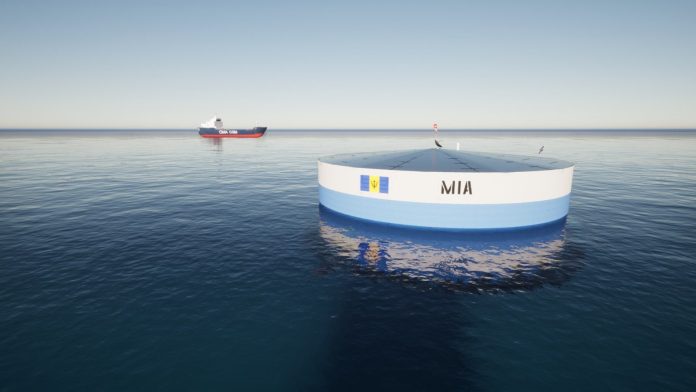
A project being developed in Europe may be the solution to this enormous and historic problem. PLOTEC consists of a consortium of seven companies experts in Ocean Thermal Energy Conversion (OTEC), plastic composites engineering, research and infrastructure, economics and environmental aspects, computational modelling tools and others. Its main goal is to design and simulate an OTEC platform capable of withstanding the extreme weather effects of tropical oceans, with a viable cost model, validated by a scaled demonstration of a structure.
“PLOTEC addresses a vision where the future of tropical islands is to be empowered to supply all the electricity, water and food they need, and create new industries for export such as alternative green fuels and critical minerals”, highlights Dan Grech, Founder and CEO of Global OTEC, one of the partners of the project.
On its computational simulations, PLOTEC will use data from tropical storms in the Caribbean, which makes the project even more suitable for the region. “The PLOTEC team set out to design a cost-effective floating platform which can hold out in the 100- year, even category 5, storm. Islands already know the feeling of having vulnerable infrastructure… for a breakthrough in energy generation to truly be island appropriate it must address as many of the challenges which the status quo faces as possible”, explains Grech.
OTEC is a renewable energy technology where surface warm seawater is used to vaporise a working fluid, which then drives a turbine to generate electricity. Cold deep water is used to condense the working fluid, and the cycle is then repeated. OTEC harnesses the power of the tropical ocean, the main natural resource of islands, to provide a continuous, cost-effective supply of clean energy, with significant environmental advantages over fossil fuels and nuclear power.

Combining the developments of PLOTEC with OTEC power demonstration facilities around the world, this ocean energy technology will become an even better fit for tropical islands, as other renewables have a more sensitive structure to severe weather or depend on sunny and windy days to generate electricity.
As the surface seawater in the tropical area of the ocean remains warm during the whole year, OTEC can generate electricity 24/7. Adding it to a storm-resistant structure, the technology becomes the potential permanent solution to power outages in the Caribbean.
PLOTEC partners
The consortium is composed of the following companies: Global OTEC (UK), Cleantech Engineering Limited (UK), WavEC Offshore Renewables (Portugal), The Oceanic Platform of the Canary Islands PLOCAN (Spain), Quality Culture (Italy), Agru Kunststofftechnik Gesellschaft m.b.H. (Austria) and University of Plymouth School of Engineering, Computing and Mathematics (UK).