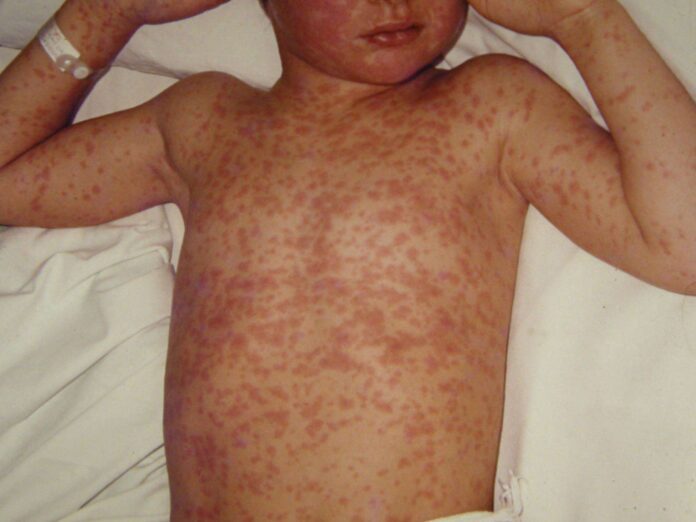
The Pan American Health Organization (PAHO) has announced that the Americas, including the Caribbean, has regained its measles-free status in 2024, following years of dedicated efforts. This achievement marks the regions’ return to a milestone it first reached in 2016. In 2023, the Americas recorded the lowest number of measles cases in its history, with just 73 reported cases.

Furthermore, vaccination coverage for the first dose of the Measles, Rubella, and Mumps (MMR1) vaccine saw a significant increase, rising by 8% for the first time since 2019. PAHO emphasized that its disease elimination initiative continues to make progress, with an ambitious goal to eliminate over 30 communicable diseases and related conditions by 2030.
It said the region also celebrated key milestones, including 30 years without wild polio virus and the elimination of mother-to-child transmission of HIV and syphilis in Belize, Jamaica and St Vincent and the Grenadines, and lymphatic filariasis in Brazil.

PAHO said in 2024, the Americas experienced a notable recovery in vaccination coverage, surpassing pre-pandemic levels for the first time since 2019.
“This marks the region’s efforts to reverse the declining trends in immunization that began in 2010 and worsened during the COVID-19 pandemic.
“The number of children under one year of age who had never received a vaccine dose decreased to 1.1 million. However, challenges remain, as one in 10 children still lack full vaccination,” PAHO said.
It added that it has supported countries in strengthening immunization programs, integrating them into primary health care systems, and offering technical and operational support for vaccination campaigns, ensuring the continued elimination of diseases like measles, rubella and polio.
The UN organization said in 2020, there was one maternal death every hour in Latin America and the Caribbean, a troubling setback to levels seen 20 years ago.
“This trend had already stagnated prior to the pandemic due to multiple barriers to accessing health services, exacerbated by COVID-19, which deepened inequalities and exposed the vulnerabilities of the region’s health systems.”

PAHO said it launched its “Zero Preventable Maternal Deaths” call to action, advocating for cross-sector collaboration, gender equality, and the creation of legal frameworks to protect women’s rights.
It said this strategy highlights that nine out of 10 maternal deaths could be prevented with universal access to quality maternal care and modern contraceptive methods, emphasizing the crucial role of the health sector in reducing maternal mortality.
PAHO said that the Americas aims to be the first region to eliminate cervical cancer, which continues to claim the lives of around 40,000 women in the Americas each year.
It said with appropriate strategies, it could be eliminated as a public health issue and that it is leading the strategy to achieve this goal by promoting widespread HPV vaccination, which prevents the primary cause of cervical cancer, along with screening and treatment. These combined measures provide a clear path to elimination.
“The actions are aligned with the World Health Organization’s 90-70-90 targets, which aim for 90 per cent HPV vaccination coverage in girls by age 15 years, 70 per cent screening coverage with high-performance tests by the ages of 35 and 45 years, and 90 per cent treatment for precancerous lesions and invasive cancer cases by 2030.”
PAHO said that significant progress has been made as 48 countries and territories in the Americas have already introduced the HPV vaccine. Nonetheless, coverage varies widely, with very few countries achieving over 80 per cent vaccination rates, and others remain below 10 percent.
PAHO said it is working to address such gaps through its Disease Elimination Initiative, ensuring that all countries have access to safe, affordable HPV vaccines and diagnostic tools through its Revolving Funds.