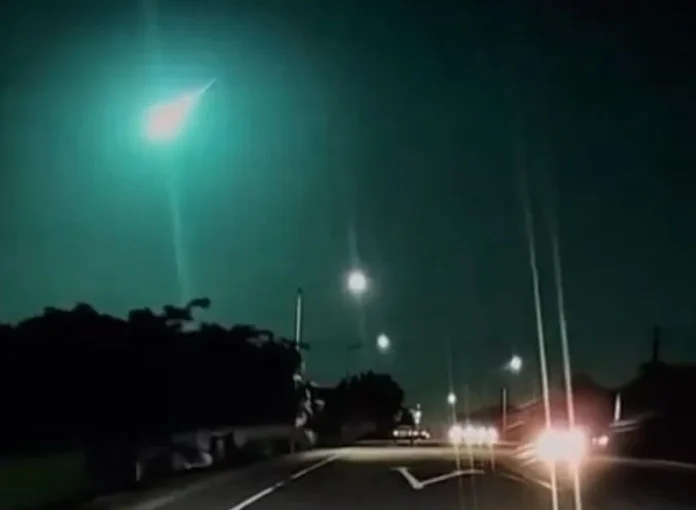
In a celestial display, the evening skies were illuminated just after 7:19 pm on Tuesday and were witnessed from as far south as Venezuela, reaching across Trinidad and Tobago, and extending as far north as Antigua and Barbuda.

The meteor blazed directly over northern Grenada, according to GOES-16 Geostationary Lightning Data.
Reading the cosmic colors
Reports are that as the meteor disintegrated in the atmosphere, it painted the night with a mesmerizing green or teal hue, trailing a fiery orange wake behind.

The distinct colors shimmering in the sky provide hints about the meteor’s chemical composition. The greenish tinge points towards a rich magnesium content, while the vibrant orange suggests a high sodium presence.
The science behind the hues
The appearance of a meteor is not solely determined by its composition. Its velocity as it pierces the Earth’s atmosphere can also influence the colors people may perceive.
As per the American Meteorological Society (AMS), faster-moving meteors tend to exhibit more vibrant hues. Slow meteors might glow red or orange, especially if they are faint.
In contrast, the swift ones often take on a bluish hue.
Meteors: Nature’s fireworks
Meteors generally begin to burn as they hit the Earth’s atmosphere, resulting in bright light emanating between 65 and 120 kilometers above the Earth’s surface. Meteors also dive into the atmosphere at speeds ranging from 40,200 to 257,500 kilometers per hour.
When meteors dive into our atmosphere, they begin to increase due to friction, lighting up at altitudes ranging from 65 to 120 kilometers above the Earth. These cosmic objects can travel at astounding speeds, anywhere from 40,200 to 257,500 kilometers per hour.

A common phenomenon, yet always awe-inspiring
Despite the awe they inspire, meteors burning up is a common global event, including in the Caribbean.
Often referred to as “shooting stars,” these re-entries are especially frequent during meteor showers.
Such showers occur when Earth sails through comet debris, causing these celestial fragments to combust upon contact with the atmosphere.
The Taurid Meteor shower is underway, which began on September 10 and runs through November 20.
It is expected to peak on November 13.