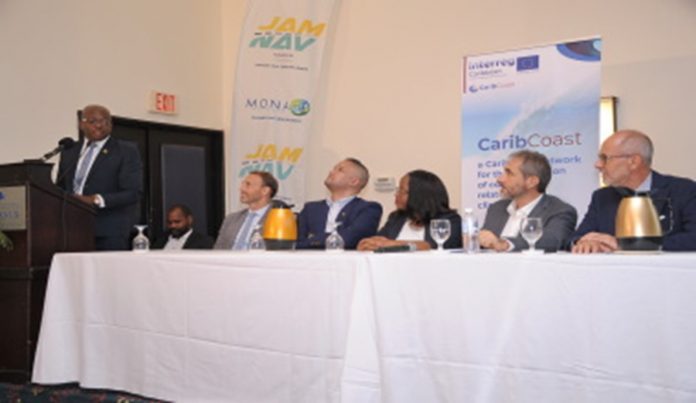
European and Caribbean officials are on the final day of their Caribbean Coastal Risk research analysis. Their discussion will cover information gathered over the last four years.
The three-day meeting is being attended by representatives from Jamaica, Trinidad and Tobago, Puerto Rico, and the Association of Caribbean States.
The INTERREG CARIB-COAST program is an EU project led by the Geological and Mining Research Bureau of Guadeloupe, allowing for the creation of a network of experts developing strategies for the prevention of coastal risks and adaptation to climate change. The main areas of focus are coastal protection amid extreme climatic events such as hurricanes and tsunamis, the fight against coastal erosion, the fight against climate change, and the anticipation of risks through modulization or the monitoring of coastal dynamics.

The organizers said the program also aims to share, build, and disseminate approaches to monitoring, prevention of coastal risks and adaptation to climate change.
“This program responds to one of the main areas of concern of the Association of the Caribbean States, namely the preservation and defense of the Caribbean Sea. It encompasses the entire insular Caribbean including the French West Indies of Guadeloupe, Martinique, and St. Martin and relies on partners such as the Caribbean Coastal Ocean Observing System in Puerto Rico, the Institute of Marine Affairs in Trinidad & Tobago, and the MONA Institute of Geoinformatics at the University of the West Indies in Jamaica,” according to a statement issued here.
It said among the existing tools is a digital platform for modeling marine submersions, which will also serve as a data bank for the storm and impact monitoring network and the coastal erosion monitoring and prevention network
The statement said the INTERREG CARIB-COAST program also takes into consideration the tourist economy related to the maintenance of the beaches and the natural inheritance of the environment, rich in biodiversity.
CMC/