



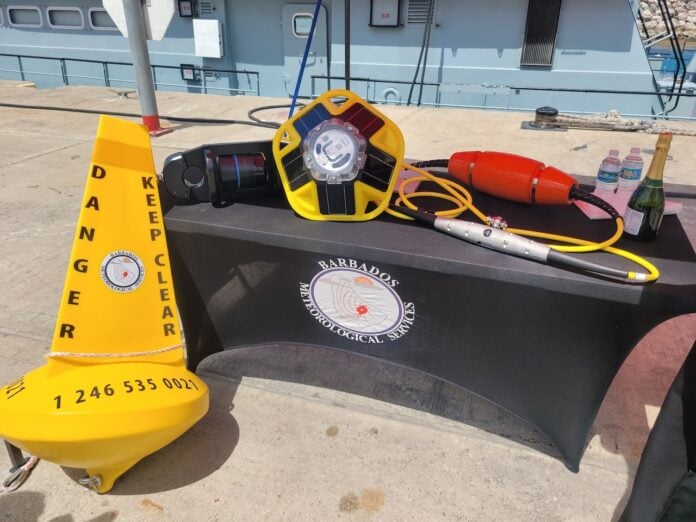
The Barbados Meteorological Services (BMS) has unveiled an upgraded Unmanned Surface Vehicle (USV) named Seawolf and a new spotter buoy, marking a significant enhancement to the island’s early warning systems and disaster preparedness capabilities.
Home Affairs and Information Minister Wilfred Abrahams highlighted the critical role of these technologies in improving the country’s ability to respond to severe weather events. “This [technology] picks up wind speed, sea swells, ocean temperatures, and currents—key data we need to make evidence-based decisions and improve our sea-state modelling,” he said.
Abrahams stressed the growing need for advanced early warning systems in the face of increasingly erratic weather patterns. He underscored the importance of a coordinated approach to hurricane preparedness, with the involvement of multiple government agencies, including the Barbados Defence Force (BDF), the Coast Guard, the Ministry of Environment and National Beautification, the National Conservation Commission (NCC), and the Department of Emergency Management.

The launch of Seawolf and the spotter buoy is expected to significantly enhance the BMS’s ability to monitor tropical cyclone intensity, sea-state conditions, and other critical meteorological data. Abrahams pointed to the effectiveness of previous USV deployments in providing early warnings during past weather events, noting that the new equipment will continue to build on those successes.
“The Barbados Met Services, I dare say, is the best functioning Met Services department in the entire Caribbean,” Abrahams declared, affirming the government’s commitment to further strengthening the country’s disaster preparedness resources. He also noted a shift in the timeline for hurricane season readiness, emphasizing that operational preparedness would now begin on May 1st, rather than waiting for the traditional June start of the season.
BMS Director Sabu Best also commended the collaborative efforts that made the launch possible. “Collaboration is key. This success isn’t just the BMS’s. It’s a collective achievement involving the BDF, NCC, and various ministries and agencies,” he said.
Best further highlighted the importance of the new technology, emphasizing that both the Seawolf and the spotter buoy represent substantial improvements in the island’s monitoring capabilities. These advancements, he said, are crucial for enhancing the country’s preparedness and response to upcoming weather events.
The upgraded technology will further strengthen Barbados’ disaster management framework, allowing the island to remain vigilant and proactive as it faces an increasingly unpredictable climate.





 has unveiled an upgraded Unmanned Surface Vehicle (USV) named Seawolf.)