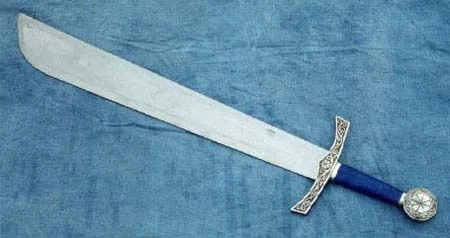
Through the various formats of buhurt and armored sparring, the selection of weapons has changed significantly in the last few seasons. According to Medieval Extreme, there is a growing interest in a falchion sword as their mass distribution, blade geometry, and grip leverage add up to better control and tempo management than that of longer straight swords under modern competition rules. This trend is not influenced by sentimentality but rather by measurable handling traits and combat realities limited by rules.
What a Falchion Is and What it Isn’t
A falchion is a sword from the Middle Ages that has a single edge and its main features are: the blade that is given more weight at the tip and the moderate overall length. It is different from a cleaver, a saber, and it is not even a longsword substitute.
If we analyze Medieval Extreme falchions from a technical point of view, we will find the following characteristics:

- The blade’s length generally varies from 65 cm to 80 cm depending on the model
- The overall length is typically between 80 cm and 95 cm
- Weight most often is between 1.2 kg and 1.6 kg
- The single-edged blade with reinforced spine for stiffness
- A point of balance that is further forward when compared to arming swords
Such design gives the blade a higher rotational inertia while still keeping the weapon mass under the tournament limit. Therefore, the falchion is not only suitable for striking with power but also for controlling the impact area.
Control, Tempo, and Safe Power in Sparring
Control means the capacity to halt, change the direction of, or recover a blow to the opponent within a very short time. The blades that weigh less than or lighter swords of the same length, the cutting edge of which almost the same as the non-cutting edge, are naturally better for this because their center of gravity is nearer the tip than straight swords.
The changes that can be scientifically measured are the following ones:
- Physical presence of the blade during binds is increased
- Overextension is diminished because of the shorter reach
- Faster recovery time after contact has been achieved
- Higher energy transfer at lower swing velocity
Impacts register clearly for scoring and dominance without excessive follow-through that risks injury or loss of balance. The average falchion strike requires less angular velocity to achieve an equivalent impact compared to lighter balanced swords.
Training Benefits: Wrists, Edge Alignment, Endurance
Falchions bring about different biomechanical difficulties which result in specific training outcomes. The forward weighting causes the wrist stabilizers and the forearm muscles to endure a greater torque load. This will in time to become:
- Better wrist and joint strength and stability
- More reliable edge alignment due to blade feedback
- Less usage of shoulder driven swings
- Better stamina in longer rounds
Endurance gain is another point which can be measured. According to fighters using falchions, the perceived effort is lower during the multi round fights as they are relying on timing and structure rather than on continuous high-speed swings.

How Rulesets Shape Weapon Trends in 2026
Melee combat styles have been influenced primarily by rules and not so much by the fighters’ choice of weapons. The current rules for buhurt and armed combat are already punishing unintentional hitting, too much follow-through, and unsafe weapon handling notoriously in a big way.
Falchions are among the swords that fit these rules perfectly:
- The shorter effective reach minimizes the chances of accidental head hits
- The forward balance allows for controlled but committed blows
- The single-edge design makes it easy to comply with the edge orientation
- The blade thickness and spine reinforcement make the sword more resistant to damage caused by the repeated striking
As the regulations concentrate on safety and prolonged fighting rather than instantaneous decisive hits. The switching of swords from longswords to falchions is happening more and more, and the fighters are attributing this to the rules that are getting stricter.
Choosing Specs: Balance, Grip, Length, Durability
The choice of a falchion should not be made according to aesthetics, but rather to the specifications that can be measured. Assess before buying:
- Blade length in relation to arm span and shield usage
- Weight from 1.2 kg to 1.6 kg, according to the person’s endurance level
- Position of the center of gravity impacting swinging speed
- Grip length allowing comfortable and firm single hand control with gloves on
- Blade width that grants strength on the edge when hitting armor
Medieval Extreme weapons are made of tempered steel and the blade shape is made so that it can withstand armor contact over cutting performance. This means that edge retention and structural integrity are considered more important than sharpness.
Responsible Manufacturing and Testing Culture
It is not possible to separate weapon safety from manufacturing and discipline. Medieval Extreme uses strict production, uniform steel treatment, and testing under actual combat conditions as the core for its production.
The decision process involves:
- Impact resistant steel selection
- Blade thickness that would not allow bending or cracking to occur
- Hilt construction that will not allow loosening through vibration
- Real environment testing in armored sparring
Manufacturing that is responsible leads to less variability among the units. This is significant as the difference in weapon weight or balance becomes the determinant factor for the handling and risk of injury to occur if the user switches between training and competition weapons.
Decision Point for Fighters
Should you be unable to give the precise weight, blade length, balanced personality, and specified use in the ruleset of a falchion, you are selecting a weapon without any performance data. It is suggested to check the following before taking a sword for the 2026 competition cycles:
- Weapon weight in kg
- Blade and total length in cm
- Grip size that is suitable for armored gloves
- Durability suitable for repeated contact between armor
Medieval Extreme makes these specifications public for the benefit of the fighters who will then be able to make their choice of falchions according to control, tempo, and safety rather than relying on guesswork. Make use of the data. Before engaging in full contact fights, pick the weapon that is compatible with your ruleset, conditioning level, and fight strategy.