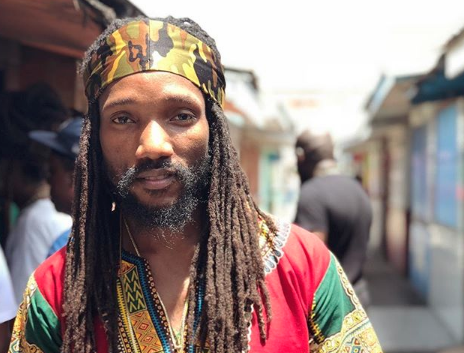
Another reggae lyricist, Kabaka Pyramid, is speaking out against violent lyrics in Jamaican music, specifically dancehall, and has suggested that the international stage may not be forthcoming of the genre because of its violently laced lyrical content.
Close to the inception of the hugely controversial genre, dancehall’s heavily laced lyrics promoting violence, horrific attacks, abuse of women and its sexually demoralizing subject matter, have all sparked conversations in small and large circles locally and globally.
Known as reggae music’s “dutty cousin”, though trendy and appealing to party-goers in Jamaica and the diaspora, dancehall’s lyrical identity has always seemed to smear its international numbers, despite the success of Shabba Ranks, Shaggy, Supercat, and Sean Paul who are not authors of violence in music.

In several tweets posted to his Twitter account on January 2, Kabaka said:
“I want to see more mainstream success for Jamaican artists. International success. But I jus feel the subject matter in di music a hold we back.”
“Galvanizing the diaspora is not the same as international mainstream success. But it’s a step towards that goal,” he said in the following tweet.
In another tweet, he expressed, “At some point in time we the creators of the music have to start thinking as an industry and make decisions that benefit the whole genre.”
Industry stakeholders weighed in on his statements, “Who knows better should just do better. The level of success will speak volume and the domino effect will follow. Same way in early 2000 we followed Vybz Kartel and Notnice down the dancehall trap path and trap we self while they both still continued to make huge hardcore dancehall songs that Garnered huge success example Kartel’s “Fever” certified gold by the RIA. Song peaked No. 2 on the Billboard Reggae Albums Charts and was viewed over 100 million times on YouTube. Notnice producing @spiceofficial “suh mi like it” with over 102 million views on YouTube. Shows that we just need to make music and let the chips fall where they may,” asserted dancehall producer Skatta Burrell.
Veteran deejay Tanya Stephens was also quick in her response to the ‘Kontraband’ singer’s comment. She asked him to define his perception of success and mainstream.

“What is mainstream success and what subject matters would you consider synonymous with it? Bear in mind “Don’t Want No Short D*** Man” remains a club banger across the world decades after release…,” she stated.
“I think you can make slack lyrics and do it in a classy way that can work, but I just think we have the cards stacked against we already cuz we depend on the international market due to our sheer lack of numbers we have in the Caribbean,” he noted in another tweet, addressing Stephens’ response.
In an interview done recently with The Gleaner, outspoken dancehall personality ‘Tu-Lox’ said:
“Our culture has changed, and we no longer have our own culture, and this is why America and the rest of the markets are losing interest in Jamaica, if the Jamaican artistes dem a seh everything weh di rapper dem seh, because mek wi nuh fool weselves, dem new youth yah a rapper dem: the murder, the scamming, just go inna the rap market and see if a nuh the same things. Will the same American market be interested in our market if we a seh the same things weh dem a seh?” he outlined.
In August 2018, a growing movement known as ‘Excuse Me Driver’ sought to enlighten adults on their responsibility to the youth of Jamaica with the premature exposure of x rated musical content. The movement sparked media attention and support from Grammy-winning, recently nominated reggae artist Gramps Morgan, Gyptian, Shane O, Farenizzi, dancer turned artist Goody Plum, reggae band Rockaz Elements and others in support of its mission of more uplifting music reflecting on the nation’s youth.
“As much as you are free to reflect what is happening in the society, you also have a duty to place it in context,” he said. “That is not right, and though you have the protection of the constitution to sing about it, you also have a duty to the children who are listening to you to say ‘man, that is not right.’” he said in a parliamentary meeting in April of last year.
History-making Prime Minister of Barbados, Mia Motley, reprimanded local artists in Barbados after a scandalous video with unbecoming lyrical content that imitated violent Jamaican dancehall music that went viral online Barbadian social circles, FM radio stations and the underground subculture emerging in Barbados and Trinidad.
The artists involved in the scandal were subsequently stripped of sponsorships, to which they apologized to the nation of Barbados, then renegotiated the terms of said contract.