



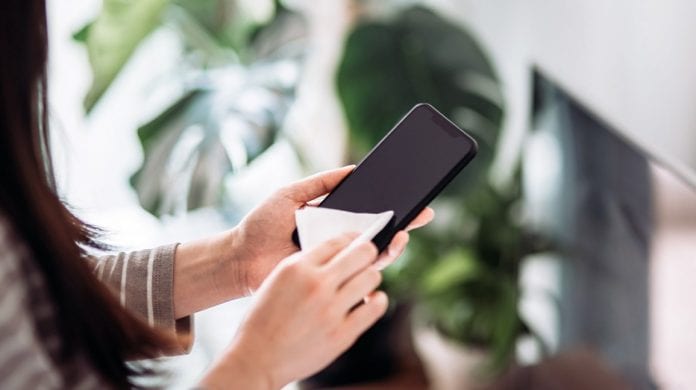
MIAMI, Florida – With a world population of close to eight billion people (7,621,018,958 at the last official count) coupled with a cellphone penetration which far outstrips it—in excess of 300,000 (7,950,000,000)—this every-day communication device is in pole position, as potentially one of the main transmitters of the deadly COVID-19 virus.
This fact is further underscored by a recent study published by the New England Journal of Medicine and authored by Carolyn Machamer, a professor in cell biology from the John Hopkins School of Medicine who specializes in coronaviruses. It found out that SARS-2-CoV-2, which causes COVID-19, can live on different surfaces for varying periods of time, ranging from 72 hours on plastic, 48 hours on stainless steel, 24 hours on cardboard, four hours on copper and is also detectable in the air for up to three hours.
However, she was quick to point out that “what is most important is the amount of virus that remains, is less than 0.1 percent of the starting (initial) viral material…therefore infection is theoretically possible but unlikely at the levels [transmittable] after a few days.”

A kind of “cold comfort”, if you may, are the professor’s words that describe the billions of people who see their cellphone—this ubiquitous communication tool—as a virtual extension of themselves and the sober but stark realization, that the majority of the external make-up of this device are plastic and glass.
Additionally, it has been proven that cellphones accumulate approximately 10 times more micro-organism than if you were in a health institution. Beginning with the fact that the average person, in a day, uses his phone more than 50 times, with the same set of hands that previously were used to touch the doorknob, exchange money, hold on to the handrails in public transportation, and the list goes on—all done in public spaces.
If that was not enough, consider the following scenario: you are talking on the phone as an asymptomatic person who also is, unknowingly, a carrier of COVID-19 virus. In your conversation, a lot of ‘spraying’ and droplets of the virus settles on your phone. On the completion of your call, you lend it to a friend or being ‘good neighborly’ to someone who asks you for a call. She then hands you back the phone and sometime later uses those same fingertips to put in her face. Boom, there goes another case of COVID-19 transmission! And, the roles could have been the reverse, as there are so many different instances where our cellphones are involved in our day-to-day activities.
So what are some of the steps that we can take to not only to sanitize our cellphone but other electronic devices such as tablets, laptops, desktop computers, keyboards, and mouse as transmitters of the dreaded COVID-19 virus?
The first step is to turn off the instrument, then get a soft piece of cloth, like the kind used to clean eyeglasses. We do not recommend paper towels or napkins as they can scratch the face of your device. Prepare a solution of warm, soapy water that you use to dampen (not too wet) the cloth that will allow it to run into ports and other areas critical to the operation of the device.
The soap solution should not be sprayed onto the devices but gently rubbed with the cloth. A word on the soap and water, it’s not that it’s the be-all and end-all, the proverbial silver bullet of COVID-19, but this particular virus has a thin membrane which is destroyed by soap and water solution.

Regarding your keyboard and laptop computer, please use a cotton swab to clean the ports and between the keys as damp cloth can pose a problem. The mouse should also not be overlooked in the sanitization process.
Finally with the current global death toll in excess of 20,000 and confirmed cases numbering 454,000 with the United States contributing 890 deaths and 64,000 confirmed cases respectively to this deadly pandemic, any step that slows down this carnage in human lives, should be embraced.










.)