Advocates hoping Supreme Court will vote in favor of President Obama’s executive action DAPA
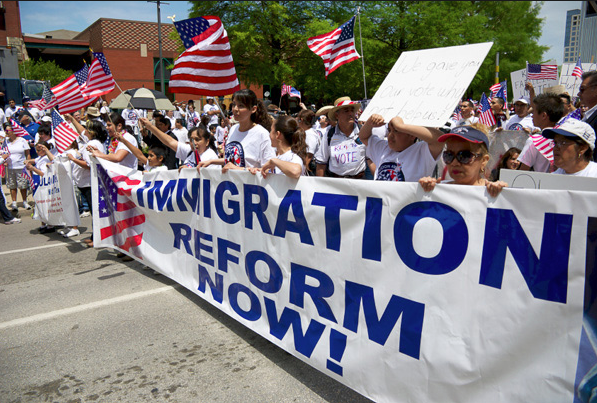
Over a hundred South Florida immigration advocates are in Washington DC this week, joining public demonstrations calling on the Supreme Court to vote in favor of President Obama’s executive action DAPA, which would defer deporting parents of legal U.S. residents.

The Supreme Court heard oral arguments this week in United v. Texas case, where 26 states, including Florida, are challenging the order’s constitutionality. Made originally in November 2014, the Deferred Action for Parental Accountability (DAPA) presidential executive order is estimated to potentially affect some 5 million, including over 183,000 persons in Florida.
The Supreme Court may release a ruling on the case as early as June. Whatever the court’s decision, it’s a personal one for Caribbean-American sisters Angela Hastings and Deborah James, who were among the Florida Immigration Coalition members who travelled to D.C. for the hearings. Deborah said she made the sacrifice to travel to Washington to support her sister Angela, who has been in the U.S. for “some fifteen years, has a 4 year old who is a US citizen by birth, and would have benefitted from DAPA.”

They were both heartbroken, says Deborah, when the executive order was halted. “She had already gathered all the necessary documents, ready to file for the authorization to stay and work in the U.S. when the lawsuit stopped everything,” says Deborah. “I think it was important that as large as possible a number of protestors rally outside the US Supreme Court to draw attention that the executive orders have strong support nationally.”
Despite her hopes, Deborah admitted to not being very confident that the Supreme Court justice will vote in favor of the executive order “seeing that one justice [Justice Antonio Scalia] recently died, and this means without a seventh justice, there may not be a clear decision, and the matter could end up deadlocked.”
The Supreme Court is currently operating with eight remaining justices, with an assumed ideological divide between four liberal justices who could support the presidential executive order, and four expected to rule against the order. For a ruling in favor or against the order, a majority vote is required. Without a majority vote, the case would revert to a Texas court’s decision against the order made in February 2015.
The wait for the Supreme Court ruling “will be long and agonizing,” says Deborah. Asked what she hopes the next step would be if the Court becomes deadlocked or rules against the presidential executive orders, James said. “There would have to be another reset for immigration reform.”