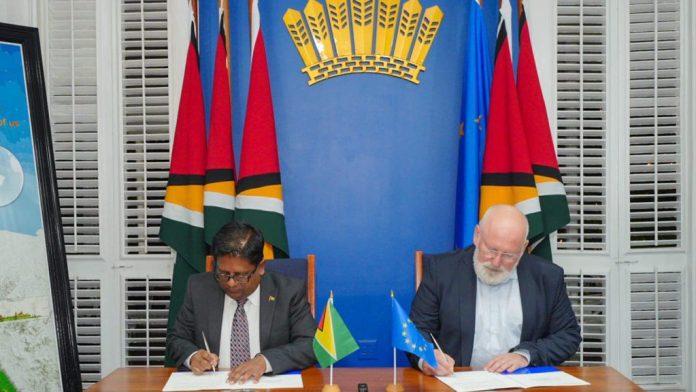
Guyana has signed an agreement with the European Union to establish a comprehensive program to protect and manage the country’s mangroves.

The project is part of the EU/Guyana partnership agreement signed at the United Nations Framework Convention on Climate Change (UNFCCC) COP 27 in Egypt last year, valued at an estimated Euro 4.6 million.
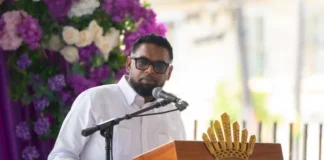
EU Commission’s Executive Vice President, Frans Timmermans, and Senior Minister in the Office of the President with responsibility for Finance, Dr Ashni Singh signed the new agreement in the presence of President Irfaan Ali, who commended the EU for its unwavering support and pivotal role in providing support, promoting democracy, and bolstering governance in the country.

Ali said Guyana’s policy framework prioritizes environmental protection, embracing climate-smart approaches, and harnessing the country’s rich natural resources to improve livelihoods and foster economic opportunities.
“We have committed to expanding the protected area system from 8.3 per cent to 17 per cent, then eventually to 30 per cent. And these are targets that we are aggressively working towards. These are targets that are integrated into our planning framework, and our policymaking framework,” he said.
Guyana’s forest spans an estimated 18 million hectares, and the extensive mangrove ecosystems occupy over 200,000 hectares of the coastal region. The country’s coastal sea defence system extends over 425 kilometers, complemented by an additional 100 kilometers of earthen embankments along rivers, which are inhabited areas.
“One of the things that we want the project to focus on is those earthen embankment and those riverine areas, where the population might be small, but agricultural output in those areas is very large,” Ali said, stressing that the project’s scope will also include the monitoring of mangrove seedling planting, the rehabilitation of existing forests, and the establishment of robust nursery programs for aggressive replanting efforts.
“Our entire policy architecture, our policy framework is geared around ensuring that we are adopting the best environmental practices and doing everything in a climate-smart way, in protecting the environment, advancing our natural attributes of biodiversity. But more importantly, leveraging these natural assets now for improving livelihoods, creating economic opportunity,” he added.
Timmermans said he is pleased Guyana is making strides towards major development, noting that the time is only fitting for the EU and Guyana to strengthen their bilateral ties.

“One of the ways to cooperate is to help preserve this country’s natural riches which are almost without limits. This is a partnership we’ve just signed so that we can support the efforts of Guyana to strengthen the position of mangroves. Mangroves are such a huge contribution to our fights against the climate crisis,” he said, adding that forestry is one of the issues that the EU and Guyana can examine closely.
“The ambition of your government, Mr. President to make sure that Guyana in its economic development, in the development of the fossil fuel industry still maintains its high ambition for climate neutrality, and for maintenance of your natural riches is something we want to be a part of, and I hope we can elaborate very concrete measures,” the visiting EU official said.
The project will be implemented by the National Agricultural Research and Extension Institute in collaboration with the Ministry of Public Works.
CMC/