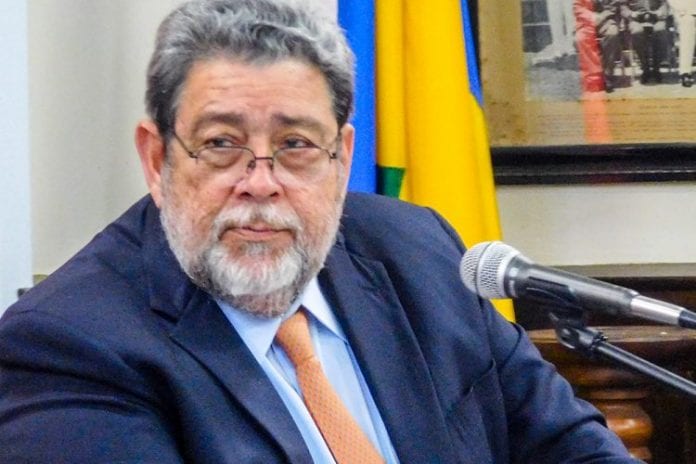
St. Vincent and the Grenadines Prime Minister Ralph Gonsalves is lending support to a suggestion by his Antigua and Barbuda counterpart, Gaston Browne, that countries most affected by climate change, such as those in the Caribbean, should seek redress before international courts.

Gonsalves, speaking on a radio program, said damage to private and public infrastructure from recent heavy rains is a result of the mountainous terrain in St. Vincent and the Grenadines “and global warming, where we are having bouts of excessive rainfall, alternated with periods of drought and having also storms and, of course, hurricanes too”.
He said these are matters being discussed in Egypt at the two-week 2022 United Nations Climate Change Conference (COP27), ending later this week.

In his address to the United Nations General Assembly, in September, Prime Minister Browne called on world leaders “to act on behalf of the smallest and most powerless among us, and in the interest of global justice”.
He said an opportunity looms for action, in the form of the resolution being sought by Vanuatu in the coming months to request the International Court of Justice to give an advisory opinion that would clarify the legal obligations of states to protect human rights and environments from climate change.
“Not to support the Vanuatu Resolution would be a vote to circumvent a decision on the legal obligations of each nation,” Browne said.
Browne also spoke of an initiative taken by his country in solidarity with Tuvalu and Palau, which, on the eve of COP 26 in Glasgow in 2021, launched the Commission of Small Island States on Climate Change and international Law (COSIS).
The purpose of the commission is to “develop and implement fair and just global environmental norms and practices,” Browne told the United Nation, reiterating the position at the COP 27 in Egypt.
“In this connection, it will seek an opinion from the International Tribunal of the Law of the Sea, regarding the binding obligations of its member states, to mitigate the effects of their greenhouse gas emissions, or to pay for the loss and damage they cause,” Browne said.

Gonsalves said while he is not present at COP 27, regional blocs CARICOM and the Organization of Eastern Caribbean States (OECS) are represented by other leaders as well as delegates from Alliance of Small Island States (AOSIS).
He said “some of our own people” are asking, “‘What Gaston talking about?
“But I want to make this point. When you’re delivering a speech in a short period of time, you don’t explain everything. But those who are listening, informed persons who are listening, know what you’re talking about.
“But just in case, there’s any doubt, I want to make this point — several points. In accordance with Article 96 of the Charter of the United Nations, we can request the International Court of Justice — pursuant to Article 65 of the statute of that court — to render an advisory opinion on a number of matters, including having regard to the obligations of the states under the applicable treaties, including the Charter of the United Nations, the International Covenant on Civil and Political Rights and on Economic, Social and Cultural Rights, the United Nations Framework Convention on Climate Change, the Paris Agreement, sometimes called the Paris Accord, and the United Nations Convention on the Law of the Sea.
Gonsalves said that having regard to all of those, “we can pose the question for an advisory opinion.”