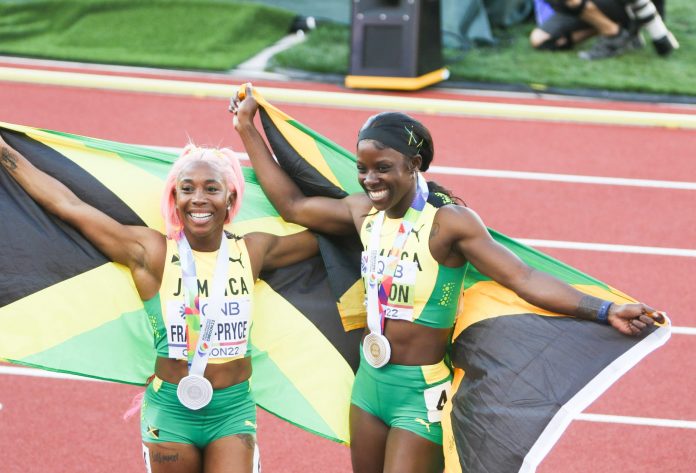
It was a welcoming sight, even for Jamaicans who are not sport fans, to see Shelly Ann Fraser Pryce, the incomparable Jamaican sprint champion, and quarter miler turn sprinter, and Sherika Jackson, among those honored by the Jamaican government at the nation’s National Heroes Day awards ceremony on October 17. Fraser-Pryce and Jackson now join other outstanding Jamaican athletes including Merlene Ottey, Usain Bolt, Veronica Campbell Brown, Asafa Powell and Elaine Thompson-Herah who were awarded national honors for their accomplishment in track and field.

It’s commendable to see respective Jamaican governments bestowing national honors on its sports men and women, and the presentation of these awards are special moments of pride for the athletes. But, these athletes, most of whom through tremendous self-sacrifice, perform at high levels on the international stage, branding Jamaica positively to the rest of the world, need more fundamental recognition long after the fanfare of the awards ceremony.
Granted, the situation for Jamaican sportsmen and women, particularly track and field athletes. is much better today, than say back in the late 20th century. Annual international meets like the Diamond League series afford athletes the potential to earn decent incomes by competing in a race or field event. Athletes also have the potential for a fairly good pay day by making it to the finals at events at the biennial World Track and Field Championships. Outstanding athletes like Bolt, Fraser-Pryce, and Thompson-Herah are also likely to gain very financially attractive endorsements from commercial companies to market their specific brands.

But most of the athletes don’t receive endorsements, nor make enough income by appearing on the international track and field circuit. After the spotlight dims on their glorious performance at international events like the Olympics and World Championships, they return home and get lost in the struggle trying to make ends meet. It becomes worse when the athlete ages and loses their competitive edge. Most are not even remembered by the rest of the society.
In recent years there has been a prevailing trend where the majority of Jamaican sports men and women, including footballers, cricketers, netballers and track and field athletes, emerge on the national stage from humble, often low-income homes in rural Jamaica or inner-city communities. Some are fortunate to obtain sports scholarships to foreign universities/colleges enabling them to pursue courses of studies to secure future careers. But there are still too many former sports men and women who are lumped into the “strugglers” category after highlighting the Jamaican colors, and the Jamaican national anthem at international events.
A few years ago, the Jamaican minister responsible for sports, spoke ambitiously of plans for the government to create a thriving, financially rewarding Jamaican sports industry. Unfortunately, the nation still awaits details of such an industry, and the ensuing implementation.

If such an industry is well planned, coordinated, and implemented it could be useful to utilize the talent of the nation’s sports men and women when they have passed their competitive prime.
Having now gained the reputation as the world’s “sprint factory”, Jamaica has the potential of being the training center for international athletes seeking to shine in sprint events at international meets. Jamaica has excellent track and field trainers, coaches, and training facilities to offer to ambitious international track and field athletes. Moreover, there are sports fields like the international cricket stadium in the parish of Trelawny which could be converted into additional track and field sporting facilities.
While some former athletes could be recruited as coaches and/or trainers at these training facilities, others who may not be able or capable of providing these services could still benefit indirectly from the income generated.

It would be ideal if the Jamaican government was able to have a fund to sustain former athletes, but of course this isn’t realistic in the current tough economic environment.
But funds generated from a viable sports industry could be set aside, as a pension fund, to assist athletes in their lean years after appearing on the global stage, should they be unable to find suitable jobs or benefit from substantive endorsements.
Here is a challenge, not only to the Jamaican government, but to the Jamaican private sector, and, indeed, to the Jamaican diaspora, to collaborate in initiating realistic plans to develop a viable Jamaican sports industry. Such an industry has the potential to be very profitable, as it has strong, inherent marketing capabilities. More importantly, this industry has the potential to assist in the financial security of former Jamaican athletes who were truly ambassadors, blazing brand Jamaica across the globe.