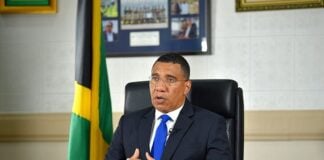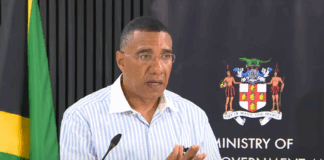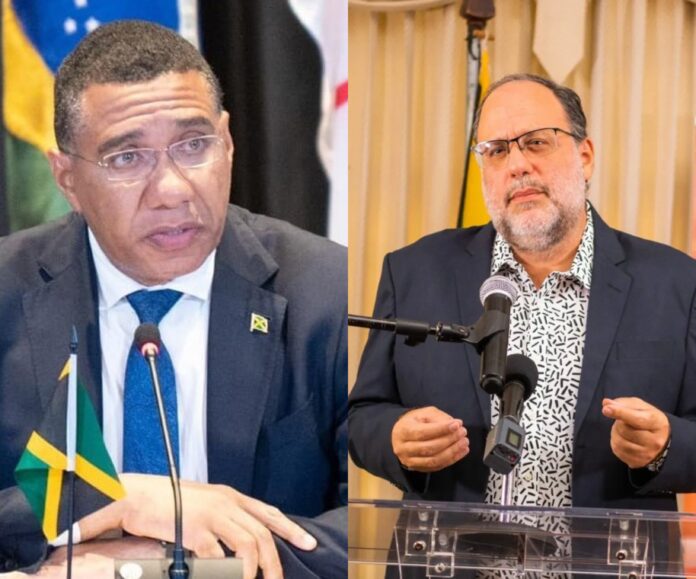
Jamaica’s Opposition Leader Mark Golding and Prime Minister Andrew Holness are once again at odds over how Jamaica should complete its transition to a republic.

The latest clash stems from Holness’ proposal for Golding to meet with Justice Minister Delroy Chuck to restart constitutional reform discussions — a suggestion Golding has flatly rejected, insisting that only direct talks between the two leaders can move the process forward.
In his letter dated October 3, 2025, Golding said the reform process must begin with direct engagement between himself and the prime minister if Jamaica is to make meaningful progress in completing what he called “the unfinished circle of Independence.” His response followed a September 30 letter from Holness proposing that Golding meet with Chuck to resume talks on constitutional reform.

Golding said he had expected the prime minister to invite him to a meeting to chart the way forward, based on Holness’s call for partnership at his recent inauguration at King’s House. At that ceremony, Holness had reportedly told him, “Mark, let us partner together to complete the work we started in making Jamaica a republic.”
“The proposal for me to meet with the justice minister will not initiate the required partnership of which we had spoken,” Golding wrote. “It is you and I, as leaders of Jamaica’s two major political parties, who must establish a basis for the required partnership if the reform process is not to become another exercise in futility.”
The Opposition Leader reaffirmed his support for Jamaica to achieve full sovereignty by both removing the British monarch as head of state and ending appeals to the Judicial Committee of the Privy Council in London. He noted that this dual goal has long been the position of the People’s National Party (PNP) and argued that both issues must be addressed together for the country to achieve genuine constitutional reform.
Golding also cited historical precedents for bipartisan cooperation, noting that significant constitutional advances have always required cross-party consensus. He referenced the collaboration between Norman Manley and Alexander Bustamante leading to Independence, as well as that between P.J. Patterson and Edward Seaga during the constitutional reforms of the 1990s. He further pointed to the 2010 passage of the Charter of Fundamental Rights and Freedoms under a partnership between then Prime Minister Bruce Golding and Opposition Leader Portia Simpson Miller.
“The only route to reaping success in this reform effort is through authentic collaboration, as demonstrated by former political leaders,” Golding said.
Golding’s letter also highlighted that with the ruling Jamaica Labour Party (JLP) no longer holding a two-thirds majority in the House of Representatives, bipartisan support is now essential to advance any constitutional amendment.

Opposing views on final court
The ongoing impasse stems from deep divisions over the sequencing of reforms. During the last parliamentary term, the Opposition withdrew from the Joint Select Committee on Constitutional Reform after the government refused to link the move to republican status with simultaneously replacing the Privy Council with the Caribbean Court of Justice (CCJ) as Jamaica’s final appellate court.
Holness and the JLP maintain that while they support removing the British monarch as head of state, the question of Jamaica’s final court should be decided by the Jamaican people in a referendum. The PNP, however, argues that both issues are central to achieving full sovereignty and must be resolved together.
That standoff led the PNP to boycott committee meetings earlier this year, effectively halting debate on the Constitution (Amendment) Republic Bill tabled by then Legal and Constitutional Affairs Minister Marlene Malahoo Forte. After the September 3 general election, Malahoo Forte was not reappointed to the Cabinet, with aspects of her former portfolio absorbed into Chuck’s Ministry of Justice.
Golding’s latest letter called on Holness to return to the principle of leadership-level dialogue to avoid another stalemate. “I therefore invite you to reconsider the matter in light of what I am suggesting in this letter, and look forward to hearing from you presently,” he wrote, adding that he would make the correspondence public since the prime minister’s invitation to partnership had been delivered in a public forum.