Trinidad and Tobago on Friday reiterated its support for the United States military presence in the southern Caribbean, saying it has been “very effective in inhibiting the innumerable activities of drug cartels within our country.”
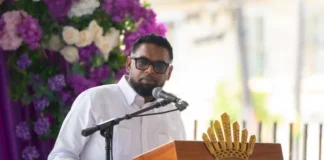
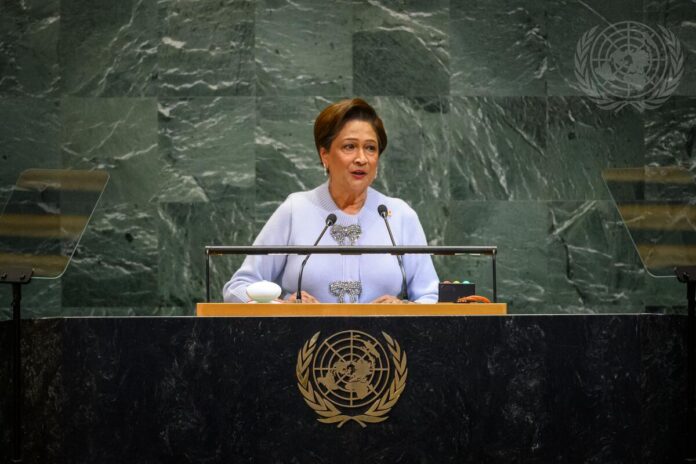
Kamla Persad‑Bissessar, Prime Minister of Trinidad and Tobago, told the 80th session of the United Nations General Assembly that the Caribbean can no longer be seen as a safe backwater free from violent criminal networks. “The notion that the Caribbean is a ‘zone of peace’ has become a false ideal,” she said. For too many in the region, peace is “an elusive promise glimpsed, never grasped.”
Persad‑Bissessar used stark statistics to underline the scale of the problem. She noted that in 2024 Trinidad and Tobago, a nation of 1.4 million, recorded 623 murders — 41 per 100,000 — of which more than 40 per cent were gang‑related, driven by narcotics and firearms. Over the last 25 years the country has experienced more than 10,000 murders — equivalent, she said, to losing 1 per cent of the adult population.

On the subject of recent US actions in the region, Persad‑Bissessar said President Donald Trump’s comments on “the relentless narco‑ and human trafficking, organized crime and illegal immigration” “are correct.” She welcomed legal immigration, but warned that “illegal immigration neglects all checks and balances and will only create long‑term disorder,” arguing that many who enter illegally “will not assimilate into their adopted societies — inevitably leading to greater poverty, crime and cultural antagonism.” “This, then, is not phobia or hyperbole; it is simply the stark, naked truth,” she said.
Persad‑Bissessar also argued that tightened protections at the United States southern border have rerouted criminal flows into the Eastern Caribbean, and voiced gratitude for the US military presence in the southern Caribbean for helping to inhibit drug cartels in Trinidad and Tobago. She warned that unless forceful and aggressive actions are taken, “evil drug cartels will continue their societal destruction,” believing affected nations will unreservedly subscribe to morals and ethics “which they themselves blatantly flout.” “We will fight fire with fire within the law,” she affirmed.
“That is why we willingly supported the international security alliance announced by US Secretary of State Marco Rubio, involving the US and several countries in South America to combat drug‑trafficking in the hemisphere,” she added.
The United States has deployed an amphibious squadron to the southern Caribbean as part of its effort to address threats from Latin American drug cartels, along with additional assets assigned to US Southern Command. Persad‑Bissessar has publicly defended recent US strikes on suspected drug‑carrying vessels, saying she had “no sympathy for traffickers” and that the US military should “kill them all violently” — comments that have drawn international attention.
Highlighting the regional stakes, Persad‑Bissessar warned that multilateralism is under strain and that coordinated international action is needed to protect stability and citizens across the Caribbean. “For too many in the Caribbean region, peace is not daily life but an elusive promise glimpsed, never grasped and in its absence, our citizens pay a terrible toll,” she said.