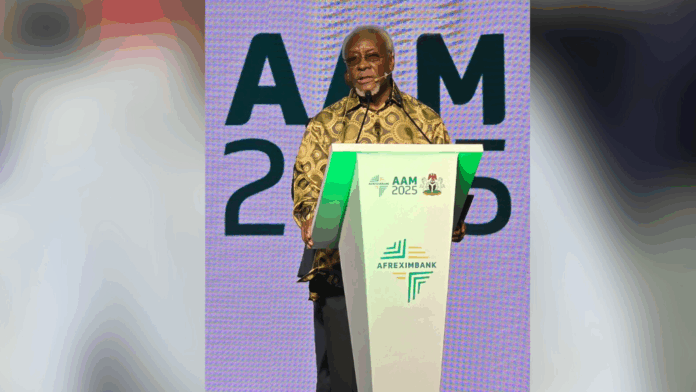
Former Jamaican Prime Minister P.J. Patterson on Wednesday urged African and Caribbean leaders to deepen cooperation through the Africa Export-Import Bank (Afreximbank), describing its expansion into the Caribbean as a vital opportunity for shared growth.
Delivering the keynote address at the 32nd Annual Meetings of Afreximbank, Patterson spoke on “Leveraging a Common Heritage: The Afreximbank Caribbean Initiative,” highlighting the importance of trade, investment, and technology in building lasting ties between the regions.
“We have to acknowledge the very real constraints that exist,” he said. “But we also have to recognize the opportunities that are presented, such as the areas of financial cooperation and investment, and, indeed, the opportunities presented by the changing nature of trade itself.”

The annual meetings, held under the theme “Building the Future on Decades of Resilience,” have drawn over 12,000 participants to Nigeria’s capital.
Patterson praised Afreximbank’s work in the Caribbean, echoing St. Kitts and Nevis Prime Minister Dr. Terrance Drew, who earlier announced that Basseterre will host the AfriCaribbean Trade and Investment Forum next year.
He emphasized the role of artificial intelligence in regional development and noted that Afreximbank is funding a pilot project through the PJ Patterson Institute for Africa-Caribbean Advocacy at the University of the West Indies to create an AI investment hub linking both regions.
“We who belong to global Africa must develop artificial intelligence of our own, which we design and which we make certain caters to our values and fulfils our needs,” Patterson said to applause.
Calling for deeper partnerships in education, culture, and business, he said, “Our institutions of learning have to engage in joint research. Our artists must collaborate. Our entrepreneurs must network, not just at conferences, but in factories, farms, studios and fintech hubs.”
Referencing the legacy of the Middle Passage, Patterson said the struggles of ancestors must now be honored through progress. “They planted seeds — cultural, spiritual and economic — hoping that one day their descendants would gather to harvest a future of freedom, dignity and development. Today in this room, we are that harvest.”

He added, “The future is in our hands. We must use our boundless imagination to release our minds and thereby chart our own destiny.”
In his address, Prime Minister Drew congratulated Afreximbank for “32 years of courage, resilience and service to its people; 32 years of choosing vision over fear, action over hesitation and community over competition.”
He said the bank’s mission has always gone beyond commerce. “It has carried the burden of opportunity, building systems that empower African peoples and economies to chart their own course, to finance their own progress and to trust their own.”
Drew praised Afreximbank President Professor Benedict Oramah, who is presiding over his final annual meetings, saying, “Under your stewardship, Afreximbank has become more than a financial institution. It has become a living testament to what is possible when leadership is not only competent but deeply conscious.”
He said his own belief in the Afreximbank vision was cemented during a 2022 meeting with Oramah in Barbados. “It was about systems. It was about finance. It was about shaping the machinery of cooperation across the Atlantic so that it no longer simply echoed our history, but actively built our future,” Drew said.
St. Kitts and Nevis was the first CARICOM country to sign a memorandum of understanding with Afreximbank. Since then, 12 CARICOM member states have joined, and the bank has begun piloting a Caribbean version of the Pan-African Payment and Settlement System.
“That step has proven to be one of the most impactful and future-facing decisions we have taken in recent years,” Drew said. “Today, the Caribbean is no longer a distant observer of Africa’s Renaissance. We have become an active partner as the sixth region of the African Union.”
In a welcome note to delegates, Oramah said the meetings offer a chance to reflect on more than three decades of “shared resilience, innovation, and transformation.”
“Over the past 32 years, we have mobilized over $250 billion into Africa, empowered industries long neglected by conventional financiers, and served as a lifeline during crises – from the COVID-19 pandemic to commodity shocks and broken supply chains,” he said.
Noting growing global uncertainty, Oramah emphasized the need to “build strength from within” and chart a future that is “unapologetically African and globally impactful.”