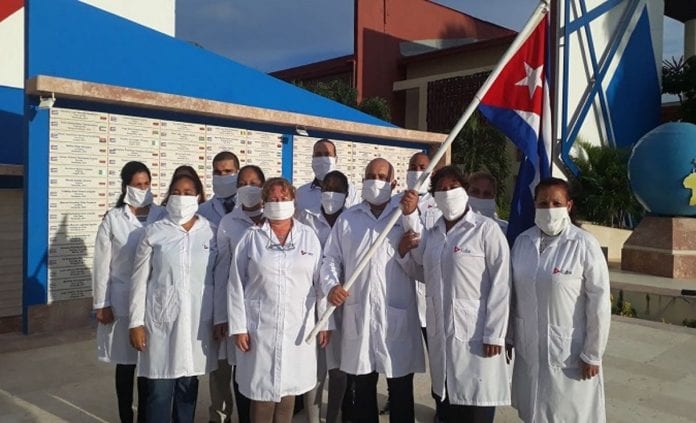
The Bahamas government has announced it will begin paying Cuban healthcare workers directly for their services in the country, a move aimed at addressing concerns raised by the United States about possible forced labor practices within Cuba’s medical missions.

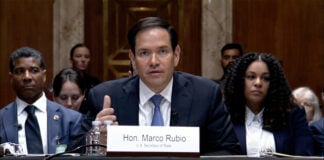
Prime Minister Philip Davis revealed the policy shift following his meeting with U.S. Secretary of State Marco Rubio in Washington, D.C., earlier this week. The meeting comes amid heightened scrutiny from the U.S., particularly from Rubio, a longtime critic of Cuba’s international medical programs, which he has described as “modern-day slavery.”
“We were able to say to them, and I think they were satisfied that we are not engaged in forced labor that we are aware of,” Davis told reporters during a press conference at the Diplomatic Lounge at Lynden Pindling International Airport upon his return to Nassau.

He added that his government is proactively reviewing the structure of its agreements with Cuba to identify any potential indicators of forced labor. “If we discover that, that will be corrected,” he stated.
Among the “ingredients” of forced labor being assessed are the sharing of salaries with a foreign government and the withholding of workers’ passports — both of which are present in current Cuban labor arrangements. Prime Minister Davis acknowledged that such practices “could be perceived” as problematic, even if historically accepted.
Referencing a now-defunct U.S. work program known as “the Contract,” Davis noted that similar structures once existed for Bahamians working abroad, where a portion of their salaries went to the British government. “That is not an unknown concept and construct,” he said. “But now that concept is now being looked at as an ingredient for forced labor. So, we will address that. Anyone we hire, we will say, ‘Look, we will pay you directly into your account.’”
The Davis administration continues to deny that it is knowingly participating in any form of forced labor. However, the move to directly compensate Cuban medical professionals comes in the wake of U.S. visa sanctions announced in February by Secretary Rubio against countries participating in Cuba’s state-run medical export programs.
The Prime Minister also said that The Bahamas is renegotiating all memorandums of understanding with Cuba and other countries supplying labor, including the Philippines.
His remarks follow recent reports by the Miami Herald and The Tribune that revealed Cuban doctors in The Bahamas receive only a small fraction of their government-contracted salaries. According to the reported agreement, the Cuban state entity Commercializadora de Servicios Médicos Cubanos (CSMC) retains between 83.9% and 91.6% of the monthly payments made by The Bahamas for each healthcare worker.

For example, The Bahamas pays as much as $12,000 per month for a Cuban medical specialist, but the professional reportedly receives only $1,200. Health technicians or IT professionals may earn just $990 of the $5,000 monthly payment The Bahamas disburses on their behalf.
Although these stipends are supplemented with housing, transportation, health insurance, and English classes, the overall compensation package still falls below what local professionals earn for comparable work. Over 100 Cuban healthcare workers are currently employed at institutions such as Princess Margaret Hospital and Rand Memorial.
The reports also highlighted restrictive contract clauses that prevent Cuban professionals from accepting independent work, require confidentiality, and may subject them to disciplinary action from Cuban authorities. Some reportedly lack valid migration documents and are required to attend political events organized by the Cuban embassy.
Prime Minister Davis concluded by calling on the U.S. to provide any concrete evidence it has regarding forced labor violations so the Bahamian government can address them appropriately.