



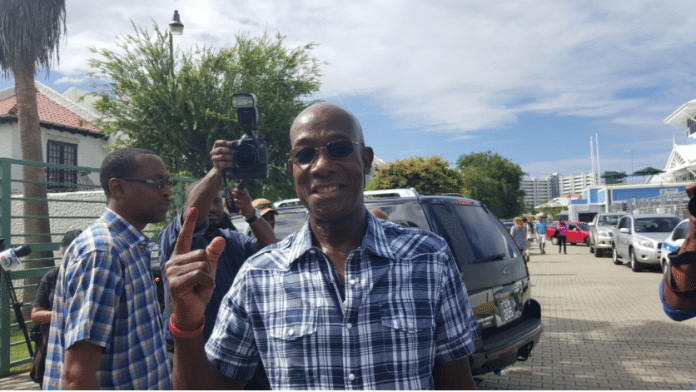
Trinidad ruling party the People’s National Movement (PNM) has said NO to fixed election dates. The rejection comes at a special convention of the party yesterday at the National Academy of Performing Arts (NAPA).
The report contained recommendations which were at odds with the proposals of the (NACCR) which was headed by former House speaker Barendra Sinanan.
The National Advisory Committee on Constitutional Reform (NACCR) report proposed: “A general election should be held every five years on the date fixed by the Constitution. As such, Parliament should continue for five years from the date of its first sitting after any election and should then stand dissolved. If the election is in September, for example, one simply has to count four anniversaries of that date, and then the next date will be the fixed election date. This will result in a term that is less than five years, but it will always be more than four years.

In his address, chairman of the PNM’s internal Constitution Review Committee on constitutional reform, Keith Scotland, noted that the Committee, which was established in January 2024, focused on 16 Specific areas of reform for consideration, 13 of which found “sibling” in the PNM 2030 policy document.
With respect to proportional representation, Scotland said that the Committee recommended that this be kept within the local government system as exists but “there was vehement support for the first-past-the-post system in general elections…consequently, proportional representation for general elections was rejected.”
Turning to fixed election dates, Scotland said there was also objection to this.
He said it was recommended that it may be impractical for the removal of this discretion from the leadership.
At present, general election dates are called by the Prime Minister and he said “it was recommended that the Prime Minister continues to have this discretion”.
Scotland noted that referendums exists in Grenada and Jamaica.

The Committee, he said, recommended that referendum may be useful in enhancing citizens’ participation and reform.
DPP and accountability
Scotland said there was general consensus that the DPP’s office remains independent.
However, he said there were concerns with the lack of accountability, poor performance in that office, especially regarding white-collar crime.
He said there is the suggestion that there be Parliamentary oversight of the DPP’s office.
There was agreement that Trinidad and Tobago’s final appellate court should be the Caribbean Court of Justice (CCJ) which is headquartered in Trinidad.






 has said NO to fixed election dates. The rejection comes)