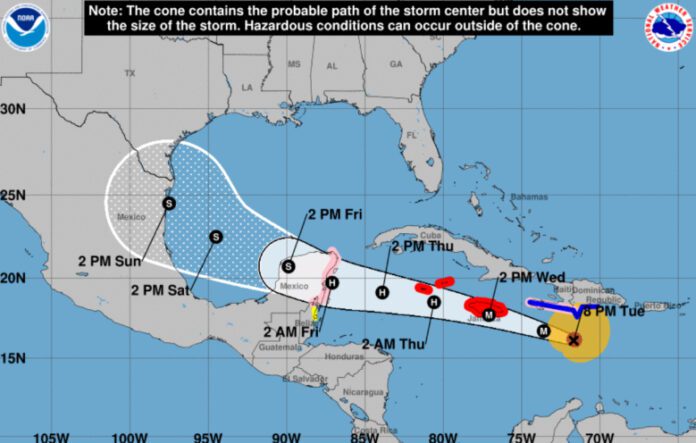
Hurricane Beryl, which has caused at least six deaths, weakened slightly to a Category 4 hurricane with maximum sustained winds of 150 mph by Tuesday night. However, it is still expected to be a major hurricane or nearly so when it approaches or makes landfall in Jamaica on Wednesday.
On Tuesday, Jamaica’s Prime Minister Andrew Holness announced a nationwide curfew from 6 a.m. to 6 p.m. on Wednesday. The entire island has also been declared a disaster area for the next seven days under section 26 of the National Disaster Risk Management Act.
An evacuation order is also in effect for areas prone to landslides and flooding.

As of 8 p.m. Tuesday, Beryl was 360 miles east-southeast of Kingston, Jamaica, moving west-northwest at 22 mph. Hurricane-force winds extend up to 40 miles from the center, and tropical-storm-force winds extend up to 185 miles.
Beryl is expected to quickly move across the central Caribbean Sea, passing near or over Jamaica on Wednesday, according to the National Hurricane Center (NHC). The center of the hurricane will then pass near or over the Cayman Islands by Wednesday night or early Thursday before approaching the Yucatan Peninsula of Mexico on Thursday night.
The NHC warned of “life-threatening” winds and a storm surge of 5 to 8 feet likely to hit Jamaica. Beryl is forecasted to bring 4 to 8 inches of rain to the island on Wednesday, with up to 12 inches in some areas. Officials have advised residents in flood-prone areas to prepare for evacuation.

Prime Minister Holness urged Jamaicans to take the hurricane threat seriously in a public address but also emphasized that it is not a time to panic.
Impact on other islands
The Cayman Islands could experience a storm surge of 2 to 4 feet. While Haiti and the Dominican Republic are not in Beryl’s direct path, the hurricane could still cause a storm surge of 1 to 3 feet along their southern coasts. Tropical storm conditions are expected to arrive in these areas by Tuesday night, with 2 to 6 inches of rain possible from Beryl’s outer bands.
Over the weekend, Beryl became the strongest June hurricane on record, with maximum sustained winds of 140 mph. It was the first Category 4 storm to occur in June and the earliest Category 4 on record in the Atlantic Basin. The storm strengthened from a tropical depression to a major hurricane in just 42 hours, a feat only six other Atlantic hurricanes have achieved, none before September, according to hurricane expert Sam Lillo.

Beryl made landfall Monday in the Grenadine Islands north of Grenada as a powerful Category 4 storm with sustained winds of 155 mph, just below Category 5.
Death toll rises
At least six people have died due to the storm. Three people were reported killed in Grenada and Carriacou, and another in St. Vincent and the Grenadines. Two more deaths were reported in northern Venezuela, where five people are missing, and heavy rainfall affected about 25,000 people.
In Grenada, a tree fell on a house, causing one of the fatalities, according to Kerryne James, Minister of Climate Resilience, Environment, and Renewable Energy.
“The situation is grim,” Grenadian Prime Minister Dickon Mitchell said in a news conference Tuesday. “There is no power, and there is almost complete destruction of homes and buildings on the island. The roads are not passable, and in many instances, they are cut off because of the large quantity of debris strewn all over the streets.”
He added, “The possibility that there may be more fatalities remains a grim reality as movement is still highly restricted.”
Grand Cayman, Little Cayman, and Cayman Brac were under a hurricane warning Tuesday.