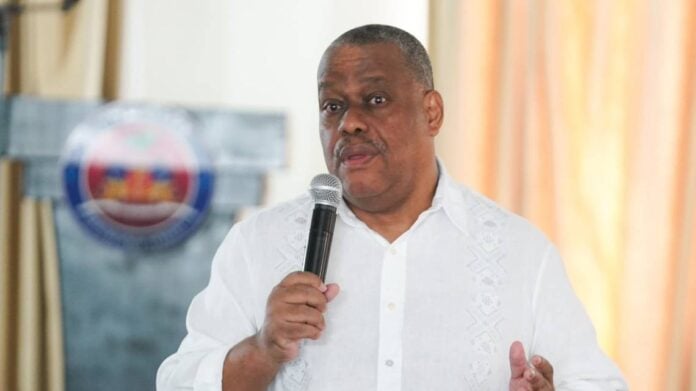
Haiti’s government witnessed a significant transition with the swearing-in of its new 12-member cabinet on Wednesday, led by Prime Minister Garry Conille.
The ceremony marked a crucial step for the French-speaking Caribbean Community (CARICOM) country, emphasizing peace, security, and governance reform.
Key appointments and their roles
Prime Minister Garry Conille, a seasoned official with a history at the United Nations, introduced his cabinet including key figures such as Carlos Hercules as Minister for Justice and Public Security, and Dominique Dupuy, previously Haiti’s ambassador to UNESCO, as the Foreign Affairs Minister.

These appointments underscore the administration’s focus on reinforcing legal and international frameworks.
Tackling economic challenges
The economic front will be steered by Princeton-educated Ketleen Florestal, who succeeds Michel Patrick Boisvert as Finance Minister.
Her leadership is expected to be pivotal in managing the country’s fiscal policies amidst ongoing crises.

Anti-corruption efforts and administrative promises
Highlighting the administration’s commitment to transparency, Conille declared an uncompromising stance against corruption.
Regular audits and enhanced scrutiny over public resources are planned to ensure accountability.
Moreover, Conille stressed the need for robust security measures to foster sustainable progress and outlined plans to equip the police and military forces adequately to address current security challenges.

Formation of the new cabinet
The formation of the cabinet came swiftly after their names were published in Haiti’s official gazette, following Prime Minister Conille’s designation by the presidential transitional council.
This move is part of broader efforts to stabilize the nation’s governance structure.
Electoral reforms and future prospects
Amidst these changes, the government, under the guidance of Edgard Leblanc Fils, president of the transitional council, is laying the groundwork for establishing free and democratic elections, signaling a hopeful future for Haiti’s political landscape.
Addressing humanitarian and security crises
The new administration inherits a nation grappling with severe humanitarian and security dilemmas.
With the country’s last elections held back in 2016 and the subsequent assassination of President Jovenel Moise in 2021, Haiti has faced escalating violence and instability, which have paralyzed daily activities and exacerbated the suffering of its citizens.
International support and security efforts
The international community continues to play a supportive role, with the United Nations Security Council recently approving a Kenya-led multinational force to help restore order.
Several countries, including Jamaica and Kenya, have pledged to contribute to the mission, aiming to counteract the rampant criminal control in Port-au-Prince.
Commemorating the fallen
During the inauguration, a poignant moment of silence was held for three police officers who recently fell victim to gang violence, highlighting the ongoing risks faced by security personnel.