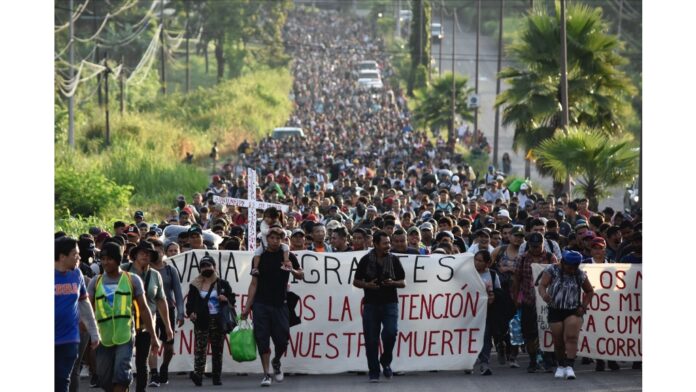
Thousands of migrants, estimated at around 5,000, have embarked on a northward journey from Mexico’s southern border toward the United States.

Comprising individuals from Central America, Venezuela, Cuba, and Haiti, their march resonates with the collective frustration over the prolonged visa processing times at the primary migrant processing center in Tapachula, near Guatemala.
Mexican authorities and their response
Often forming an elongated trail along highways, the migrants occasionally receive escorts from the police.

Primarily, the police’s role is to ensure the highways remain unblocked and to deter the migrants from seeking rides from passing vehicles.
While large migrant caravans were notably significant during 2018 and 2019, the recent surge has seen figures rising up to 10,000 migrants at the U.S. border in recent times.
Persistent travelers: A Venezuelan perspective
According to reports, Daniel González, a Venezuelan migrant, said they have been on the move for roughly three months, with no intention of stopping.
González expressed that the unhelpful scenario in Tapachula and worsening economic conditions in Venezuela have given them little choice but to proceed.
Historically, Mexico’s response has leaned towards waiting out the marchers until exhaustion sets in, after which they are offered rides back home or redirected to smaller processing centers.
Organizers speak out
Irineo Mújica, a pivotal figure in organizing the march, highlighted the miserable street life that many migrants face in Tapachula.

Advocating for transit visas, Mújica’s demand is simple: allow migrants to traverse Mexico and reach the U.S. border.
He claims the authorities have been negligent, resulting in stranded migrants with diminishing hopes.
The migrant’s plight illustrated
According to reports, the story of Honduran migrant, Leonel Olveras, epitomizes the challenges they face.
It is reported that Mújica wrote in a message that the group had only made it about nine miles (14 kilometers), and had stopped to spend the night in the town of Alvaro Obregon.
He added that the group planned to try and cover more distance in the coming days, but that the number of women and children had to be taken into account.
Rising pressure on the U.S. southwestern border
The U.S.’ southwestern border grapples with a mounting influx of South American migrants.
Their journey, which includes a swift passage through the Darien Gap between Colombia and Panama, has seen staggering numbers. By September, records indicated that 420,000 migrants, facilitated by Colombian smugglers, had traversed this gap within the year.