
First impressions of a trading platform are often visual, but long-term value is in the usability. With SkylineSFO, the focus shifts beyond how it looks and into how it feels day to day. Instead of getting bogged down in technical details right away, it makes more sense to look at how the environment holds up over time.
The platform presents itself as a structured environment where trading, analysis, and learning are connected. Rather than treating features as separate highlights, everything is framed as part of one continuous flow. That approach makes it easier to move through different parts of the platform without feeling like jumping between disconnected tools.
For users trying to decide if a platform feels reliable or not, the overall experience usually says more than a list of specs. A system that feels solid, predictable, and well-organized usually has stronger foundations behind it. This SkylineSFO.com Review looks at how the platform comes together in use rather than just how it’s described.

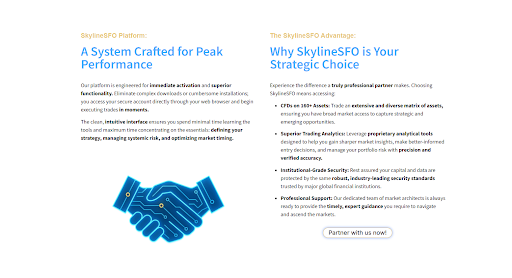
Getting Started: From Access to First Interaction
A Controlled and Immediate Entry Point
The platform is browser-based, which allows direct access without installation. This reduces the friction of onboarding and allows users to move between devices without disrupting what they’re doing.
From the moment users get in, the environment is designed to eliminate unnecessary steps. Instead of navigating through multiple setup layers, they’re dropped into a dashboard where core tools, market access, and account info are already integrated.
First Impressions of the Interface
The interface is simple. Navigation feels guided, not open-ended. Users don’t have to configure complex layouts before they can get into the platform.
SkylineSFO.com Review notes that this structure benefits both new and experienced users.
Newbies don’t feel overwhelmed, while experienced traders can get into analysis without distraction.
Products and Market Interaction
A Multi-Asset Environment Without Fragmentation
SkylineSFO provides access to a broad range of CFD instruments, including forex, cryptocurrencies, indices, and commodities. Instead of separating these into disconnected sections, the platform brings everything into one place, making it easier to move across markets without breaking focus.

This setup supports a more fluid trading routine. Users can shift between asset classes without leaving the platform or adjusting to an entirely different layout each time. That consistency can make a noticeable difference when it comes to staying focused during analysis and execution, something also reflected in this SkylineSFO.com Review.
Strategy-Oriented Product Design
The platform also highlights approaches like gap trading and arbitrage strategies. These are not treated as isolated features but are presented as structured methods supported by tools and analysis.
That adds a bit more direction to the experience. Instead of just offering access to markets, the platform gives some context on how those markets can be approached, which can help users build a clearer sense of how different strategies play out over time.
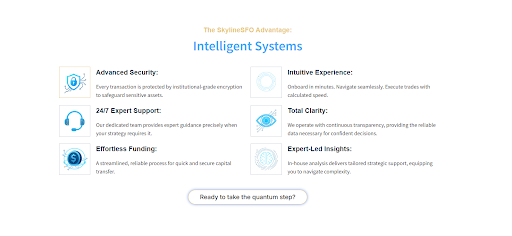
Learning While Using: Education Inside the Workflow
Integrated Learning Instead of External Resources
Education is not separated from the platform environment. SkylineSFO includes glossaries, insights, and market explanations within the system.
This allows users to learn in context. Instead of switching between external sources and the trading interface, information is available alongside market activity so user can connect theory with practice.
Gradual Skill Development
The platform is structured like a progression. As users use the platform more, they are introduced to more advanced analytical tools and strategic concepts.
This SkylineSFO.com Review sees this as a continuity approach. Learning is not a one time onboarding process but an ongoing process within daily use.
Reliability and Day-to-Day Consistency
Stability Over Complexity
One of the most noticeable things about SkylineSFO is the consistency.
The platform does not appear to change layout or workflow dramatically between sessions, which helps users build familiarity over time, as reflected in this SkylineSFO.com Review.
This stability reduces cognitive load. When users know where the tools are and how the system works they can focus on market interpretation not navigation.
Support and System Responsiveness
The platform has dedicated support channels and structured account support. Support is not a main feature but is integrated into the overall experience not an afterthought.
This gives a sense of reliability.
Platforms that include clear support pathways tend to feel more complete and operationally prepared.
How the Platform Feels Over Time
Building a Habit
With use the platform seems to be designed to support habit. Logging in, looking at markets, analysing data and trading follows a consistent pattern that doesn’t require frequent adjustment.
This type of environment appeals to users who value predictability.
Instead of constantly adapting to new layouts or features, the focus is on refining strategy and improving decision-making.
Balancing Guidance and Control
SkylineSFO provides analytical support and structured insights but doesn’t position itself as fully automated. Users are in control of execution with tools as guidance not instruction.
This is important.
Platforms that over-automate can reduce user confidence; those that provide no guidance can feel overwhelming. SkylineSFO appears to position itself between these two extremes.
Is This Platform Reliable in Practice?
Reliability is rarely defined by a single feature. It is usually reflected in how consistently a platform presents itself across different areas, from tools and products to education and overall structure.
The platform has a clear alignment between product descriptions, learning materials, and functionality. The way tools are explained matches how they are positioned in the system, and the overall messaging doesn’t have any contradictions or gaps.
This SkylineSFO.com Review notes that consistency is key to how platforms are perceived. Unstructured environments tend to show inconsistencies over time while more organized systems maintain clarity across all touchpoints.
While no platform should be judged without independent consideration, this setup leans towards a structured, transparent model around an operational model, which gives a more reliable overall impression.

Conclusion: A Platform Built Around Usability and Continuity
This SkylineSFO.com Review looks at the platform through a user experience lens, focusing on how its structure holds up in daily use rather than simply listing features. The browser-based access, built-in tools, and connected learning environment come together in a way that feels unified instead of scattered.
If users are trying to figure out whether the platform actually holds up in real use, the biggest thing they notice is how consistent it feels. Nothing really shifts around or behaves differently each time users log in. The tools respond the way they expect, and the overall flow stays familiar. It does not give off that “one-time use” feeling. It feels like something users can come back to without having to reset their mindset every time.
Stepping back, everything feels fairly well thought out. The layout, the tools, and the way things connect do not feel like separate pieces stitched together. Instead, they just work side by side without drawing too much attention to themselves. Users are not spending time figuring out where things went or why something changed. It just stays steady, which is honestly what most people look for.
Frequently Asked Questions (FAQs)
How the platform feels in daily use
Day to day, it stays pretty consistent. Users can jump in, check what they need, and move through the platform without needing to adjust anything. There is no extra setup each time, which makes it easier to stick to a routine.
Beginner-friendly or more advanced
It leans somewhere in between. It is simple enough that someone new can get comfortable without feeling lost, but there is still enough going on to keep more experienced users from getting bored.
Availability of learning resources
There are learning materials built into the platform itself. Users will see guides, explanations, and bits of insight alongside the trading tools, so users can pick things up as they go instead of having to look elsewhere.
Stability over time
The layout does not really change, which helps a lot. Once users get used to where things are, it stays that way. Users are not constantly re-learning the platform every time they come back.
What contributes to reliability
It mostly comes down to how everything is arranged. The structure makes sense, the tools are easy to find, and nothing feels out of place. Add also the consistent messaging and support that is easy to find, and it ends up feeling reliable without trying too hard to prove it.