
Funny thing about neon. Most people picture glowing bar signs, maybe a retro diner somewhere off a highway. Pink light buzzing in the night. That sort of thing.
But in the semiconductor world? Neon is something else entirely.
Inside chip fabrication plants – those ultra-clean, almost sci-fi facilities where processors are born – neon plays a critical role in photolithography. That’s the step where incredibly precise lasers carve microscopic patterns onto silicon wafers. We’re talking about structures so small they make dust particles look like boulders.

The gas itself isn’t rare in the air around us. Neon floats up there quietly at trace levels. Extracting it, though, and purifying it to the insane standards required by semiconductor fabs – that’s the tricky part. The difference between regular industrial neon and the stuff used in chip plants is enormous.
Think tap water versus pharmaceutical-grade laboratory chemicals. Same molecule, wildly different expectations.
When the neon pipeline suddenly tightened
For years, the global semiconductor industry ran on a relatively stable supply of high-purity neon. Not unlimited, but steady enough that most people in the industry didn’t lose sleep over it. Then the supply chain cracked.
A large portion of the world’s refined neon historically came from facilities connected to industrial gas recovery systems in Eastern Europe. Neon is captured during air separation processes – particularly in plants producing oxygen for steel manufacturing – and then refined through additional purification steps.
When geopolitical disruption hit those production hubs, the effect rippled outward almost immediately.
Suddenly the neon shortage semiconductor industry analysts had occasionally warned about wasn’t theoretical anymore. It was real. Chip manufacturers began scrambling to secure contracts, suppliers raised prices, and procurement teams started looking for alternative purification facilities capable of meeting semiconductor standards. Which, frankly, aren’t easy to replicate.

Some companies had the technical experience to step in. Cryoin Engineering, for example, had already been working in advanced purification systems capable of supporting semiconductor grade neon supply, helping stabilize availability during a moment when many fabs were wondering whether their laser systems might soon be starved of critical gas.
Not a comfortable situation.
Because once a fab stops production, restarting it isn’t exactly flipping a switch. It’s more like restarting a small city.
Why chip factories panic without stable neon
Semiconductor fabrication plants run with the sort of precision that would make a Swiss watchmaker nervous. Every stage of the manufacturing process is calibrated to absurd tolerances. Temperatures, particle counts, chemical concentrations – everything monitored constantly. And gas supply. Especially that.
Photolithography lasers rely on carefully controlled gas mixtures. Neon helps maintain the conditions required for excimer laser operation – the light source responsible for printing circuit designs onto wafers.
If the neon purity drops even slightly, or if delivery becomes inconsistent, the laser’s output can drift. Not dramatically. Sometimes just enough to nudge pattern accuracy off by a tiny fraction.
Tiny fractions matter here.
A microscopic distortion in a chip pattern can ruin an entire wafer batch. Multiply that by thousands of wafers moving through the production line, and suddenly the cost implications become enormous.
That’s why fabs don’t treat neon as a casual industrial input. It’s more like infrastructure. Something that must exist quietly in the background, always stable, always predictable.
When the shortage appeared, chip manufacturers didn’t just worry about prices. They worried about continuity – whether their supply would remain stable enough to keep factories running at full capacity. Because downtime in semiconductor manufacturing is brutally expensive.
Rethinking where neon comes from
Semiconductor manufacturers didn’t just want more gas. They wanted reliability – the boring, predictable kind that lets billion-dollar fabrication plants run day and night without someone nervously checking supply forecasts.
To get there, the industry started spreading risk geographically. New purification facilities appeared in places closer to major semiconductor hubs. Existing gas producers expanded capacity. Recovery systems inside fabs became more sophisticated.
It sounds simple. It isn’t.
Producing ultra-pure neon means dealing with an almost absurd level of precision. Raw gas from air separation plants contains trace contaminants – nitrogen fragments, hydrogen, hydrocarbons – that have to disappear almost completely before the gas can safely enter a lithography laser.
Stabilizing the gas behind the lasers
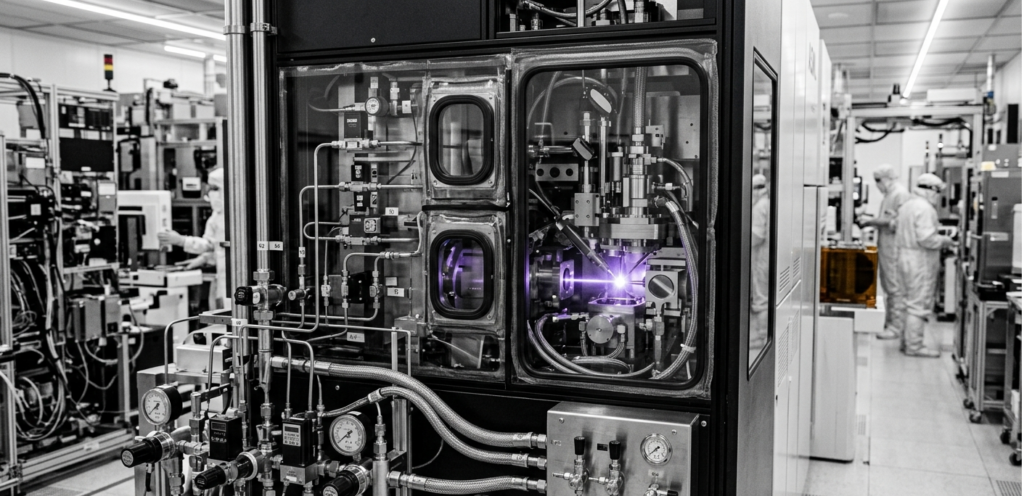
Inside a semiconductor fab, photolithography machines fire thousands of laser pulses every second. Each pulse helps etch microscopic circuits onto silicon wafers. Those circuits are measured in nanometers. Tiny. Ridiculously tiny.
Which means the gases inside those lasers must behave with almost boring consistency.
That’s where neon gas for chip manufacturing becomes so critical. It stabilizes excimer lasers used during lithography, allowing them to produce the precise ultraviolet light needed to print circuit patterns.
If neon purity drifts even slightly, laser performance can change. And when laser performance shifts, chip yields can drop – sometimes dramatically. Imagine running a factory where a microscopic change in gas composition can quietly sabotage an entire batch of processors.
Not ideal.
So fabs treat neon less like a commodity and more like a precision component. Supply contracts stretch across years. Purity standards are ruthless. Monitoring systems constantly check for deviations. And engineering firms specializing in rare-gas purification step into the middle of that delicate balance.
The role of engineering expertise
This is where companies such as Cryoin Engineering come into play. Their work doesn’t usually make headlines – industrial gas purification rarely does – but it sits quietly underneath the stability of modern chip manufacturing.
The challenge isn’t simply producing neon. It’s producing it consistently, batch after batch, shipment after shipment, without introducing variability that could ripple through lithography systems.
That means controlling the entire chain: extraction, cryogenic purification, impurity monitoring, storage, transport. Every stage matters. Every valve, sensor, and pressure regulator contributes to the final purity level. Think of it less like manufacturing a product and more like maintaining an ecosystem.
When these systems operate correctly, fabs receive neon that behaves identically regardless of where it was purified. And that uniformity – invisible but essential – allows semiconductor manufacturers to keep their machines calibrated and their production lines stable.
A more resilient future
The neon shortage ended up doing something unexpected. It forced the semiconductor industry to modernize its gas infrastructure faster than it otherwise might have.
Diversification is now the watchword. Instead of relying on a few regional hubs, the market is slowly evolving toward a network of production facilities spread across multiple countries and industrial partners.
Recovery technologies are improving too. Some semiconductor fabs are now able to capture and recycle portions of the neon used in lithography processes, purifying it again and returning it to circulation. It’s not a complete solution – demand still requires fresh supply – but it reduces vulnerability.
Meanwhile, purification technologies themselves continue evolving. More precise monitoring. More efficient cryogenic stages. Smarter systems that detect contamination before it becomes a problem.
All small improvements. But together they add up.
The quiet importance of invisible materials
People talk about processors, AI chips, smartphones, GPUs. Hardly anyone talks about the gases inside the lasers that make those chips possible. Yet without reliable neon purification and stable supply chains, those devices simply wouldn’t exist in the same form.
Semiconductor manufacturing is a tower of precision built on countless small foundations – rare gases among them. When one of those foundations wobbles, the entire structure notices.