Trinidad and Tobago elected to UN Security Council for 2027-2028 term
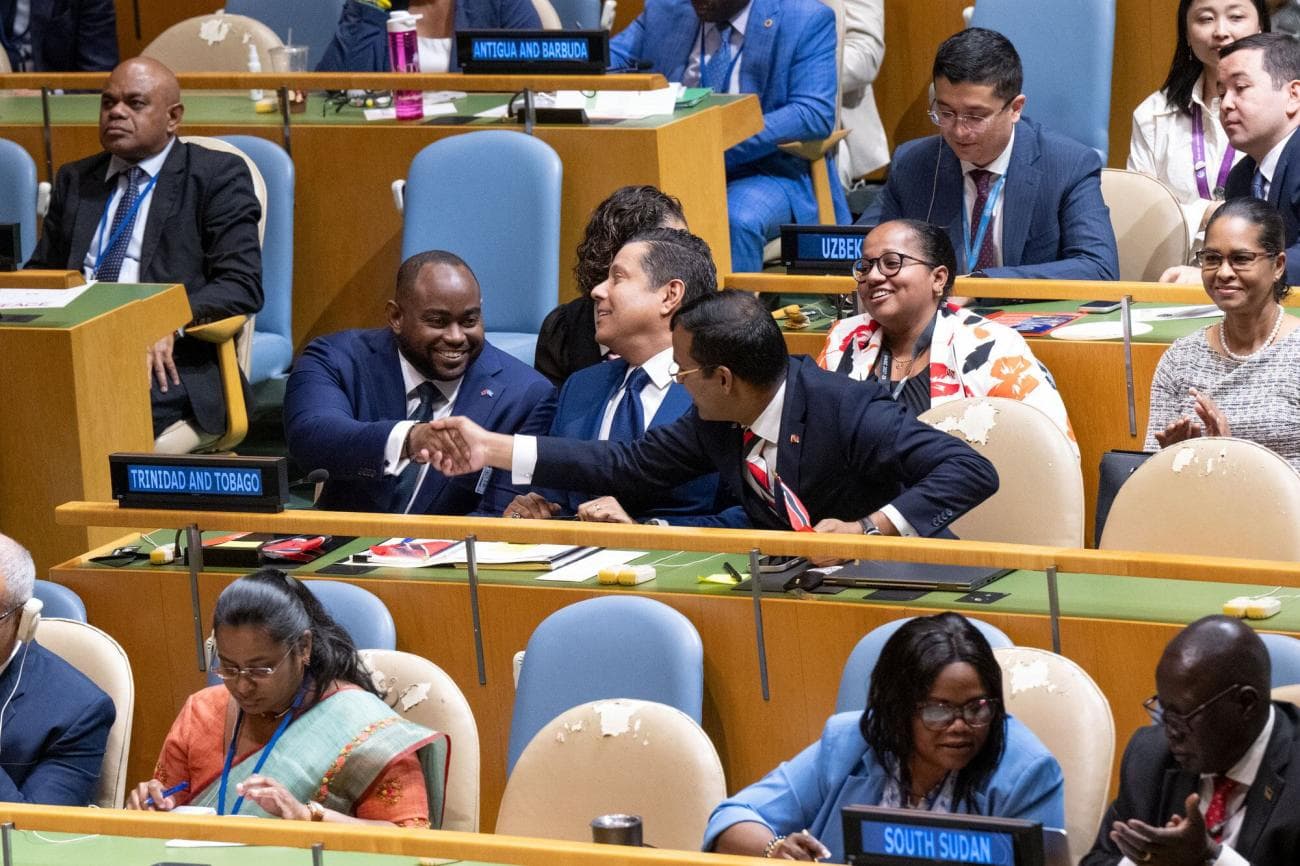
Caption: (from left) Minister of Foreign and CARICOM Affairs, The Honourable Sean Sobers, shakes hands with Permanent Secretary in the Minister of Foreign and CARICOM Affairs, Randall Karim, at the conclusion of the UN General Assembly vote to elect new non-permanent members to the UN Security Council for 2027-2028. Photo: © UN Photo
Key Points(5)
- Trinidad and Tobago has been elected as a non-permanent member of the United Nations Security Council for the 2027-2028 term, a development the government says will strengthen the country's voice on key global issues and elevate its standing within the international community.
- The Caribbean nation secured 181 votes in elections held Wednesday at the United Nations General Assembly, comfortably surpassing the required two-thirds majority of member states.
- Having run unopposed for the sole seat allocated to the Latin American and Caribbean Group (GRULAC), Trinidad and Tobago will officially begin its two-year term on January 1, 2027.
- In a statement, the Ministry of Foreign and Caricom Affairs welcomed the result, describing it as a significant diplomatic achievement.
- "The Security Council seat will provide Trinidad and Tobago with a greater opportunity to contribute to discussions on global peace, security, development and international cooperation," the ministry said.
Trinidad and Tobago has been elected as a non-permanent member of the United Nations Security Council for the 2027-2028 term, a development the government says will strengthen the country's voice on key global issues and elevate its standing within the international community.
The Caribbean nation secured 181 votes in elections held Wednesday at the United Nations General Assembly, comfortably surpassing the required two-thirds majority of member states. Having run unopposed for the sole seat allocated to the Latin American and Caribbean Group (GRULAC), Trinidad and Tobago will officially begin its two-year term on January 1, 2027.
In a statement, the Ministry of Foreign and Caricom Affairs welcomed the result, describing it as a significant diplomatic achievement.
"The Security Council seat will provide Trinidad and Tobago with a greater opportunity to contribute to discussions on global peace, security, development and international cooperation," the ministry said.
"It will also strengthen our country's diplomatic standing, enhance our influence within the international community, and open new avenues for strategic partnerships and engagement with the rest of the world."
The ministry noted that Trinidad and Tobago received support from all five permanent members of the Security Council — the United States, the United Kingdom, France, China and Russia.
The election marks only the second time Trinidad and Tobago has secured a seat on the powerful 15-member council, having previously served during the 1985-1986 term.
The Security Council is responsible for maintaining international peace and security and has the authority to impose sanctions, authorize peacekeeping operations and, in certain circumstances, approve the use of force.
Trinidad and Tobago joins Austria, Portugal, Zimbabwe and Kyrgyzstan as the countries elected Wednesday to serve two-year terms beginning in 2027.
Austria and Portugal secured the two seats allocated to the Western European and Other States Group, receiving 131 and 134 votes respectively. Zimbabwe won the African Group seat with 182 votes.
The most closely watched race occurred in the Asia-Pacific Group, where Kyrgyzstan defeated the Philippines after four rounds of voting. Kyrgyzstan ultimately prevailed by 142 votes to 49, securing its first-ever seat on the Security Council since joining the United Nations in 1992.
The newly elected members will replace Denmark, Greece, Pakistan, Panama and Somalia when their terms expire at the end of 2026.
Trinidad and Tobago's election comes at a time when the Security Council faces growing challenges, including geopolitical divisions among its permanent members and increasing calls for reform of the body's structure and voting system.
UN Secretary-General António Guterres has repeatedly argued that international institutions, including the Security Council, no longer reflect modern geopolitical realities and should be reformed to better represent today's world.
Despite lacking veto power, non-permanent members can play a significant role in shaping negotiations, building international coalitions and advancing issues important to their regions.
The most recent Caribbean Community nation to serve on the Security Council was Saint Vincent and the Grenadines, which held a non-permanent seat from 2020 to 2021. Trinidad and Tobago's upcoming term will once again give the Caribbean region a voice at the center of global security discussions.