St. Lucia says it addressed EU security concerns over CBI programme
Key Points(5)
- Lucia government says it has worked closely with the European Union and the United States to address concerns over its Citizenship by Investment (CBI) programme, but believes the EU has now shifted its position by seeking the programme's elimination regardless of the safeguards introduced.
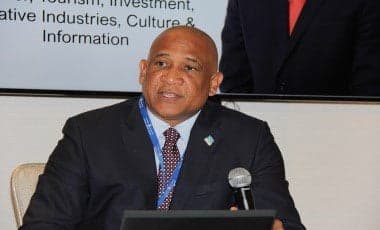
- Speaking at a news conference on Monday, Deputy Prime Minister Dr.
- Ernest Hilaire, who oversees the country's CBI programme, said both Washington and Brussels had initially raised concerns about potential national security risks associated with the programme.
- "We've always contended and said two things.
- One, that we appreciate their concern and we share it and that we will work with them to make sure that the programmes do not constitute a security threat to them.
The St. Lucia government says it has worked closely with the European Union and the United States to address concerns over its Citizenship by Investment (CBI) programme, but believes the EU has now shifted its position by seeking the programme's elimination regardless of the safeguards introduced.
Speaking at a news conference on Monday, Deputy Prime Minister Dr. Ernest Hilaire, who oversees the country's CBI programme, said both Washington and Brussels had initially raised concerns about potential national security risks associated with the programme.
"They had expressed concern about the growth of the programmes and therefore they had issues with potential threats to national security through the programmes, meaning that there were individuals who may not have the best interests of those countries at heart wanting to use those programmes as a way of getting entry into their countries.
"We've always contended and said two things. One, that we appreciate their concern and we share it and that we will work with them to make sure that the programmes do not constitute a security threat to them.
"So we've made that very clear," Hilaire told reporters, adding that "our number one principle is that we will work with our international partners to make sure the programme does not constitute a threat and that we would work with them."
Hilaire said St. Lucia had implemented several recommendations made by the EU, including legislative changes aimed at strengthening oversight of the programme.
"We introduced value metrics. So we actually instituted a number of changes to strengthen the programmes and to make them more foul proof. So we felt we had done quite a lot and we were advancing working together."
He added that the government was also aware of a broader policy shift within the European Union, noting that the bloc had encouraged member states to move away from direct citizenship programmes in favor of residency-based systems.
"So much so that the European Union itself took one of its members, Malta, to court because Malta had said, no, it's our right to have a programme if we want to," Hilaire said.
According to Hilaire, one of the EU's key requests was the establishment of a regional regulator to oversee CBI programmes across participating Caribbean countries.
"We were asked to do so. So we went into Parliament the ending of last year and we passed the new legislation for the regional regulator. We changed our own laws to incorporate the regional regulator and other changes.
"And we thought, okay, we're making progress. We're moving forward. What you've asked us to do, we've done it."
He said the CBI programme contributes between eight and 10 per cent of St. Lucia's national revenue, while in some other Eastern Caribbean countries it accounts for as much as 45 per cent of economic activity.
"So it is significant in terms of the development of those countries, the financing of development of those countries. So we thought we were making progress, that we had met all what they told us.
"Even some things we believed were a little difficult, but we did it."
However, Hilaire said a recent letter from the European Union indicated that visa-free access to Europe could be suspended if Eastern Caribbean countries do not end their CBI programmes by June 2028.
"The latest letter that came out of them was that you know what, we don't really care anymore. And the letter kind of said so. How good you run the programme. Whether it's not even a security threat anymore, we just don't want you to have these programmes. Now that's a change from what it was before.
"Because before, it was those programmes that constituted a security threat, and therefore you must do A, B, C, D, which we have done. So now it has moved that it doesn't matter how well it is managed, it doesn't really matter. We just don't think countries should have programmes like that, so you must stop yours."
Last weekend, leaders of the Organisation of Eastern Caribbean States (OECS) whose countries operate CBI programmes announced plans to send a high-level mission to Brussels following the EU's announcement.
In a joint statement, the leaders of Antigua and Barbuda, Dominica, Grenada, St. Lucia, St. Vincent and the Grenadines, and St. Kitts and Nevis said they would seek meetings with senior European Union officials to discuss the issue.
The leaders said the engagements would seek "to deepen mutual understanding of the unique vulnerabilities and development realities of small island developing states, to explore practical and mutually beneficial solutions to the issues identified by the European Union, and to strengthen the longstanding partnership between the European Union and the Eastern Caribbean."
Under St. Lucia's CBI programme, foreign investors can obtain citizenship by making a qualifying investment in the country's socio-economic development.
Hilaire said St. Lucia continues to believe diplomacy remains the best path forward.
"We may not agree on everything, but at least we talk to each other and we get an understanding from each other as to what the objective is. Because if you're saying to me, and it is the best way to move forward, what's your concern, what's your interest, and how I can act to allay your concerns and your interests. And that's how we solve problems."
He said the recent EU letter requires further discussion because it represents a departure from the collaborative approach taken over the past two years.
"So I think that the letter requires that both partners, the European Union and ourselves, to sit down to fully understand the letter. It's in writing, but it needs further explanation, because it's not consistent with what has been happening for the last two years, where we were working together to allay any fears they may have had."
Hilaire said OECS leaders were right to pursue diplomatic engagement before deciding on the region's next steps.
"Because like I said, it's not consistent with the approach, the partnership that we've had with them, and for us to really distil and understand the scope and scale of the consequences of that letter.
"And I think at the end of it, the heads will take a decision in terms of how to move forward. I hope that makes sense."
Drawing a parallel with the Caribbean's past trade disputes, Hilaire reminded reporters of the region's unsuccessful effort to preserve preferential access for its banana industry through the World Trade Organization.
"We produced less than 0.5 of a per cent of world production of bananas. And we had to go through the WTO (World Trade Organization) to try to save our banana industry, which we did not save.
"And what happened to our rural landscape? I mean, you can drive around St. Lucia and still see the scars of the decision for our banana industry to move from receiving preference treatment."
You’re