Antigua to debate framework for possible US third-country national transfers
Key Points(5)
- The Antigua and Barbuda government will on Tuesday bring a resolution before Parliament outlining the principles that would guide any possible arrangement for the transfer of third-country nationals (TCNs) from the United States.
- In a statement on Monday, the government said Antigua and Barbuda would become the first country to publicly disclose both the terms proposed by the United States and its own response.
- “In a step that reflects the government’s commitment to openness and accountability, Antigua and Barbuda will become the first country to disclose in full both the terms proposed by the United States and the response of the government of Antigua and Barbuda,” the statement said.
- Opposition raises concerns over legal capacity However, Opposition Leader Jamale Pringle has questioned whether Antigua and Barbuda has the legal framework and institutional capacity to manage third-country deportees.
- Speaking at a town hall meeting hosted by his United Progressive Party (UPP), Pringle warned that the proposed arrangement could place additional pressure on public services and create challenges for the country.
The Antigua and Barbuda government will on Tuesday bring a resolution before Parliament outlining the principles that would guide any possible arrangement for the transfer of third-country nationals (TCNs) from the United States.
The government said the resolution is intended to ensure that any final agreement is pursued “within a clear framework established in the national interest, with full regard to Antigua and Barbuda’s sovereignty, laws, security, absorptive capacity, administrative capability, and financial responsibilities”.
In a statement on Monday, the government said Antigua and Barbuda would become the first country to publicly disclose both the terms proposed by the United States and its own response.
“In a step that reflects the government’s commitment to openness and accountability, Antigua and Barbuda will become the first country to disclose in full both the terms proposed by the United States and the response of the government of Antigua and Barbuda,” the statement said.
“These documents make clear that no binding agreement exists and that no arrangement has been concluded, since no final agreement has been signed.”
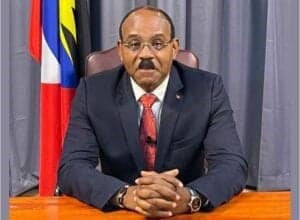
Prime Minister Gaston Browne has said issues involving legal, humanitarian, financial and security considerations must be addressed transparently and with parliamentary oversight.
“By bringing the full proposal from the United States, and our response, before the House of Representatives, Antigua and Barbuda is demonstrating transparency and accountability, while maintaining our longstanding friendship and cooperation with the Government and people of the United States,” Browne said.
Opposition raises concerns over legal capacity
However, Opposition Leader Jamale Pringle has questioned whether Antigua and Barbuda has the legal framework and institutional capacity to manage third-country deportees.
Speaking at a town hall meeting hosted by his United Progressive Party (UPP), Pringle warned that the proposed arrangement could place additional pressure on public services and create challenges for the country.
He said the government’s White Paper acknowledges legal and operational gaps that must be addressed, including the absence of a standalone Refugees Act and legislation to deal with stateless or non-removable persons.
“According to the White Paper, Antigua and Barbuda lacks a standalone Refugees Act,” Pringle said, adding “there is no legal mechanism to resolve statelessness.”
He argued that individuals unable to return to either their home countries or the United States could be left in legal uncertainty, while Antigua and Barbuda lacks the necessary laws to determine their status.
Pringle also pointed to the White Paper’s acknowledgement that the country is a small state with limited absorptive capacity and already-stretched public services.
“So already they’re telling us they’re coming, but we’re not in a position to manage them because it can affect public order and social cohesion. If you know all the challenges that this is going to pose, how are you still telling us it’s not a matter of if they’re coming?” he questioned.
The opposition leader also maintained that Parliament cannot fully assess the proposal without access to the underlying Memorandum of Understanding (MOU) and related operational documents.
He argued that lawmakers are being asked to consider only the government’s interpretation of the arrangement rather than the agreement itself.
Government outlines safeguards
The government said the resolution would establish safeguards for any continued discussions while maintaining Antigua and Barbuda’s authority to approve or reject proposed transfers on an individual basis.
“The resolution seeks to establish the principles and safeguards within which the Government may continue discussions, while preserving Antigua and Barbuda’s complete sovereign discretion to accept or refuse any proposed individual on a case-by-case basis,” the statement said.
Among the principles outlined, the government said Antigua and Barbuda “will not accept any standing, automatic, or open-ended programme”.
It added that no predetermined number of people could be transferred without prior government approval in each case, including consideration of criminal records, and that no transfer would occur until all legal, operational, financial and administrative arrangements were agreed upon in writing.
The resolution also requires “satisfactory arrangements concerning identity, documentation, accommodation, support, legal status, funding, security, and onward or return responsibility before any proposal can be considered”.
“The Government of Antigua and Barbuda values its longstanding friendship and cooperation with the Government and people of the United States. At the same time, it has a constitutional responsibility to protect the interests of the people of Antigua and Barbuda and to ensure that no external proposal places an undue burden on the country’s institutions, resources, or social stability,” the statement said.
The government said bringing the matter before Parliament and the public demonstrates that the issue will be handled with “candour, responsibility, and respect for democratic oversight”.
CARICOM discusses regional concerns
The issue was also discussed by Caribbean Community (CARICOM) leaders during their summit in St. Lucia last week.
The leaders said they examined proposed TCN arrangements between the United States and individual CARICOM member states, while acknowledging concerns about the capacity of small countries to manage such agreements.
They stressed “that every effort would be made to ensure that TCN arrangements do not disrupt the security of countries in the region or divert resources and services from the citizens of respective countries”.
“Heads of Government highlighted the fact that the proposed MOUs were intended to provide for the transit of individuals without criminal antecedents to their home countries rather than settlement in member states and emphasised the need for citizens of the region to understand the distinction,” CARICOM said.
“They further agreed that every effort should be made to engage CARICOM citizens on these issues. They also affirmed their commitment to the principles of safe, orderly and regular migration, and to the dignity of migrants.”
CARICOM leaders noted that some member states have already signed TCN agreements with the United States, while others remain in discussions. They also noted that 30 countries worldwide have signed similar agreements.