Minister Witter urges stronger partnerships to combat praedial larceny
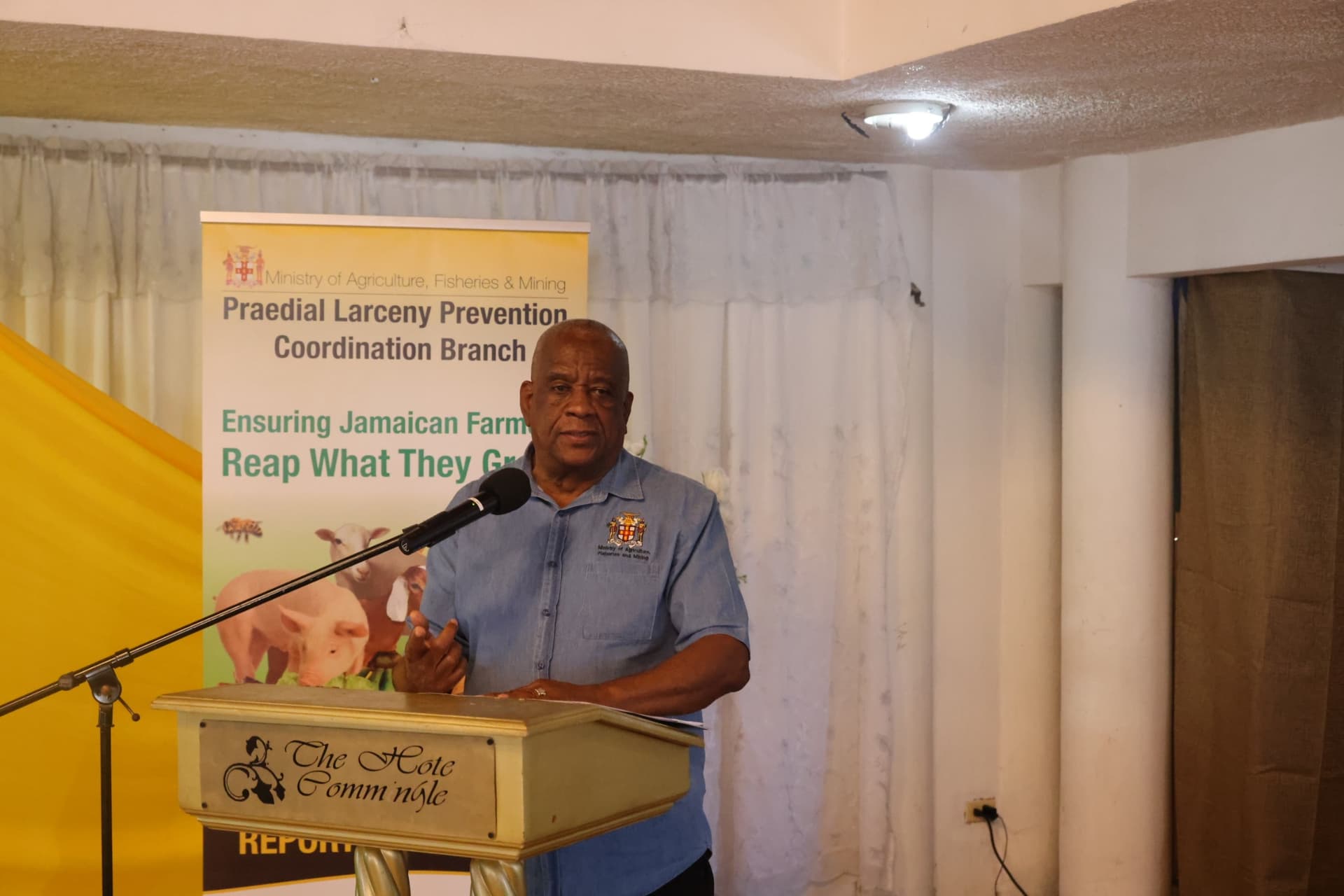
Minister of State in the Ministry of Agriculture, Fisheries and Mining, Hon. Franklin Witter, MP, addresses farmers and stakeholders during the Westmoreland Praedial Larceny Farmer Sensitisation Meeting held at The Hotel Commingle in Savanna-la-Mar on October 22, 2026.
Key Points(5)
- Witter said a coordinated approach involving prevention, enforcement, intelligence gathering and improved traceability is necessary to make it more difficult for criminals to steal and profit from agricultural produce and livestock.
- He was speaking at the Westmoreland Praedial Larceny Farmer Sensitisation Meeting, held on Thursday, October 22, at The Hotel Commingle in Savanna-la-Mar.
- The meeting, held under the theme “Ensuring that Farmers Reap What They Grow,” brought together farmers and representatives of key agricultural agencies to discuss measures to prevent theft, strengthen investigations and improve the tracking of agricultural products.
- Witter noted that praedial larceny continues to impose significant financial and social costs on farmers, their families and rural communities, with annual economic losses estimated at approximately $14 billion.
- He stressed that the consequences extend beyond the immediate loss of crops and animals, affecting farmers’ livelihoods, food safety and confidence in the agricultural sector.
Minister of State in the Ministry of Agriculture, Fisheries and Mining Franklin Witter is calling for stronger collaboration among farmers, law enforcement and agricultural agencies to tackle praedial larceny as the Government intensifies efforts to curb the multibillion-dollar problem affecting Jamaica’s agricultural sector.
Witter said a coordinated approach involving prevention, enforcement, intelligence gathering and improved traceability is necessary to make it more difficult for criminals to steal and profit from agricultural produce and livestock.
He was speaking at the Westmoreland Praedial Larceny Farmer Sensitisation Meeting, held on Thursday, October 22, at The Hotel Commingle in Savanna-la-Mar. The meeting, held under the theme “Ensuring that Farmers Reap What They Grow,” brought together farmers and representatives of key agricultural agencies to discuss measures to prevent theft, strengthen investigations and improve the tracking of agricultural products.
Witter noted that praedial larceny continues to impose significant financial and social costs on farmers, their families and rural communities, with annual economic losses estimated at approximately $14 billion.
He stressed that the consequences extend beyond the immediate loss of crops and animals, affecting farmers’ livelihoods, food safety and confidence in the agricultural sector.
“When we talk about fighting praedial larceny, we are not talking about protecting property alone. We are protecting lives, livelihoods, and food safety of our consumers,” Witter said.
He outlined several areas of focus in the Government’s response, including public education, legislative reform, improved enforcement, intelligence sharing and stronger systems for establishing the origin and ownership of agricultural produce and livestock.
The minister also urged farmers to take greater advantage of existing mechanisms to protect their investments, including registration with the Rural Agricultural Development Authority (RADA), the use of Agricultural Produce Receipt Books and livestock identification through the National Animal Identification and Traceability System (NAITS).
Sergeant Denver Ennis, sub-officer in charge of the Area 1 Agricultural Protection Branch, underscored the importance of prompt reporting and effective law enforcement in addressing the problem.
He noted that praedial larceny affects the wider agricultural value chain and can discourage farmers from continuing production, with implications for agricultural output and the sustainability of farming communities.
“True success must also be measured by the confidence of our farmers, the prevention of offences, recovery of stolen property, and the number of farming communities that can operate with greater security,” Ennis said.
He encouraged farmers to report theft as soon as it is discovered and to provide the police with accurate information to support investigations.
Ennis also highlighted the need to disrupt the market for stolen agricultural goods, urging buyers, vendors and transporters to comply with the law and maintain the required documentation to establish the legitimate source of the produce they handle.
Meanwhile, Veterinary Officer in the Veterinary Services Division Dr. Anneisha Foote highlighted the role of NAITS in protecting livestock and strengthening disease surveillance, food safety and traceability.
She explained that cattle registered under the system receive ear tags and passports, while information on ownership and animal movement is recorded in a database. The system allows authorities to better identify animals and establish their movement history, supporting efforts to combat livestock theft.
According to Foote, more than 120,000 head of cattle have been identified and more than 5,500 establishments registered under NAITS.
“It is your hard work, it is your time and your effort that you have put into this, so you want to keep your animals protected,” she told farmers.
Foote encouraged cattle owners to ensure their animals are tagged, maintain their passports and promptly report changes in ownership or movement to keep the information accurate and useful.
The importance of documenting agricultural transactions was also highlighted by Jamaica Agricultural Society (JAS) Parish Manager Noel Hamilton, who outlined how the Agricultural Produce Receipt Book System can help establish the legitimacy of produce being transported or sold.
Hamilton explained that the receipt book is linked to a farmer’s RADA identification and provides a record of agricultural transactions, enabling law enforcement officers to investigate the source of produce and determine whether it may have been stolen.
“There are a lot of ways to trace where the produce is coming from and to see if it is stolen or if it is coming from a legitimate source,” Hamilton said.
He noted that the Agricultural Produce Receipt Book contains 100 pages and costs $1,200. It is available through the JAS to farmers registered with RADA.
Hamilton encouraged farmers to regard the receipt book as an investment in their businesses, noting that proper documentation can help protect their produce and demonstrate that their transactions are legitimate.
Witter reiterated that farmers have an important role to play in reducing praedial larceny by registering their operations, maintaining accurate records, reporting incidents promptly and cooperating with the agencies responsible for agricultural protection.
He said closer collaboration among farmers, law enforcement and agricultural institutions is essential to strengthening accountability throughout the sector and ensuring that those who invest their time, labour and resources in farming are able to benefit from their production.